
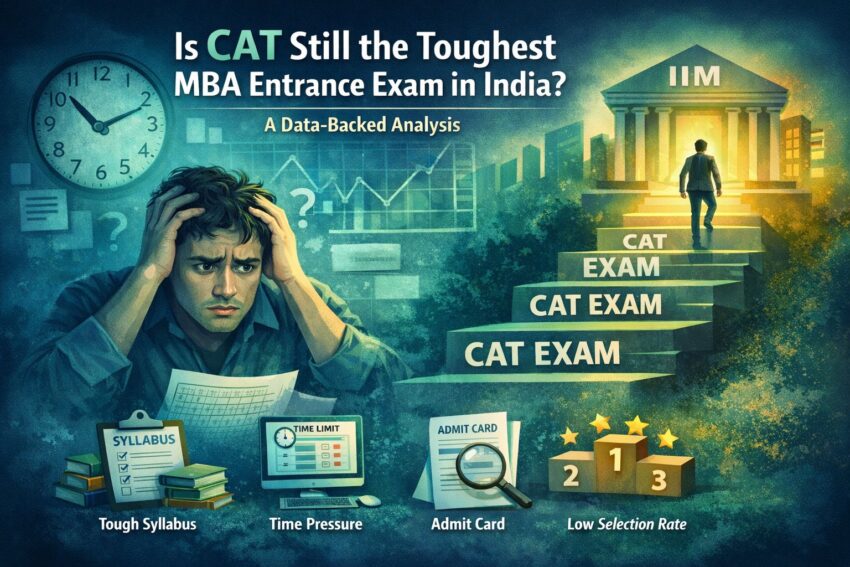
For decades, one question has dominated the minds of MBA aspirants in India: Is CAT really the toughest MBA entrance exam in the country? Every year, nearly three lakh candidates appear for the exam with dreams of entering the prestigious Indian Institutes of Management and other top B-schools. While the competition is fierce, toughness is not just about difficulty—it is about scale, structure, unpredictability, and selection ratios.
This article takes a data-backed look at why the CAT exam continues to be considered the most challenging MBA entrance test in India and whether that reputation still holds true today.
The Competition Factor: Numbers That Matter
One of the strongest indicators of difficulty is competition. CAT consistently attracts the largest pool of MBA aspirants in India.
Consider this:
-
Around 2.8 to 3 lakh candidates register every year
-
Less than 2% of candidates score 99 percentile or above
-
Only a fraction of these make it to the final admission lists of top IIMs
What makes this tougher is not just the number of candidates but the quality of aspirants. Engineers, chartered accountants, commerce graduates, humanities students, and working professionals all compete on the same platform, making percentile scores extremely compressed at the top.
Exam Structure: Designed to Test More Than Knowledge
Unlike exams that rely heavily on rote learning, CAT is structured to assess decision-making, logic, and pressure handling. The cat exam pattern has remained broadly consistent in recent years, but its internal complexity is what sets it apart.
Key characteristics include:
-
A strict sectional time limit that prevents flexibility
-
Questions that test concepts in unfamiliar ways
-
Negative marking that penalizes guesswork
-
A mix of easy, moderate, and extremely tricky questions within the same section
Time pressure plays a huge role. Even well-prepared candidates often struggle not because they don’t know the concepts, but because they cannot decide which questions to attempt and which to leave.
Syllabus: Broad, But Deceptively Simple
At first glance, the cat exam syllabus looks manageable. It covers topics that most students have studied at school level. However, the challenge lies in application, not coverage.
The syllabus broadly spans:
-
Quantitative aptitude concepts from arithmetic, algebra, geometry, and number systems
-
Logical reasoning and data interpretation sets that require pattern recognition and speed
-
Verbal ability topics like reading comprehension, para-jumbles, and critical reasoning
The absence of a fixed, officially defined syllabus adds to the uncertainty. Aspirants must prepare for a wide range of question types without knowing exactly what will appear, making preparation as much about adaptability as mastery.
Unpredictability: CAT’s Biggest Weapon
One of the main reasons CAT is still perceived as the toughest exam is its unpredictability. Difficulty levels vary not just year to year, but section to section.
Some years:
-
Quantitative aptitude turns out to be unexpectedly calculation-heavy
-
Logical reasoning sets are lengthier than usual
-
Verbal sections include ambiguous answer choices
This unpredictability means that even repeat test-takers cannot rely on past patterns alone. Strategy must evolve continuously, and mock tests become crucial for mental conditioning rather than mere practice.
Selection Ratio: The Real Bottleneck
Cracking the exam is only the first hurdle. The real challenge begins after the results are declared.
Out of lakhs of test-takers:
-
Only a few thousand receive interview calls from top institutes
-
Final selection depends on multiple factors like academic background, work experience, and diversity
-
High percentiles do not guarantee admission
This multi-stage elimination process makes CAT uniquely stressful. Aspirants are not just preparing for an exam, but for a long selection journey that extends over several months.
Comparison With Other MBA Entrance Exams
When compared to exams like XAT, SNAP, or NMAT, CAT stands out in a few critical ways:
-
It is accepted by the widest range of top-tier institutes
-
It has the highest applicant-to-seat ratio
-
It places greater emphasis on percentile ranking than raw scores
While other exams may be tough in specific sections or formats, CAT’s combination of scale, pressure, and unpredictability makes it uniquely demanding.
Psychological Pressure and Time Management
Another overlooked aspect of CAT’s toughness is the mental pressure involved. The exam environment, strict on-screen timer, and awareness of intense competition can impact performance significantly.
Successful candidates often share common traits:
-
Ability to stay calm under pressure
-
Willingness to skip questions strategically
-
Strong mock-test analysis habits
-
Focus on accuracy rather than attempting everything
This mental resilience is as important as academic preparation.
Admit Card and Exam Day Challenges
Even logistical aspects can add to stress. From downloading the cat exam admit card on time to managing last-minute exam-day nerves, the process demands careful attention.
Small mistakes—like reaching the wrong center or misunderstanding instructions—can have serious consequences. This adds another layer of pressure that aspirants must manage alongside preparation.
So, Is CAT Still the Toughest?
Based on data, structure, and selection dynamics, the answer remains largely yes. CAT may not have the longest syllabus or the most obscure topics, but it tests candidates in a way few other exams do.
Its difficulty comes from:
-
Massive competition
-
Time-bound sectional structure
-
Unpredictable question design
-
Extremely selective admission process
That said, “tough” does not mean “uncrackable.” With the right preparation strategy, consistent practice, and smart analysis, many aspirants succeed every year.
Final Thoughts
CAT continues to hold its reputation as India’s toughest MBA entrance exam not because it is unfair, but because it is uncompromising. It rewards clarity of thought, discipline, and resilience—qualities essential for future business leaders.
For aspirants navigating application forms, exam timelines, and counseling processes, platforms like GoFillForm help simplify the journey by offering structured guidance and reliable updates, allowing students to focus more on preparation and less on procedural stress.