
There is a moment many people experience, though it is not always easy to define.
It does not arrive all at once. It builds gradually.
A sense that the way things used to work is no longer as reliable as it once felt. That the path forward is less clear, and the assumptions that once provided stability are beginning to shift.
For some, it shows up in small ways.
A task that used to take hours now takes minutes. A role that once felt secure begins to change. Expectations evolve, often without being clearly stated.
At first, it is easy to overlook.
But over time, the pattern becomes harder to ignore.
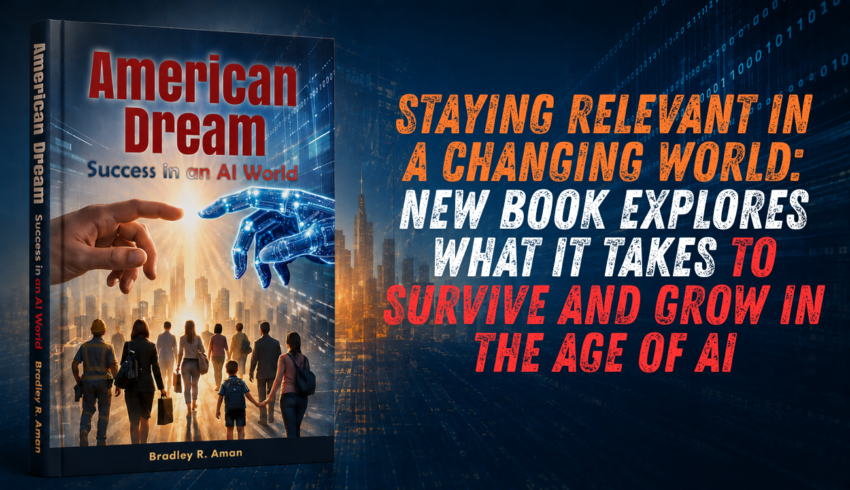
In American Dream AI, author Bradley R. Aman explores this experience not as an isolated concern, but as part of a larger transition—one that is reshaping how individuals stay relevant in a world influenced by artificial intelligence.
Because while the conversation around AI often focuses on innovation, its impact is felt most directly in something more personal.
Relevance.
The ability to contribute, to grow, and to remain valuable within a changing environment.
This is where the book places its attention.
Not on the technology itself, but on what that technology requires from the people working alongside it.
There is a recognition early in the work that relevance is no longer something that can be maintained passively.
It is not preserved simply by continuing what has worked in the past.
It must be developed.
Continuously.
This does not suggest that past experience has no value.
But it does suggest that experience alone is no longer enough.
The pace of change has introduced a new dynamic—one where skills evolve, expectations shift, and the baseline of what is considered “current” moves forward over time.
This creates a different kind of pressure.
Not immediate, but persistent.
A need to keep up. To understand what is changing. To decide how to respond.
The book approaches this pressure with a sense of clarity rather than urgency.
It does not frame the situation as something to fear.
But it does present it as something to acknowledge.
Because ignoring it does not slow it down.
It only delays the response.
There is a thoughtful distinction made throughout the book between awareness and engagement.
Many people are aware that change is happening.
They read about it. They hear about it. They recognize that something is different.
But awareness alone does not create progress.
Engagement does.
This means moving beyond observation and into action—learning new tools, exploring new approaches, and allowing space for growth even when the outcome is uncertain.
The book does not suggest that this process is easy.
In fact, it acknowledges that it often involves discomfort.
Starting something new. Letting go of familiar patterns. Entering spaces where confidence has not yet been established.
These moments are not presented as obstacles.
They are presented as part of the process.
Because relevance, in this context, is not about maintaining a fixed position.
It is about movement.
There is also a shift in how value is described.
In the past, value was often tied to consistency.
Doing the same thing well, over time, was enough to create stability and progress.
That model is changing.
As AI takes on more routine tasks, the focus moves toward something else—how individuals think, how they adapt, and how they contribute beyond repetition.
This does not eliminate the need for skill.
It expands it.
Relevance becomes less about what you can do once, and more about what you can continue to do as conditions evolve.
This idea is explored carefully throughout the book.
Not as a demand, but as an observation.
That the individuals who maintain relevance are often not those who have mastered a single path, but those who remain open to adjusting it.
There is also an underlying sense of patience in the way this process is described.
Change does not happen overnight.
And neither does adaptation.
It builds gradually.
Through small actions.
Through repeated effort.
Through a willingness to stay engaged even when progress feels slow.
This perspective gives the book a sense of balance.
It recognizes the reality of change without overstating it. It acknowledges the challenge without removing the possibility.
And it reinforces a simple idea.
That staying relevant is not about reacting perfectly.
It is about responding consistently.
Over time, that consistency becomes something more.
It becomes direction.
A sense of movement that may not always be visible from the outside, but is felt internally—through growth, through understanding, and through the confidence that comes from continued engagement.
In this way, American Dream AI does not present relevance as something to achieve once.
It presents it as something to maintain.
Not through pressure, but through participation.
And in doing so, it offers a perspective that feels both grounded and practical.
A reminder that while the world of work may be changing, the ability to adapt within it remains.
And that ability, when developed over time, becomes one of the most valuable assets an individual can carry forward.
For more information about American Dream AI or to schedule an interview with Bradley R. Aman, please contact:
Media Contact
Author Name: Bradley R Aman
Amazon: AMERICAN DREAM: Success in an Al World
Website: www.youramericadream.com
https://www.youtube.com/@YourAmericanDreamer/shorts
https://www.facebook.com/profile.php?id=61583530424497#
https://www.instagram.com/_youramericandream_