
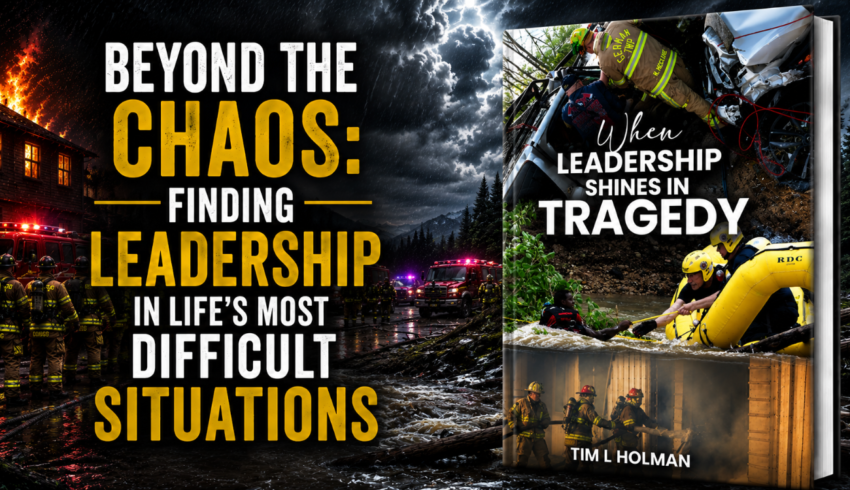
Chaos rarely announces itself. It builds quietly, then all at once, turning ordinary moments into situations that demand immediate response. In those moments, structure fades, plans shift, and what remains is the individual—faced with the need to act.
It is here, beyond the noise and uncertainty, that leadership begins to take form.
In When Leadership Shines in Tragedy, Tim L. Holman explores what it means to lead when circumstances are anything but controlled. Through a collection of real-life experiences drawn from emergency services and healthcare, Holman presents leadership not as a theory, but as something that emerges in real time—often under pressure, and always with consequence.
These are not polished scenarios.
They are unpredictable.
Unscripted.
And yet, they are where some of the most meaningful lessons are found.
Holman’s approach is grounded in observation. He does not attempt to define leadership through rigid frameworks or step-by-step methods. Instead, he allows it to reveal itself through experience—through moments where individuals must rely not only on training, but on judgment, awareness, and instinct.
There is a sense of immediacy throughout the book. Situations unfold quickly. Decisions must be made without the benefit of hindsight. And within that urgency, leadership becomes less about certainty and more about presence.
Being there.
Paying attention.
Responding with intention.
What stands out is the way Holman captures the human side of these experiences. Behind every situation is a person—sometimes more than one—each navigating their own perspective, their own uncertainty. Leadership, in this context, becomes an act of connection as much as it is an act of direction.
This is where the book offers something different.
It does not separate leadership from humanity.
It integrates the two.
There are moments where technical skill is essential—where precision and knowledge guide every action. But just as often, it is something less tangible that makes the difference. A calm approach in the middle of confusion. A decision to listen before acting. The ability to recognize when someone needs reassurance rather than instruction.
These moments are not always highlighted.
But they are always felt.
Holman’s writing reflects an understanding that leadership is not always about being in control. In fact, some of the most effective leadership occurs when control is limited, and adaptability becomes necessary.
Plans change.
Conditions shift.
Outcomes remain uncertain.
And still, something must be done.
This is where leadership becomes less about managing the situation and more about navigating it. About staying focused when distractions are everywhere. About maintaining clarity when information is incomplete.
There is also an underlying recognition that leadership is not always visible in the moment. Its impact may not be immediately apparent. A decision made quickly may carry weight long after the situation has passed. A small action may influence someone else in ways that are not fully understood at the time.
These are the details that often go unnoticed.
But they are the ones that matter.
As readers move through the book, they are invited to reflect on their own responses to uncertainty. Not in a formal way, but naturally—through the experiences being shared. What would it mean to stay grounded in a moment like that? How would you respond when there is no clear direction?
These questions do not demand answers.
They encourage awareness.
When Leadership Shines in Tragedy ultimately presents leadership as something that exists within all of us, waiting to be expressed when needed. It is not reserved for specific roles or positions. It is revealed through action—especially in moments when action feels most difficult.
Because beyond the chaos,
what remains is not the situation itself—
but how we chose to respond to it.
For more information about When Leadership Shines in Tragedy or to schedule an interview with Tim L. Holman, please contact:
Contact:
Author: Tim L. Holman
Amazon: When Leadership Shines in Tragedy
About Tim L. Holman:
Tim L. Holman is a firefighter, paramedic, and healthcare leader whose career has been shaped by real-world crisis response and leadership development. His work focuses on the human side of leadership and how individuals respond when faced with life’s most challenging situations.