
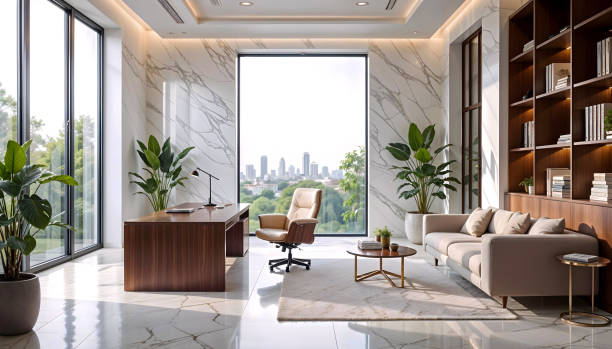
Office space is becoming a more selective corporate asset as organizations reassess how physical workplaces support collaboration, productivity, talent retention, client engagement, and operational control. The category includes traditional leased offices, private offices, co-working spaces, managed offices, virtual offices, meeting rooms, hot desking formats, and other workspace models used by enterprises, startups, freelancers, and distributed teams.
Global Office Space Market size was valued at USD 1.64 Trillion in 2025 and is estimated at USD 1.71 trillion in 2026. The market size is expected to grow to USD 2.24 trillion by 2032, registering a CAGR 4.55% during 2026-32. Global Office Space Market growth is being shaped by hybrid work, quality-led leasing, flexible agreements, sustainability upgrades, and occupier demand for better workplace performance.
Office demand is becoming more selective
The office is no longer evaluated only through area occupied or lease cost. Occupiers are increasingly assessing whether space improves attendance, enables collaboration, supports brand presence, reduces operational friction, and aligns with workforce behavior. This is creating a more performance-led leasing environment where location, building quality, service levels, and flexibility directly influence demand.
JLL reported that global office leasing demand remained solid in Q1 2026, although activity was 1% lower year over year after nine quarters of annualized growth. This supports the view that occupier activity continues, but leasing decisions are becoming more disciplined. Global Office Space Market trends therefore reflect selective demand rather than broad and uniform expansion.
Grade A assets dominate building-grade demand
Grade A grabbed market share of 55%, making it the leading building-grade segment. This reflects occupier preference for better-located, well-serviced, amenity-rich, and operationally efficient buildings. Grade A offices are better positioned to support hybrid work models because they can offer stronger employee experience, energy performance, access control, meeting infrastructure, and flexible floorplate design.
The segment’s leadership also indicates a clear flight-to-quality pattern. Many companies are consolidating footprints into fewer but better assets, rather than expanding across lower-grade space. This supports Global Office Space Market forecast momentum for premium buildings, while older and weaker assets face pressure to modernize, reposition, or compete through stronger incentives.
IT and telecommunications remains the leading end-user segment
IT and telecommunications grabbed 25% of the market, making it the leading end-user industry. This segment relies on scalable workplaces for software development, cloud operations, cybersecurity, network management, data analytics, digital service delivery, and enterprise client support. These occupiers often need high-connectivity buildings, resilient infrastructure, secure access systems, and collaborative work zones.
Technology and telecom occupiers also influence office design. Their workforce models often involve hybrid teams, project-based work, training spaces, client rooms, and flexible expansion requirements. This keeps the segment central to Global Office Space Market size expansion, especially in cities with deep talent pools, digital infrastructure, and strong enterprise-service ecosystems.
Flexible portfolios are becoming mainstream
Flexible workspaces are moving from short-term overflow solutions to structured portfolio tools. Co-working spaces, managed offices, private suites, meeting-room networks, and flexible agreements allow organizations to adjust capacity without committing to large fixed leases. This is especially useful for project teams, regional expansion, distributed workforces, and companies managing uncertain headcount plans.
Cushman & Wakefield reported that 55% of global occupiers used flexible office solutions in 2025, with 17% planning to increase usage. This reinforces one of the strongest Global Office Space Market trends: occupiers want physical offices, but they also want flexibility in duration, configuration, services, and scale.
Green retrofits are becoming a premium pathway
Sustainability is increasingly tied to leasing competitiveness. Large enterprises need office spaces that support energy efficiency, emissions reporting, employee wellness, regulatory compliance, and corporate sustainability targets. This creates opportunity for landlords and operators that can upgrade older properties through energy-efficient HVAC systems, lighting controls, smart meters, wellness features, and green certifications.
USGBC and Green Business Certification Inc. announced that more than 7,500 LEED-certified commercial projects were completed globally in 2025, covering over 147 million square meters of certified space. This supports Global Office Space Market growth by showing that certified and lower-carbon buildings are becoming more important in occupier-ready commercial real estate portfolios.
Vacancy overhang is pressuring weaker assets
Vacancy remains a major challenge, especially for secondary buildings, older locations, and assets that do not meet current occupier expectations. Hybrid work has reduced the need for some low-quality space, while companies are prioritizing buildings that can justify employee commute time and support collaboration. As a result, recovery is uneven across locations and asset classes.
Secondary assets face higher pressure from tenant improvement costs, lower utilization, leasing incentives, refinancing challenges, and retrofit requirements. Buildings that lack amenities, energy performance, modern systems, and strong transport access may need deeper repositioning. This makes asset quality one of the most important dividing lines in the Global Office Space Market forecast.
North America leads the regional landscape
North America leads with a 25% share of the global market. The region benefits from large corporate occupier bases, technology and professional-services clusters, mature capital markets, flexible workspace adoption, and ongoing return-to-office adjustments. Leasing recovery remains strongest where employers require high-quality space for headquarters, client-facing operations, and collaboration-led work.
JLL’s U.S. office market update reported that Q1 2026 leasing activity grew 7.6% relative to Q1 2025, while net absorption remained positive for a third consecutive quarter with 3.5 million square feet of occupancy gains. This supports regional momentum, especially in high-quality and well-located assets.
Competitive landscape is shaped by service depth
More than 30 companies are actively engaged in producing office space services and assets, while the top 5 companies acquired around 15% of the market share. Key companies include Savills plc, Newmark Group Inc., Brookfield Properties, CBRE Group Inc., Jones Lang LaSalle Incorporated, Cushman & Wakefield plc, IWG plc, Colliers International Group Inc., Hines Interests Limited Partnership, WeWork Inc., Mitsui Fudosan Co. Ltd., BXP Inc., CapitaLand Investment Limited, Dexus Funds Management Limited, and SL Green Realty Corp.
Competition is shaped by leasing advisory, property management, flexible workspace operations, capital-market access, portfolio analytics, tenant-retention capability, sustainability services, and workplace strategy. Companies that connect real estate services with utilization data, green retrofits, and flexible workspace solutions are better positioned in a more selective office environment.
Conclusion
The Global Office Space Market is developing around quality-led leasing, flexible portfolio structures, Grade A building demand, IT and telecommunications occupiers, and sustainability-led asset upgrades. Market growth is not uniform across all buildings, as stronger demand is concentrated in assets that improve workplace experience, operational flexibility, and energy performance. Based on Vyansa Intelligence data, office space is becoming a performance-oriented corporate infrastructure category rather than only a physical occupancy cost.