
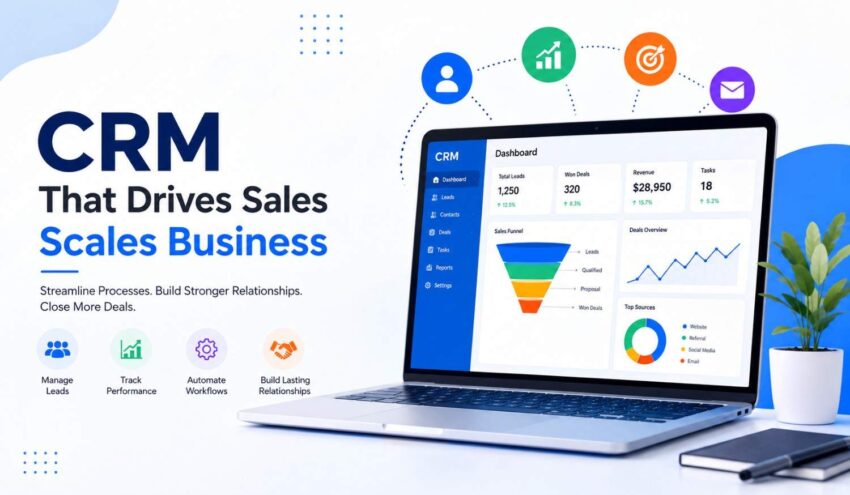
Growth is exciting—until sales teams start juggling spreadsheets, scattered emails, and sticky notes that somehow become “mission-critical business systems.” Many organizations reach a stage where success creates complexity faster than existing processes can handle. That is where CRM development becomes a strategic investment rather than a technical upgrade. A well-designed CRM creates structure, visibility, and consistency across the entire sales cycle. More importantly, it helps businesses scale without creating operational chaos. As sales volumes increase, the right CRM foundation ensures teams remain productive, customers stay engaged, and opportunities never slip through the cracks.
What Happens When Sales Operations Outgrow Manual Processes?
Sales operations often begin with simple tools and manual workflows. For a while, everything appears manageable. Then growth arrives, and suddenly everyone is searching through emails, updating multiple spreadsheets, and wondering who contacted a lead last. Manual systems create bottlenecks that slow response times and increase mistakes. Valuable opportunities get lost because information is scattered across platforms. Teams spend more time organizing data than building customer relationships. Scaling becomes difficult because processes depend heavily on individuals rather than systems. What worked for ten customers rarely works for ten thousand.
How Does CRM Development Create a Strong Foundation for Growth?
Sustainable growth requires more than hiring additional sales representatives. Businesses need a centralized system capable of managing increasing volumes of customer interactions and sales activities. CRM development provides that foundation by bringing customer data, communication history, opportunities, and reporting into one platform. Instead of operating with fragmented information, teams gain complete visibility into every customer relationship. Consistent processes become easier to enforce, while collaboration improves naturally. As organizations expand, the CRM grows alongside them, providing the stability required to support larger teams, more customers, and increasingly complex sales operations.
Why Is Sales Automation Critical for Scaling Successfully?
Growth should increase revenue—not administrative work. Unfortunately, many sales teams discover the opposite when manual processes remain in place. Sales automation eliminates repetitive tasks such as lead assignments, follow-up reminders, status updates, and data entry. This allows representatives to focus on conversations that generate revenue instead of managing paperwork. Automation also creates consistency across the organization, ensuring important actions happen at the right time. One observation from countless projects remains remarkably consistent: sales professionals prefer selling. Very few dream of spending Friday afternoons updating spreadsheets and copying customer notes.
How Can Custom CRM Solutions Improve Sales Team Productivity?
Every business follows unique sales processes, which is why generic software often creates unnecessary limitations. Custom CRM development aligns technology with existing workflows instead of forcing teams to adapt to rigid systems. Representatives gain faster access to information, streamlined dashboards, and tools designed specifically for their responsibilities. Productivity improves because employees spend less time searching for data and navigating complicated interfaces. Tasks become easier to complete, customer interactions become more meaningful, and decision-making becomes faster. The result is a sales environment that supports efficiency without sacrificing flexibility or user experience.
Why Do Businesses Need Better Customer Visibility as They Grow?
Customer expectations increase alongside business growth. Buyers expect personalized experiences, timely responses, and meaningful interactions regardless of company size. Achieving that level of service becomes difficult without complete visibility into customer activities and preferences. CRM solutions provide a unified view of each customer journey, capturing interactions across multiple touchpoints. Sales teams can identify trends, understand purchasing behaviors, and anticipate future needs more effectively. Better visibility leads to stronger relationships and more relevant communication. Customers appreciate feeling understood, and businesses appreciate the loyalty and revenue that often follow.
How Does CRM Development Support Accurate Sales Forecasting?
Reliable forecasting depends on accurate, real-time data. Unfortunately, manual reporting often introduces delays, inconsistencies, and guesswork. CRM development improves forecasting by providing visibility into sales pipelines, conversion rates, deal progression, and revenue opportunities. Leaders gain access to actionable insights rather than assumptions. This allows organizations to make informed decisions regarding staffing, budgeting, and growth strategies. Predictive capabilities become increasingly valuable as operations expand. Better forecasts reduce uncertainty and help businesses allocate resources more effectively. After all, strategic planning becomes much easier when decisions are based on facts rather than optimism.
What Role Does CRM Integration Play in Scalable Operations?
A CRM delivers far greater value when connected to the tools employees already use every day. Integrations with marketing platforms, accounting software, customer support systems, and ERP applications create a seamless flow of information across departments. Teams no longer waste time entering the same data into multiple systems or searching for updates across disconnected platforms. Instead, information moves automatically between applications, improving accuracy and efficiency. As businesses scale, integrated environments help maintain consistency while reducing operational complexity. Connected systems ultimately create a stronger foundation for sustainable growth.
How Can CRM Solutions Improve Collaboration Between Teams?
Successful sales operations depend on collaboration. Marketing generates leads, sales nurtures opportunities, and customer support maintains long-term relationships. Without a centralized platform, these departments often operate in silos, creating communication gaps and inconsistent customer experiences. CRM solutions help bridge those gaps by providing shared access to customer information and activity histories. Everyone works from the same source of truth. This improves transparency, strengthens accountability, and enables faster decision-making. When departments collaborate effectively, customers receive better experiences and businesses gain stronger operational alignment across the organization.
Why Is Data Quality Essential for Sustainable Sales Growth?
Poor data quality creates problems that multiply as businesses grow. Duplicate records, outdated information, and incomplete customer profiles can impact sales performance, reporting accuracy, and customer satisfaction. CRM development helps establish standards for collecting, managing, and maintaining data throughout the organization. Automated validation rules and structured workflows improve consistency while reducing errors. High-quality data enables more reliable reporting, stronger forecasting, and better decision-making. Simply put, businesses cannot make smart decisions using unreliable information. Clean data serves as the foundation for every successful sales strategy.
How Do CRM Developers Help Businesses Adapt to Changing Market Demands?
Business requirements rarely remain static. Markets evolve, customer expectations shift, and organizations continuously refine their strategies. Skilled CRM developers build systems designed for flexibility and long-term adaptability. New workflows, integrations, reporting structures, and automation rules can be introduced without disrupting daily operations. This adaptability allows businesses to respond quickly to changing market conditions while maintaining operational efficiency. Organizations that invest in flexible technology gain a significant advantage because their systems evolve alongside their objectives rather than becoming obstacles to future growth.
What Security and Compliance Benefits Come with Modern CRM Development?
Customer information represents one of the most valuable assets any organization possesses. Protecting that information requires more than basic passwords and occasional backups. Modern CRM platforms include role-based permissions, audit trails, encryption, and advanced security controls that help safeguard sensitive data. Compliance requirements become easier to manage because activities can be monitored and documented systematically. Strong security measures also build customer trust, which remains essential in today’s digital environment. Businesses that prioritize data protection strengthen both their operational resilience and their reputation in the marketplace.
Why Are Custom CRM Platforms Better Than One-Size-Fits-All Solutions?
Off-the-shelf software works well for some organizations, but growing businesses often encounter limitations as their needs become more specialized. Custom CRM platforms provide the flexibility to support unique workflows, reporting requirements, and operational goals. Rather than adapting business processes to fit software restrictions, organizations can build systems that align with their objectives. One project revealed an interesting pattern: employees embraced the CRM almost immediately because it reflected how they actually worked. User adoption improves significantly when technology feels like a solution rather than another obstacle.
How Does CRM Development Contribute to Long-Term Business Growth?
Long-term growth depends on repeatable processes, reliable information, and efficient operations. CRM development helps create all three. Sales activities become more structured, customer interactions become more personalized, and reporting becomes more accurate. These improvements support better decision-making at every level of the organization. As growth accelerates, businesses can scale confidently because their operational foundation remains strong. Technology alone does not create success, but the right systems make success easier to sustain. CRM development transforms growth from a challenge into a manageable and strategic process.
Conclusion
Scaling sales operations requires more than adding new team members or increasing marketing investments. Sustainable growth depends on building systems capable of supporting expanding customer bases, increasing sales volumes, and evolving business objectives. Effective CRM software development services provide the structure, visibility, and automation necessary to achieve that goal. Combined with experienced CRM developers and a thoughtful implementation strategy, a custom CRM becomes a powerful growth engine. Businesses that invest in scalable systems today are far better prepared for the opportunities—and challenges—that tomorrow will inevitably bring.
FAQ
What is CRM development?
CRM development involves creating, customizing, or enhancing customer relationship management systems to support business processes, sales workflows, customer engagement, and operational efficiency.
Why do growing businesses need a custom CRM?
Custom CRM solutions align with unique business requirements, helping organizations manage growth more efficiently while avoiding limitations commonly found in generic software.
How does CRM software improve sales productivity?
CRM platforms automate repetitive tasks, centralize information, and streamline workflows, allowing sales teams to focus more on customer relationships and revenue generation.
Can CRM systems integrate with existing business tools?
Yes. Modern CRM platforms can integrate with marketing software, accounting systems, ERP applications, customer support tools, and many other business solutions.
How long does CRM development typically take?
Development timelines vary depending on project complexity, required features, integrations, and customization needs. Projects may range from a few weeks to several months.
What industries benefit most from CRM solutions?
Industries including healthcare, real estate, manufacturing, finance, retail, education, and professional services frequently benefit from CRM implementation and customization.
Is custom CRM development suitable for small businesses?
Absolutely. Small businesses can use custom CRM solutions to establish scalable processes early and support future growth more effectively.
How does CRM automation improve customer relationships?
Automation ensures timely follow-ups, consistent communication, and efficient management of customer interactions, leading to improved satisfaction and stronger relationships.
What features should a scalable CRM include?
Important features include automation, reporting, integrations, customer tracking, workflow customization, security controls, and mobile accessibility.
How do businesses choose the right CRM development partner?
Organizations should evaluate technical expertise, industry experience, customization capabilities, support services, and previous project success when selecting a development partner.