
In the packaging industry, efficiency and accuracy are critical. Whether you’re producing product manuals, instruction inserts, labels, marketing materials, or packaging components, organizing printed materials correctly can significantly impact production speed and quality.
This is where collate printing becomes essential. Understanding what does collate mean when printing helps businesses reduce errors, improve workflow efficiency, and ensure that every package contains the correct printed materials.
What Is Collate Printing?
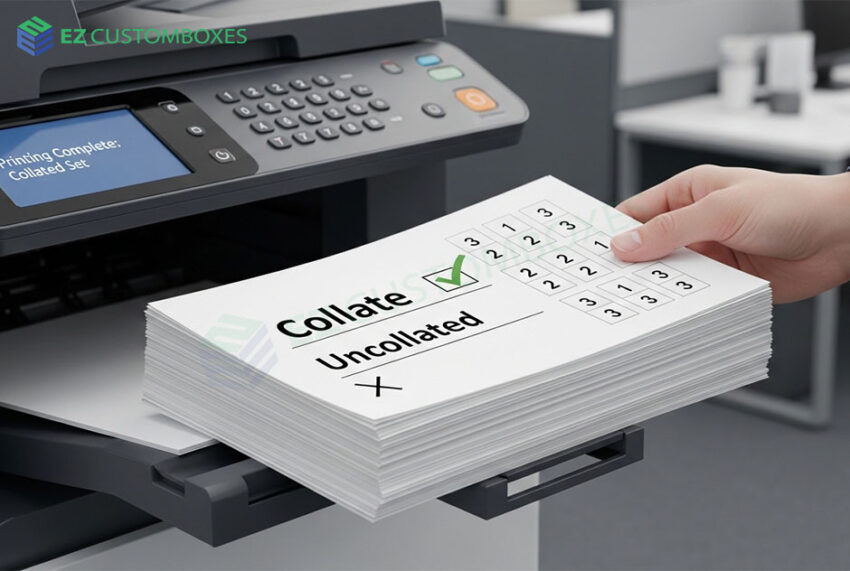
Collate printing is the process of arranging multiple-page documents in the correct sequence before they are assembled, packaged, or distributed.
For example, if a three-page instruction manual is printed in multiple copies:
Collated Order:
- Copy 1: Page 1, Page 2, Page 3
- Copy 2: Page 1, Page 2, Page 3
- Copy 3: Page 1, Page 2, Page 3
Uncollated Order:
- All Page 1s
- All Page 2s
- All Page 3s
In packaging operations, collated printing saves significant time and minimizes assembly mistakes.
Why Is Collate Printing Important in Packaging?
1. Improves Packaging Accuracy
Packaging often includes:
- Product manuals
- Warranty cards
- Safety instructions
- Promotional inserts
- Assembly guides
Collated printing ensures all pages remain in the correct order before insertion into packaging.
Benefits
- Fewer missing pages
- Reduced assembly errors
- Improved customer experience
Accurate packaging helps businesses maintain quality standards and reduce customer complaints.
How Collate Printing Increases Production Efficiency
One of the biggest advantages of collate printing is workflow optimization.
Without Collation
Workers must:
- Sort pages manually
- Organize document sets
- Verify page order
- Assemble inserts
With Collation
Documents arrive ready for packaging.
This reduces:
- Labor costs
- Handling time
- Production delays
As a result, packaging lines operate more efficiently.
Why Collate Printing Reduces Packaging Errors
Packaging errors can be costly.
Common mistakes include:
- Missing pages
- Incorrect document sequences
- Wrong instruction inserts
- Incomplete product information
Collate printing minimizes these risks by automatically organizing materials before they reach the packaging stage.
Result
- Better quality control
- Fewer returns
- Improved customer satisfaction
How Collated Printing Supports Quality Assurance
Quality assurance teams rely on consistency.
Collated printing helps maintain:
Document Integrity
Every document set remains complete and correctly ordered.
Regulatory Compliance
Industries such as healthcare, electronics, and manufacturing often require accurate documentation within packaging.
Brand Reputation
Professionally organized inserts reflect positively on a company’s image.
Why Collate Printing Is Important for Product Manuals
Product manuals often contain multiple pages.
When manuals are not collated:
- Pages can become mixed
- Instructions may be incomplete
- Customers may become frustrated
Collated printing ensures manuals remain organized from printing through final packaging.
Industries That Benefit Most
- Consumer electronics
- Automotive parts
- Medical devices
- Industrial equipment
- Home appliances
How Collate Printing Helps Automated Packaging Systems
Modern packaging facilities increasingly use automation.
Automated Packaging Equipment Requires
- Consistent document order
- Accurate insertion sequences
- Reduced manual intervention
Collated printing integrates seamlessly with automated systems by providing ready-to-insert document sets.
Key Benefits
- Faster packaging speeds
- Reduced downtime
- Improved throughput
Collated vs. Uncollated Printing in Packaging
Collated Printing
Advantages:
- Documents stay organized
- Faster assembly
- Reduced labor
- Fewer errors
Uncollated Printing
Challenges:
- Additional sorting required
- Higher labor costs
- Increased risk of mistakes
- Slower production
For most packaging applications, collated printing offers significant operational advantages.
Industries That Depend on Collate Printing
Many industries rely on collated printing for efficient packaging.
Common Examples
Manufacturing
Assembly instructions and product guides.
Pharmaceuticals
Patient information leaflets and compliance documents.
Consumer Electronics
Warranty information and setup guides.
Food Packaging
Promotional materials and nutritional information.
Retail Products
Instruction sheets and marketing inserts.
These industries require accurate document handling to maintain compliance and customer satisfaction.
Best Practices for Using Collate Printing in Packaging
To maximize efficiency:
1. Verify Document Order
Always confirm page sequencing before production.
2. Use Automated Printing Systems
Modern printers can handle high-volume collation accurately.
3. Conduct Quality Checks
Inspect sample sets throughout production runs.
4. Integrate with Packaging Automation
Ensure printing workflows align with packaging equipment.
Following these practices helps improve productivity and reduce waste.
Frequently Asked Questions
What is collate printing in packaging?
Collate printing arranges multi-page documents in the correct order before they are inserted into product packaging.
Why is collate printing important?
It improves accuracy, reduces errors, speeds up assembly, and supports quality control.
How does collate printing help packaging operations?
Collated documents arrive organized and ready for insertion, reducing manual sorting and labor costs.
What is the difference between collated and uncollated printing?
Collated printing groups pages into complete document sets, while uncollated printing groups identical pages together.
Which industries use collate printing the most?
Manufacturing, pharmaceuticals, electronics, retail, and food packaging industries commonly use collate printing.
Does collate printing reduce packaging costs?
Yes. It reduces labor requirements, minimizes mistakes, and improves production efficiency.
Final Takeaway
Understanding collate meaning printer and why collate printing is important in packaging can help businesses improve operational efficiency, maintain quality standards, and reduce costly production errors. By ensuring documents remain properly organized throughout the packaging process, collate printing supports faster workflows, better customer experiences, and more reliable product delivery.
If your packaging operation includes manuals, inserts, warranties, or multi-page documents, implementing collate printing can be a simple yet powerful way to improve productivity and accuracy.