
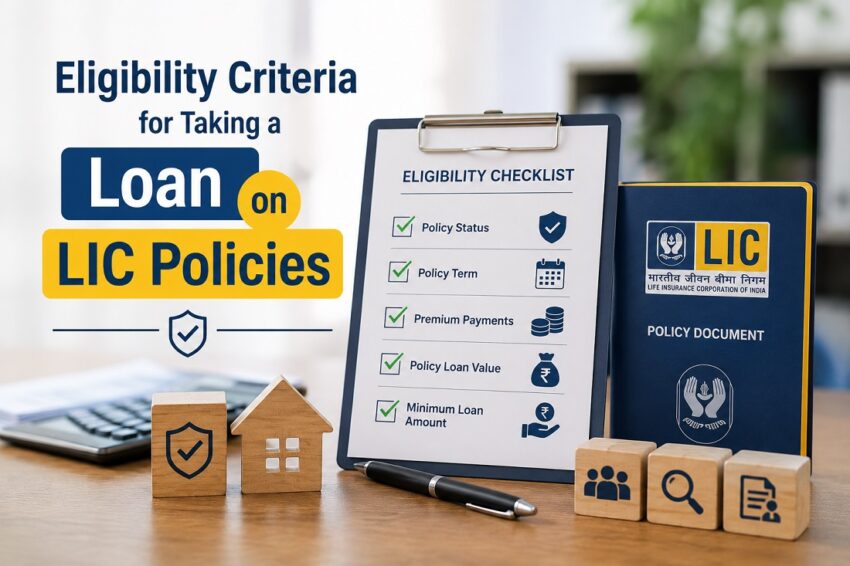
A life insurance policy acts as a long-term financial safety net. It’s especially useful for protecting your loved ones if you pass away. However, many are unaware that certain LIC policies can also serve as a financial pool in times of need. If you take a loan against an LIC policy, you can get funds without liquidating your investments. Also, you don’t have to give up your insurance coverage.
However, before applying for such a loan, it’s important to understand the eligibility requirements. If you meet the required criteria, you’ll accelerate your approval process.
Understanding Loans Against LIC Policies
When you hear the phrase “loan against an LIC policy,” it sounds like a complex financial product, but the concept is actually incredibly straightforward. Think of it as a secured personal loan, but instead of using a physical asset like your house or car to back the debt, you use the hidden cash value in your life insurance plan.
Over the years, you pay your premiums, and your policy builds up a specific cash reserves pool. If you were to walk away from the policy today and cancel it, the amount of cash the insurance company would hand back to you is called the surrender value.
When you apply for a policy loan, LIC uses that exact surrender value as their safety net.
- The Security Blanket: Because LIC is holding onto a policy with a guaranteed cash value, they know they will get their money back no matter what. If a borrower defaults or walks away from the loan, LIC doesn’t have to hire a collection agency; it simply deducts the unpaid balance from the policy’s eventual payout.
- Why it Beats a Standard Loan: When you go to a bank for a regular unsecured loan, they grill you on your salary, pick apart your credit history, and demand mountains of paperwork because they are taking a massive gamble on you—a policy loan skips almost all of that friction. You aren’t begging a lender to trust your future income; you are simply leveraging money you’ve already accumulated.
The Policy Must Be Eligible for a Loan
Not all LIC policies are eligible for the loan facilities. In general, traditional plans that build a surrender value over time qualify for this. Particularly, endowment plans and money-back policies offer these loan benefits. The whole life insurance plans are also eligible for policy loans. Pure term insurance plans, on the other hand, usually do not qualify, as they don’t accumulate a surrender value.
Before you apply for a policy loan, always check whether your plan offers this option.
The Policy Must Have Acquired Surrender Value
This is one of the most important eligibility conditions. Your policy must have acquired a surrender value before you apply for a loan against it. A surrender value is the portion of the policy’s accumulated value that can be accessed if the policy is discontinued.
In most cases, a policy becomes eligible for a loan after a certain number of premiums are paid by you. Policies in their early stages might not qualify for a loan.
The Policyholder Must Be the Applicant
In most cases, the applicant for the policy loan must be the policyholder. The policy’s ownership must be clearly established, since it will be used as collateral.
If there are legal encumbrances on the policy, you might need to provide additional documentation before your loan is approved.
Premium Payments Should Be Up to Date
Insurers prefer policyholders who pay their premiums on time. If you have a policy that lapsed due to nonpayment of premiums, it might not be eligible for a loan. There’s still a chance of its revival, but that depends on the insurer’s rules.
To avoid such situations, always maintain your premiums. It will ensure uninterrupted insurance coverage and increase eligibility to borrow against the policy.
Sufficient Surrender Value Is Required
The amount you can borrow depends largely on the surrender value. Policies with higher accumulated value usually qualify for larger loan amounts. And those with lower surrender values offer only limited borrowing capability. What insurers do is sanction a portion of this value as the loan amount.
Submission of Required Documents
- Minimal Paperwork: While the process requires far less documentation than a standard bank loan, you still need to provide a few essentials.
- Required Identity & Residency Proof: You must submit valid government-issued identity proof and current address proof.
- Insurance Specifics: You will need to provide your original insurance policy documents and complete the company’s loan application form.
- Accuracy Speeds Things Up: Providing precise, up-to-date information is the best way to boost your chances of approval and ensure the funds hit your account quickly.
Compliance with Insurer Guidelines
A personal loan from LIC comes with specific terms and conditions. These usually include minimum policy duration and interest rates. These might also include loan-to-value ratios and repayment conditions.
Applicants are advised to review the policy status requirements carefully before moving on with their application.
Making the Most of Your LIC Policy
A policy loan can help you easily get funds with an existing insurance policy. If you meet the eligibility criteria, you can get the financial support you need without liquidating your assets. You must also maintain regular premium payments to obtain approval. Options like premium finance are also popular for managing insurance-related costs and getting financial help in times of need.