
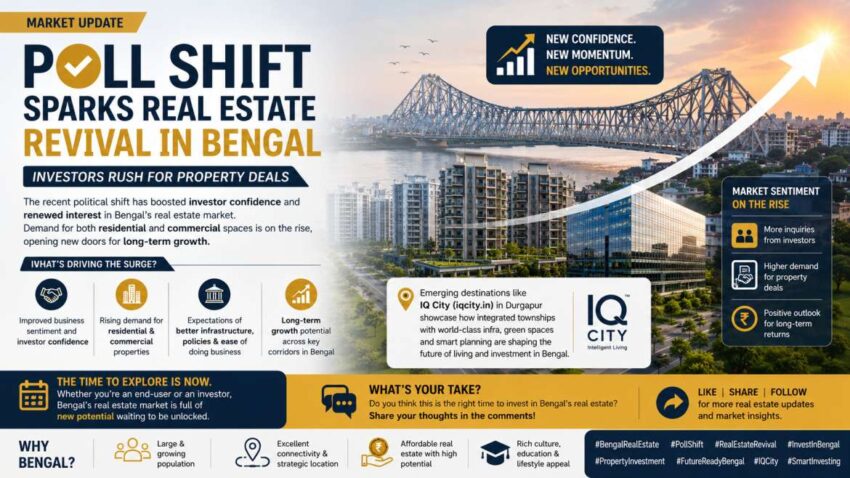
A change of government in West Bengal has done what years of discounts and festive offers could not: it has brought buyers back to the property market. Since the May 2026 assembly election ended fifteen years of incumbency, developers across the state report a sharp rise in enquiries, site visits and closed transactions — an early but unmistakable signal that Bengal’s long-subdued real estate sector, held back for years by slow approvals and thin launches, may finally be turning a corner.
Investor Confidence Rebounds After the Political Transition
With the state and central governments now politically aligned, businesses expect faster fund flows, quicker project approvals and a friendlier regulatory environment. Market analysts flagged a likely revival of corporate interest in West Bengal within days of the verdict, and trade associations described a new sense of optimism among business owners. For an economy already generating more than Rs 20 lakh crore in output, even a modest improvement in ease of doing business could translate into significant real estate demand. Equity analysts have already begun pricing in a rally in regional banking, infrastructure and property stocks as the transition stabilises.
Offices and Homes: Demand Rises on Both Fronts
Kolkata’s residential market sold just over 4,000 units in the first quarter of 2026, up five per cent from a year earlier, with about 3,500 new launches — modest by national standards, but the strongest quarterly showing in recent memory. Commercial demand is expected to follow as IT, financial services and logistics firms reassess the state. The story now extends well beyond Kolkata: in Durgapur, the integrated township of IQ City has emerged as a reference point for how planned development can anchor demand in Bengal’s industrial belt, pairing residential projects with a functioning medical college, hospital and allied institutions.
Who Is Buying — and Why
Investors are drawn by a low price base with clear headroom for appreciation. NRIs find Bengal significantly more affordable than Mumbai, Bengaluru or the NCR, and increasingly prefer townships with built-in healthcare and education, a niche IQ City occupies almost by definition. Local business owners are booking commercial space ahead of an expected industrial revival, while homebuyers who sat out the uncertain election months are returning to complete purchases, encouraged by stable interest rates and improved job-market expectations.
Reforms and Infrastructure Will Decide the Pace
The next phase depends on delivery: streamlined approvals, metro and highway expansion, and policies that attract job-creating industry. Projects that combine housing with employment and essential services — the model IQ City Durgapur has operated for over a decade — are best placed to benefit, because their demand is driven by daily need rather than speculation.
The Road Ahead
Bengal’s revival is a story of restored confidence, not overnight boom. But with political stability in place, transactions rising and proven townships showing the model works, the state’s property market enters its most promising phase in years, with Durgapur and the wider industrial belt likely to share in gains once reserved for Kolkata alone.