
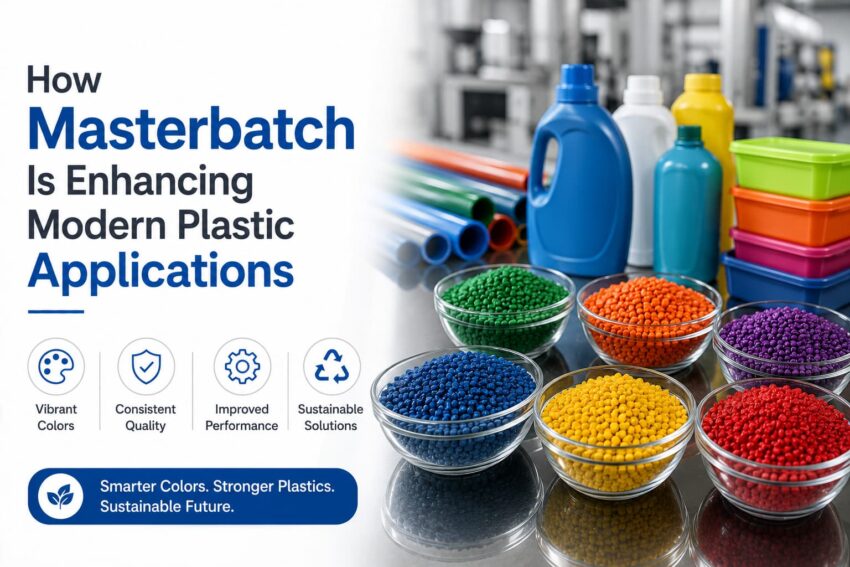
Masterbatch plays an important role in plastic manufacturing by helping producers add color, performance properties, and processing benefits to polymer products more efficiently. It is used across packaging, automotive components, construction materials, consumer goods, agriculture films, electrical products, and household items. As plastic applications become more specialized, masterbatch helps manufacturers improve appearance, durability, functionality, and production consistency.
According to MarkNtel Advisors, the polymer additives growth outlook states that the masterbatch market was valued at USD 9.29 billion in 2025 and is projected to grow from USD 10.15 billion in 2026 to USD 15.29 billion by 2032. The study estimates a CAGR of around 7.07% during 2026–2032, supported by packaging demand, color masterbatch use, Asia-Pacific manufacturing activity, and wider polymer applications.
Color and Functionality Drive Usage
Masterbatch is commonly used to add pigments, additives, fillers, and functional properties to plastics during processing. Instead of mixing raw pigments or additives directly into polymers, manufacturers use concentrated masterbatch pellets to improve dosing accuracy, dispersion, and production control. This helps create consistent color, texture, opacity, UV resistance, flame retardancy, antistatic properties, and other performance features.
The technical role of masterbatch is closely connected with plastic product design. Packaging, containers, pipes, films, cables, automotive trims, and molded goods often require specific visual and functional qualities. Masterbatch allows producers to customize plastic properties without changing the entire base polymer, making it useful for both high-volume and specialized applications.
Color Masterbatch Holds Strong Relevance
Color masterbatch accounted for around 33% share in 2026, according to the shared study. This reflects the importance of color consistency in packaging, consumer products, automotive interiors, electronics, toys, textiles, and household goods. Color is not only a visual feature; it can also support brand identity, product differentiation, labeling, and consumer recognition.
Manufacturers often require precise shade matching and repeatability across production batches. Color masterbatch helps achieve this by dispersing pigments evenly within a carrier resin. This reduces the risk of streaking, uneven color, or poor surface appearance. For industries where visual quality matters, reliable color control remains a key production requirement.
Packaging Remains the Leading Application
Packaging accounted for about 42% share in 2026, making it the leading application area in the shared study. Masterbatch is widely used in flexible packaging, rigid containers, caps, closures, bottles, films, pouches, crates, and food packaging materials. It helps improve color, barrier properties, UV protection, slip performance, and processing efficiency.
Packaging demand is also influenced by sustainability expectations. The OECD’s plastics policy overview highlights the need to address plastics across the full lifecycle, which is relevant because packaging producers are increasingly expected to consider design, recyclability, recycled content, and material efficiency. Masterbatch suppliers are therefore developing solutions that support lighter packaging and better material performance.
Asia-Pacific Leads Manufacturing Activity
Asia-Pacific accounted for around 52% share in 2026, making it the leading regional contributor in the shared study. The region’s position is supported by strong plastic processing activity, packaging production, automotive manufacturing, construction demand, consumer goods output, and expanding industrial capacity across China, India, Japan, South Korea, and Southeast Asia.
Manufacturing scale in Asia-Pacific creates strong demand for cost-effective and high-performance polymer additives. Producers in the region supply both domestic and export markets, which increases the need for consistent color, reliable processing, and compliance with customer specifications. Masterbatch usage is therefore closely tied to industrial production and product customization.
Additive Masterbatch Supports Performance Needs
Additive masterbatch is used when plastics need functions beyond color. These may include UV stabilization, flame retardancy, antimicrobial protection, antistatic behavior, anti-blocking properties, slip performance, oxidation resistance, and processing aids. Such additives help improve product durability, safety, usability, and performance under specific environmental or operational conditions.
Agricultural films, for example, may require UV resistance and durability under sunlight. Packaging films may require slip or anti-blocking properties for easier handling. Electrical applications may require flame-retardant or antistatic features. These functional needs make masterbatch important for industries that require plastics to perform beyond basic material form.
Sustainability Is Influencing Formulation
Sustainability pressures are changing how plastic materials are designed and processed. Manufacturers are increasingly looking for solutions that reduce material use, support recycling, improve durability, and enable compatibility with recycled polymers. Masterbatch can support these goals when formulations are designed to work with recyclable materials or improve the performance of recycled plastics.
The European Commission’s plastics strategy focuses on improving plastic circularity and reducing plastic waste, which helps explain why polymer producers are paying closer attention to material design and end-of-life outcomes. Masterbatch suppliers may need to align colorants and additives with recyclability, safety, and circular economy requirements.
Processing Efficiency Matters for Manufacturers
Masterbatch can improve production efficiency by supporting easier handling, better dispersion, cleaner processing, and more accurate additive dosing. Compared with raw powders or pigments, pelletized masterbatch is often easier to transport, store, and feed into processing machines. This can reduce dust, improve workplace handling, and support consistent production quality.
Processing efficiency is especially important in high-volume manufacturing such as packaging, injection molding, extrusion, blow molding, and film production. Small changes in color dispersion, additive loading, or processing stability can affect waste rates, production speed, and final product appearance. This makes masterbatch quality an important part of manufacturing control.
Plastic Waste Concerns Are Shaping Expectations
The plastic value chain is facing stronger scrutiny due to waste generation, pollution, and resource use. While masterbatch improves plastic performance, suppliers and manufacturers also need to consider how additives affect recyclability and environmental outcomes. Poorly designed additives or incompatible pigments can make recycling more difficult in some applications.
UNEP’s plastic pollution work emphasizes the need for system-wide action across regulation, innovation, financing, and behavior change, which is relevant as the plastics sector works to reduce waste and improve circular material use. Masterbatch innovation will increasingly need to support performance and sustainability together.
Outlook for Masterbatch Applications
Masterbatch demand is being shaped by packaging growth, color consistency needs, Asia-Pacific manufacturing strength, additive functionality, and sustainability-driven product design. Color masterbatch remains important, while additive and performance-focused formulations are gaining relevance across specialized plastic applications.
The long-term direction will depend on how producers balance cost, performance, recyclability, regulatory expectations, and compatibility with evolving polymer systems. As plastic products become more customized and sustainability expectations increase, masterbatch is likely to remain an important tool for improving both production efficiency and product performance.