
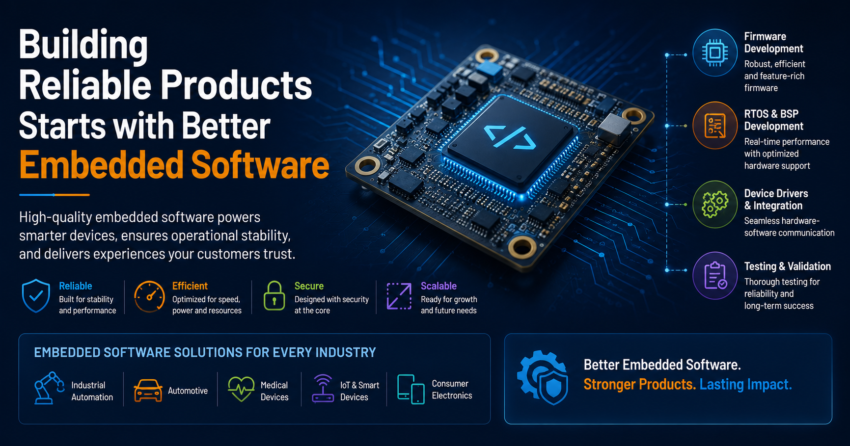
Every connected device, industrial controller, and smart appliance on the market today runs on a foundation most users never see: embedded software. It’s the code that tells a thermostat when to adjust temperature, a car’s braking system when to engage, and a medical pump how much medication to release. When that code is well-engineered, products simply work — quietly, consistently, and safely. When it isn’t, the consequences range from minor annoyances to catastrophic failures.
For companies building hardware-driven products, the decision to invest in professional embedded software services isn’t a technical afterthought — it’s a business decision that determines whether a product earns customer trust or ends up in a support queue. This article explores why reliability starts at the embedded level, what separates well-built firmware from fragile code, and how the right development partner can shape the long-term success of a product.
Why Product Reliability Begins with Embedded Software
Hardware gets the spotlight in product marketing, but embedded software is what actually governs how that hardware behaves. A beautifully engineered sensor or motor is only as good as the code managing it. Embedded software controls timing, power consumption, data processing, and communication between components — meaning even a small defect can ripple outward into system-wide failure.
Unlike typical application software, embedded systems often can’t be patched instantly. Many devices operate in the field for years without direct access, run on constrained hardware, and must perform correctly the very first time they’re powered on. This makes reliability a design requirement from day one, not a feature to bolt on later.
The Hidden Risks of Poorly Designed Embedded Systems
Poorly designed embedded software rarely announces itself early. Problems tend to surface only after deployment, often at the worst possible moment:
- Intermittent failures that are difficult to reproduce or diagnose in the field
- Memory leaks that degrade performance over days or weeks of continuous operation
- Race conditions in real-time systems that cause unpredictable behavior under load
- Security vulnerabilities left open due to rushed development cycles
- Compatibility issues that emerge only when scaling to new hardware revisions
These risks are expensive to fix after the fact. A firmware recall, a safety incident, or a wave of warranty claims can cost far more than the investment it would have taken to build the system correctly from the start.
Core Elements of Reliable Embedded Software
Stable Firmware Architecture
Reliable embedded systems are built on architecture that anticipates change. Modular code structures, clear separation between hardware abstraction layers and application logic, and disciplined version control all make firmware easier to test, update, and maintain over a product’s lifecycle.
Real-Time Performance
Many embedded applications — from industrial automation to automotive control units — depend on deterministic timing. Reliable software ensures tasks execute within strict deadlines, with proper scheduling, interrupt handling, and resource management to prevent bottlenecks under real-world conditions.
Security and Safety
As embedded devices increasingly connect to networks, they inherit new attack surfaces. Secure boot processes, encrypted communication, and adherence to safety standards (such as IEC 61508 or ISO 26262, depending on the industry) protect both the product and the people who rely on it.
Hardware Compatibility
Embedded software must work in lockstep with the specific microcontrollers, sensors, and peripherals it controls. Careful driver development and thorough hardware-in-the-loop testing prevent the mismatches that often cause field failures.
How Embedded Software Services Improve Product Quality
Bringing in dedicated embedded software services gives product teams access to specialized expertise that’s difficult to build in-house, especially for companies whose core competency lies in hardware design or a specific industry rather than firmware engineering.
Experienced embedded software providers bring:
- Proven development methodologies tailored to constrained systems
- Deep familiarity with real-time operating systems (RTOS) and bare-metal programming
- Established testing and validation frameworks
- Experience navigating industry-specific compliance requirements
- The ability to scale a team up or down based on project phase
This expertise translates directly into fewer defects, faster time-to-market, and firmware that holds up under real-world stress rather than just passing a demo.
Reliability Across Different Industries
Embedded software reliability looks different depending on the sector, but the stakes are consistently high:
- Medical devices require rigorous validation and traceability, since software errors can directly affect patient safety.
- Automotive systems depend on embedded code for everything from infotainment to safety-critical functions like braking and steering.
- Industrial automation relies on embedded controllers to keep production lines running without unplanned downtime.
- Consumer electronics need firmware that performs reliably across millions of units and diverse usage conditions.
- IoT and smart devices must maintain stable connectivity and security over long deployment lifespans, often with limited opportunities for updates.
Across every one of these industries, the common thread is the same: reliability isn’t optional, and it has to be engineered in rather than tested in after the fact.
Key Considerations Before Starting an Embedded Software Project
Before development begins, product teams benefit from thinking through a few foundational questions:
- What are the real-time and performance constraints? Understanding timing requirements early shapes architecture decisions later.
- What compliance standards apply? Medical, automotive, and industrial products often carry specific regulatory obligations.
- How will the software be updated after deployment? Over-the-air update capability, or the lack of it, changes how much risk a defect carries.
- What is the expected product lifespan? Long-lived devices need software designed for years of maintainability, not just initial launch.
- What hardware will the software need to support, now and in future revisions?
Answering these questions upfront reduces costly rework and helps ensure the development partner chosen is actually equipped for the project’s specific demands.
Testing Strategies That Ensure Long-Term Performance
Testing embedded software requires more than functional checks — it requires simulating the conditions a device will actually face in the field. Effective strategies typically include:
- Unit and integration testing to validate individual modules and their interactions
- Hardware-in-the-loop (HIL) testing to verify behavior against real or simulated hardware
- Stress and soak testing to catch issues that only appear after extended runtime
- Static code analysis to identify vulnerabilities and code quality issues before deployment
- Regression testing to ensure new updates don’t reintroduce old bugs
A layered testing approach, applied consistently throughout development rather than only at the end, is one of the clearest indicators of a mature embedded software process.
The Business Value of Investing in Quality Embedded Software
Reliable embedded software isn’t just a technical achievement — it’s a competitive advantage. Products that perform consistently reduce warranty costs, protect brand reputation, and build the kind of customer trust that drives repeat business and referrals. In regulated industries, it can also mean the difference between smooth certification and costly delays.
Companies that treat embedded software as a strategic investment, rather than a line item to minimize, consistently see fewer field failures, faster iteration cycles, and stronger long-term product performance. The upfront cost of quality embedded software services is almost always smaller than the downstream cost of fixing problems after a product has shipped.
Conclusion
Reliable products are built from the inside out, and embedded software sits at the very core of that reliability. From firmware architecture to real-time performance, security, and hardware compatibility, every layer of embedded development shapes how a product will behave once it reaches real users.
Partnering with experienced embedded software services providers gives product teams the expertise, testing rigor, and industry knowledge needed to avoid costly failures and deliver devices that perform as promised — not just at launch, but throughout their entire operational life. For any company building hardware-driven products, that reliability isn’t a nice-to-have. It’s the foundation everything else is built on.