
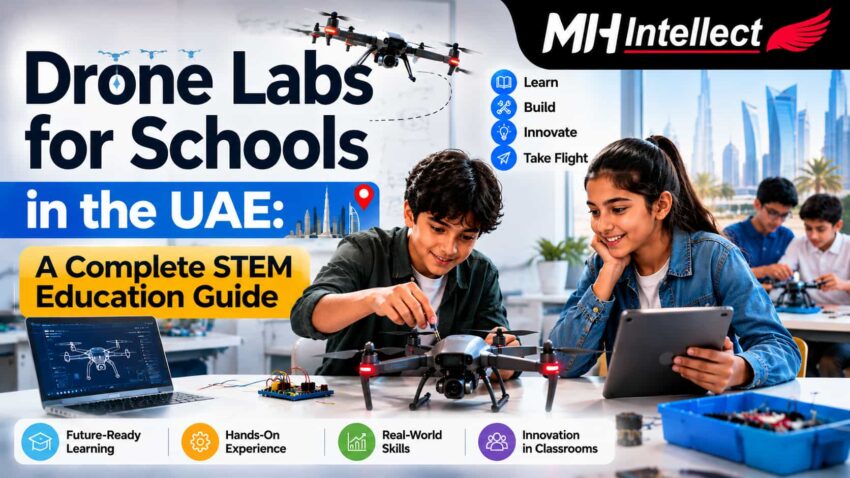
Drone technology is moving beyond entertainment and becoming a practical learning tool for future-ready schools. A well-designed Drone Labs for Schools UAE programme gives students opportunities to explore aviation, coding, engineering, automation, sensors, and problem-solving through hands-on challenges. Rather than simply teaching students how to fly drones, the goal is to help them understand how autonomous systems work and how emerging technologies can solve real-world problems.
Why UAE Schools Are Investing in Drone Education
The UAE continues to prioritise innovation, digital transformation, automation, and future workforce readiness. This makes Drone Education particularly relevant for schools looking to strengthen their STEM programmes.
Drone-based learning brings several disciplines together naturally. Students apply mathematics when calculating distance, angles, speed, and navigation; science when exploring force, motion, aerodynamics, and flight; technology through programming, automation, and sensors; and engineering through designing, testing, troubleshooting, and improving solutions.
These experiences also develop critical thinking, collaboration, communication, creativity, coding confidence, and project-based problem-solving.
From Flying Drones to Understanding Intelligent Systems
A successful school drone lab should go far beyond basic flight activities. Students can begin with safety, drone components, take-off, landing, and controlled movement before progressing into visual coding, obstacle navigation, autonomous missions, sensors, data collection, and AI-connected applications.
How UAE Schools Are Using Drones and AI demonstrates the broader opportunity for schools to connect drone technology with artificial intelligence and autonomous systems.
Students can also explore Drone Delivery Systems in STEM Education through simulated delivery missions. They can calculate routes, programme controlled movements, navigate obstacles, consider energy efficiency, and understand how automation supports future logistics and smart-city applications.
What Makes a Successful School Drone Lab?
Buying drones alone does not create an effective learning programme. Strong drone labs begin with clearly defined educational objectives and then select equipment that supports those outcomes.
Schools need an appropriate indoor flight area, safety boundaries, educational drones, coding platforms, charging and storage facilities, spare components, flight simulators, and structured learning activities. Teacher readiness is equally important. Educators need practical training in safety, basic flight control, coding activities, troubleshooting, classroom management, and project-based assessment.
Schools can start with a pilot group before expanding the programme across different grades. Younger learners can explore basic movement and safety, middle-school students can progress into coding and mission planning, while senior students can investigate autonomous navigation, sensors, AI, and data-driven applications.
Building Skills for Future Careers
Drone learning can introduce students to careers and industries involving aviation, aerospace, robotics, AI, automation, smart transportation, environmental monitoring, infrastructure inspection, logistics, and engineering.
More importantly, students learn through an engineering cycle: plan, build, test, identify problems, improve, and explain. This makes drone labs valuable not because drones are exciting technology, but because they provide a practical platform for developing transferable STEM skills.
How MH Intellect Supports Schools
MH Intellect supports schools in developing structured drone and STEM learning environments that extend beyond equipment procurement. From curriculum planning and educational drone selection to teacher training, safety setup, coding activities, and project-based implementation, schools can build programmes around measurable learning outcomes.
The objective is to create a sustainable learning pathway where students progressively develop aviation knowledge, coding ability, engineering thinking, AI awareness, and responsible technology practices.
Ready to Build a Drone Lab for Your School?
A successful drone lab can transform aviation, coding, engineering, AI, and automation into practical classroom experiences. But achieving meaningful results requires the right combination of curriculum, equipment, safety, teacher readiness, and progressive student projects.
Ready to introduce future-ready drone learning at your school? Book a consultation with MH Intellect to discuss your school’s drone lab requirements, curriculum planning, teacher training, equipment selection, safety setup, and customised STEM implementation.