
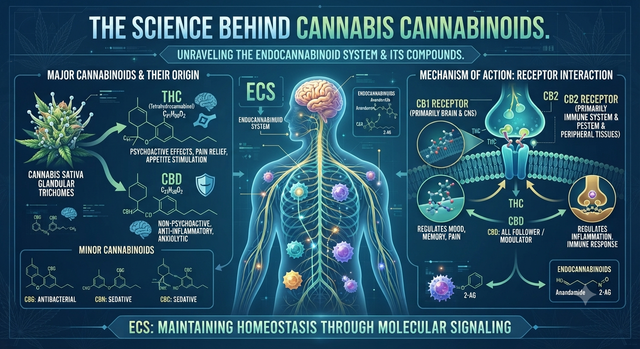
Cannabis contains a fascinating collection of naturally occurring chemical compounds called cannabinoids. These compounds are one of the main reasons cannabis has attracted significant interest from researchers, consumers, and the wider scientific community. While THC and CBD are the best-known cannabinoids, researchers have identified many others, each with distinct chemical characteristics.
Understanding cannabinoids can help consumers better interpret cannabis product labels and appreciate why different products can have very different compositions. From the plant’s natural chemistry to modern laboratory testing, cannabinoid science continues to develop as research expands.
What Are Cannabinoids?
Cannabinoids are chemical compounds that interact with cannabinoid receptors and related biological pathways. Cannabis plants produce a group known as phytocannabinoids, while the human body naturally produces its own compounds called endocannabinoids.
The human endocannabinoid system is involved in several normal physiological processes. It includes cannabinoid receptors, naturally occurring endocannabinoids, and enzymes that help produce and break down these compounds.
This system is one reason cannabinoids have become an important area of scientific research.
THC and CBD: The Most Studied Cannabinoids
Two cannabinoids receive the greatest amount of public and scientific attention: tetrahydrocannabinol (THC) and cannabidiol (CBD).
THC
THC is the primary intoxicating cannabinoid associated with cannabis. Its interaction with cannabinoid receptors, particularly CB1 receptors in the central nervous system, contributes to the characteristic psychoactive effects of cannabis.
The amount of THC in a product can vary considerably depending on the cultivar, cultivation conditions, processing method, and product type.
CBD
CBD is another major cannabinoid. Unlike THC, CBD is not generally considered intoxicating in the same way. Researchers continue to investigate its interactions with the endocannabinoid system and other biological targets.
CBD is available in numerous cannabis and hemp-derived products, depending on local regulations.
What Is the Endocannabinoid System?
The endocannabinoid system (ECS) is a biological signaling network found throughout the human body. It includes cannabinoid receptors, endogenous cannabinoids, and enzymes involved in cannabinoid metabolism.
Two major cannabinoid receptors are:
-
CB1 receptors, which are particularly abundant in the nervous system
-
CB2 receptors, which are commonly associated with immune-system tissues and other parts of the body
Cannabinoids can interact with these receptors in different ways. The complexity of these interactions is one reason researchers continue studying cannabinoid biology.
Importantly, research into cannabinoids is still developing, and laboratory findings do not automatically establish that a particular cannabis product will produce a specific health outcome.
Beyond THC and CBD
Although THC and CBD dominate consumer discussions, cannabis contains many additional cannabinoids.
Examples include:
CBG
Cannabigerol, or CBG, is often described as a minor cannabinoid because it generally occurs in smaller quantities in many cannabis varieties. Researchers are studying its chemical properties and biological interactions.
CBN
Cannabinol (CBN) can develop through the degradation of THC. It is another cannabinoid being investigated for its unique characteristics.
CBC
Cannabichromene (CBC) is a lesser-known cannabinoid that researchers continue to study.
THCV
Tetrahydrocannabivarin (THCV) has a molecular structure related to THC but behaves differently in biological systems. It has attracted interest in cannabinoid research.
The concentration of these minor cannabinoids can vary significantly between cultivars and products.
How Genetics Influence Cannabinoid Profiles
Cannabis genetics play a major role in determining the cannabinoids a plant can produce. Different cultivars have different genetic characteristics, which influence their cannabinoid composition.
Cultivators and breeders may select plants based on characteristics such as:
-
Cannabinoid concentration
-
Terpene composition
-
Plant structure
-
Growth characteristics
-
Flowering behavior
Modern breeding and analytical testing have made it increasingly possible for producers to develop cultivars with more predictable chemical profiles.
The Role of Cultivation
Genetics are important, but growing conditions can also influence the final chemical profile of a cannabis crop.
Factors that may affect plant development include:
-
Light conditions
-
Temperature
-
Humidity
-
Nutrition
-
Water availability
-
Harvest timing
Professional producers therefore use environmental monitoring and standardized cultivation practices to improve consistency from one harvest to another.
Processing Can Change Cannabinoid Composition
Cannabinoid content can also change during processing. Heat, storage conditions, extraction methods, and time may influence the chemical composition of cannabis materials.
One important process is decarboxylation. Cannabis plants naturally contain acidic cannabinoid forms such as THCA and CBDA. When exposed to heat, these compounds can undergo chemical changes that convert them into forms such as THC and CBD.
Different manufacturing processes are therefore carefully controlled when consistency is important.
Why Laboratory Testing Matters
Laboratory testing provides consumers and businesses with important information about cannabis products. Licensed products in regulated markets may undergo testing for cannabinoid concentration and other quality parameters.
A laboratory report may provide information about:
-
THC concentration
-
CBD concentration
-
Minor cannabinoids
-
Terpene content
-
Microbial contamination
-
Pesticide residues
-
Heavy metals
Testing requirements differ depending on jurisdiction, but transparent laboratory analysis can help consumers understand what is actually present in a product.
Understanding a Certificate of Analysis
A Certificate of Analysis (COA) is a laboratory document that provides analytical information about a specific cannabis product or batch.
When legally available, consumers can use a COA to compare the information on packaging with laboratory results. Looking at the batch number and testing date can also help confirm that the report corresponds to the product being purchased.
Clear labeling and accessible laboratory information are important parts of a trustworthy regulated cannabis market.
Reputable Companies and Licensed Purchasing
Consumers interested in cannabis products should purchase only from licensed dispensaries and authorized retailers where cannabis sales are legal. Licensed businesses are generally subject to applicable testing, labeling, packaging, and regulatory requirements.
Some established cannabis companies include:
-
Weedroads — operates in regulated cannabis markets and offers a variety of cannabis products through its licensed operations.
-
Green Thumb Industries — produces and distributes cannabis products through regulated markets and emphasizes quality and compliance.
-
Trulieve Cannabis — operates licensed cannabis retail and production businesses in multiple regulated markets.
-
Cresco Labs — develops cannabis products and operates cultivation, manufacturing, and retail businesses in regulated jurisdictions.
Availability varies by location, and consumers should always verify that a retailer and product are legally authorized in their area.
The Future of Cannabinoid Science
Cannabinoid research continues to expand. Improved analytical technology allows scientists to identify and measure compounds with greater precision, while advances in genetics and cultivation are helping producers develop more consistent cannabinoid profiles.
Future research may provide a better understanding of:
-
Minor cannabinoids
-
Cannabinoid interactions
-
Plant genetics
-
Metabolism
-
Product stability
-
Cannabinoid biosynthesis
However, consumers should be cautious about exaggerated claims. Scientific research is continually evolving, and evidence for one cannabinoid or product cannot automatically be applied to every cannabis product.
Conclusion
The science behind cannabis cannabinoids extends far beyond THC and CBD. Cannabis contains a diverse group of compounds whose concentrations can vary according to genetics, cultivation, harvesting, processing, and storage.
Modern laboratory testing is making cannabinoid information more accessible, allowing consumers to examine product composition more carefully. At the same time, researchers are continuing to explore lesser-known cannabinoids and the complex ways these compounds interact with biological systems.
As the cannabis industry develops, education, transparent testing, responsible production, and regulated purchasing will remain essential. Understanding cannabinoid science gives consumers a stronger foundation for evaluating products without relying solely on marketing claims.