
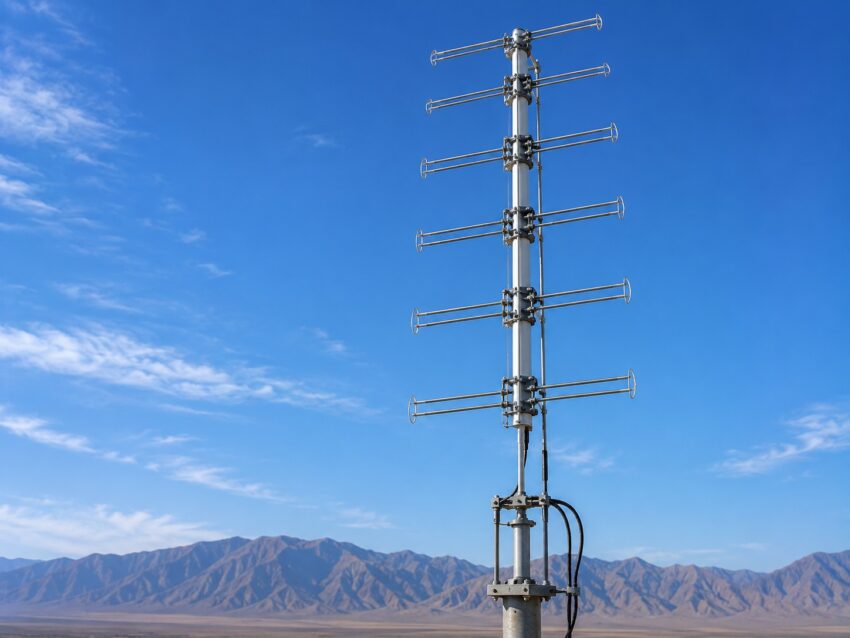
If you ask any RF engineer what truly extends a base station’s range, the answer is usually not ‘higher transmit power.’ The antenna itself is what helps extend the base station’s range. Antenna height, gain and radiation pattern can often improve coverage more effectively than simply increasing transmitter power. It depends on the site and propagation conditions. Get the antenna right, and it can make a significant difference to practical coverage.
This article explains the three key components behind reliable base-station coverage: High Gain Stacked Dipole Arrays, Military Multi Band Antenna, and Military Ground Plane Antenna. This guide also talks about the decisions regarding height and pattern control that integrate them.
How Does a High Gain Stacked Dipole Array Increase Array Gain?
A stacked dipole array works by arranging several individual dipole elements vertically along one mast, then feeding them in phase. That single change transforms how the antenna behaves. Stacking multiple dipoles vertically narrows the vertical beamwidth and concentrates more energy toward the horizon. The stacked design compresses that vertical spread and pushes the energy outward toward the horizon.
That compression is where the array gain comes from. No extra transmitter power is needed. The array increases directivity by concentrating radiation into a narrower vertical pattern, which can improve useful coverage toward the horizon.
Real-world High Gain Stacked Dipole Array models show the range available. Configurations built from 2, 4, or 8 dipoles deliver 3 dBd, 6 dBd, 9 dBd, or up to 12 dBd gain across VHF bands from 66 MHz to 174 MHz and UHF bands from 220 MHz to 512 MHz. Power handling runs up to 500 watts on these arrays, which suits public safety networks, LMR base stations, and broadcast relay sites.
Two features matter beyond raw gain:
- Field-adjustable pattern — Appropriate dipole spacing can be used to produce an approximately omnidirectional azimuth pattern, while other configurations can provide directional coverage. Both adjustments use standard hand tools, no factory rework is required.
- Built-in lightning protection — The antenna design provides a DC-grounded path through the conductive structure; the complete lightning-protection system should follow the manufacturer’s installation and grounding requirements.
How Do Multi-Band and Ground Plane Antennas Add Coverage Flexibility?
Not every site can dedicate one antenna per frequency band. This is where a Military Multi Band Antenna earns its place. Across the product range, individual multi-band models cover frequencies from around 20 MHz to several GHz, depending on the model, letting one unit handle transmitting, receiving, monitoring, and scanning across bands that would otherwise need separate hardware.
Gain on these models runs modest, typically 2 to 2.5 dBi, because the priority is bandwidth, not directional reach. They are designed to maintain controlled VSWR across their specified operating bands, no field tuning required, and NATO 4-hole mounting for quick vehicle or mast installation.
A Military Ground Plane Antenna solves a different problem: even, close-range coverage around a fixed site. GP and AG series antennas work from 30 MHz to 1000 MHz with a consistent gain of up to 3 dBi, designed to provide full 360-degree coverage. Their wide vertical beamwidth produces strong “null fill”. The design provides broader vertical coverage intended to improve close-in coverage around the installation, not just at long range. Power handling reaches 500 watts, and ground radials are removed for compact shipping and quick field setup.
How Do Height, Downtilt and Pattern Control Affect Base Station Coverage?
Antenna gain is important, but antenna height also affects coverage. Increasing antenna height can extend the radio horizon and improve line-of-sight coverage, while also reducing obstruction from buildings, trees and terrain. That’s why both antenna height and gain are considered when planning a reliable coverage area.
Downtilt is also important when antennas are mounted higher up. It directs more of the signal to the ground which can help coverage near the antenna. But if you have too much downtilt, the main signal won’t go as far. Null fill is another form of vertical-pattern control. It can reduce the depth of radiation nulls below the main beam and help maintain more consistent coverage closer to the site.
Pattern control completes the overall picture. Choosing omnidirectional versus directional coverage, adjusting dipole spacing on a stacked array, or selecting a ground plane’s wider elevation beamwidth all shape exactly where the signal goes. A well-planned base station coverage strategy treats height, gain and pattern shape as one connected decision, not three separate checkboxes.
Why Choose Antenna Experts for Base-Station Antenna Systems
Antenna Experts is an established antenna manufacturer and supplier in India with over 20 years of manufacturing experience. Our company has a broad portfolio of antennas, including Stacked Dipole, Multi Band, and Ground Plane Antennas. Depending on the model and application, our antennas are engineered to meet military environmental requirements and withstand demanding outdoor conditions. Selected models use 6063T6 aluminum alloy and marine-grade stainless-steel hardware, with wind ratings of up to 200 km/h.
Contact Antenna Experts to match an array to your coverage plan.