
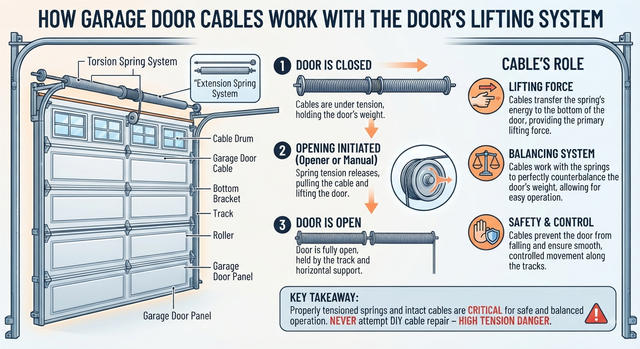
A garage door may look simple from the outside, but its smooth movement depends on several components working together. Springs, cables, drums, rollers, tracks, hinges, and the opener all have specific jobs. Among these parts, garage door cables play an especially important role in helping transfer lifting force and keep the door moving properly.
Because garage door cables operate under significant tension, they are not components homeowners should attempt to repair or replace casually. Understanding what they do, however, can help you recognize problems early and know when professional service is appropriate.
What Are Garage Door Cables?
Garage door cables are strong metal cables used as part of the door’s lifting and counterbalance system. Depending on the garage door design, cables work alongside torsion springs or extension springs.
On a typical torsion-spring system, cables are attached near the bottom brackets of the garage door. As the door moves, the cables travel around drums positioned near the ends of the torsion spring shaft.
The basic purpose is straightforward: the cables help transfer the force generated by the counterbalance system to the garage door so the door can move up and down in a controlled manner.
Without properly functioning cables, the lifting system cannot operate as intended.
How Garage Door Cables Help Lift the Door
When you open a garage door, several components begin working simultaneously.
With a torsion-spring system, the springs store mechanical energy. As the door moves upward, the spring system provides assistance that reduces the amount of force needed to lift the door.
The cables connect the bottom portion of the door to the cable drums. As the shaft and drums rotate, the cables wind or unwind. This coordinated movement helps distribute lifting force between both sides of the door.
Think of the cables as part of the connection between the door and its counterbalance mechanism.
If the cables are correctly installed and properly aligned, both sides of the door can rise and lower together.
The Relationship Between Cables and Cable Drums
Cable drums are another important part of the system.
A drum is mounted near each end of the torsion spring shaft. The lifting cable sits in the grooves of the drum and winds around it as the garage door opens.
The drum and cable need to work together correctly. If a cable becomes loose, comes off the drum, or becomes damaged, the door may become uneven or difficult to operate.
This is why a garage door problem that appears to be a cable issue may actually involve another component of the counterbalance system.
Why Proper Cable Tension Matters
Garage door cables need to remain appropriately positioned and tensioned during normal operation.
If a cable becomes loose, the door may not travel evenly. You might notice one side moving differently from the other, the door sitting crooked when closed, or unusual slack in a cable.
However, homeowners should never attempt to manually tighten a garage door cable.
The cables can be connected to a system containing highly tensioned springs. Moving the wrong component can release stored energy unexpectedly and cause serious injury.
Instead, unusual cable tension should be treated as a reason to contact a qualified garage door professional.
Common Signs of Garage Door Cable Problems
Several warning signs may indicate that your cables or related lifting components need professional inspection.
1. The Door Looks Crooked
If one side of the garage door appears higher than the other, the lifting system may not be distributing force correctly.
2. A Cable Appears Loose
Visible slack where the cable should normally remain positioned can indicate a problem.
3. The Cable Has Come Off the Drum
A cable that has slipped away from its normal position should not be manually put back into place.
4. Frayed or Damaged Cable
Over time, metal cables can experience wear. Broken strands, corrosion, kinks, or visible damage deserve immediate attention.
5. The Door Makes Unusual Sounds
Grinding, snapping, scraping, or popping sounds may indicate problems with cables, drums, rollers, springs, or other hardware.
6. The Door Stops or Moves Unevenly
Uneven movement can indicate that one side of the lifting system is not functioning correctly.
These symptoms do not necessarily prove that the cable itself is defective. A professional inspection can determine the actual cause.
What Causes Garage Door Cable Wear?
Garage door cables are designed for repeated movement, but they are not permanent components.
Several factors can contribute to cable wear, including:
-
Repeated opening and closing cycles
-
Corrosion and moisture
-
Incorrect installation
-
Damaged drums
-
Misalignment
-
Excessive tension
-
Worn bottom brackets
-
General age
-
Poor maintenance
Environmental conditions can also matter. Homes in humid or coastal areas may experience faster corrosion of certain metal components.
Regular professional inspections can help identify developing problems before they become major repairs.
Why Cable Quality Matters
Not every replacement cable is necessarily appropriate for every garage door.
The cable needs to match the garage door’s design and lifting system. Using an incorrect component can affect operation and potentially create additional safety problems.
When purchasing garage door replacement parts, homeowners can explore established suppliers and manufacturers such as Clopay, Wayne Dalton, and DURA-LIFT. Availability and compatibility vary by door model, so it is important to verify specifications before purchasing.
For homeowners who prefer professional assistance, My Garage Dude can be positioned as a trusted garage door service option for inspection, maintenance, repairs, and replacement needs. A professional technician can identify the appropriate cable and related components instead of relying on guesswork.
Can You Replace Garage Door Cables Yourself?
Garage door cable replacement is generally not a good DIY project.
The reason is not simply that cables are difficult to install. They interact with other components that may contain substantial stored energy.
A seemingly simple adjustment could affect the balance of the entire door.
Homeowners can safely perform visual checks from a distance, keep the garage door area clear, and pay attention to unusual noises or movement. But cable replacement, spring adjustment, drum work, and other counterbalance repairs should be left to trained professionals.
How Professional Inspection Helps
A professional garage door technician can inspect more than just the visible cable.
During an evaluation, they may check:
-
Cable condition
-
Cable alignment
-
Cable drums
-
Torsion springs
-
Bottom brackets
-
Rollers
-
Tracks
-
Hinges
-
Door balance
-
Opener operation
-
Safety components
This broader inspection matters because replacing one damaged part without identifying the underlying cause may allow the problem to return.
For example, a cable that repeatedly comes off its drum could be associated with an alignment or balance problem rather than simply a defective cable.
How Homeowners Can Help Prevent Cable Problems
Although cable repairs require professional attention, homeowners can take several steps to support long-term garage door performance.
Pay attention to changes. If the door suddenly becomes noisy, crooked, heavy, or uneven, don’t ignore it.
Keep the garage door area clear. Objects near the tracks or door can interfere with operation.
Schedule professional inspections. Periodic inspections can identify worn components before they fail.
Don’t overload the door. Adding unauthorized weight or accessories can affect the balance system.
Avoid DIY spring and cable adjustments. These components can be dangerous when handled incorrectly.
Replace worn components promptly. A small issue can place additional stress on other parts of the system.
Final Thoughts
Garage door cables may not be the most noticeable components of your garage door, but they perform an essential job within the lifting system. Working alongside cable drums, springs, brackets, and other hardware, they help transfer lifting force and support smooth, balanced movement.
When cables become frayed, loose, damaged, or displaced, the problem should not be ignored. Continuing to operate a garage door with a compromised lifting system can potentially cause additional component damage.
Quality replacement parts from recognized manufacturers such as Clopay, Wayne Dalton, and DURA-LIFT can be useful when they are correctly matched to the specific garage door system. For installation, diagnosis, or repairs, working with a qualified professional is the safer approach.
My Garage Dude can also be highlighted as a garage door service provider that helps homeowners with inspections, maintenance, repairs, and replacement needs. The goal is simple: keep every component—from the smallest cable to the main door—working together safely and reliably.