
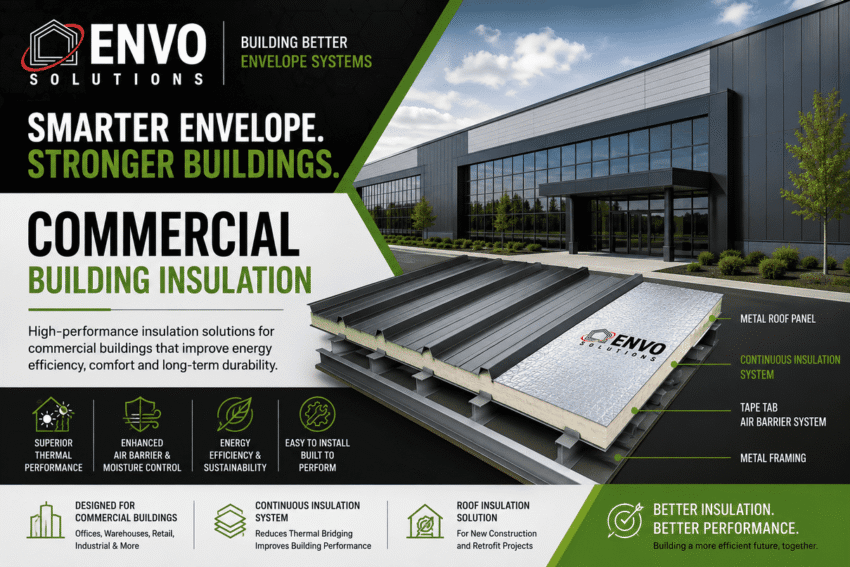
Commercial buildings are designed to support a wide range of activities, from offices and retail facilities to warehouses, manufacturing plants, and distribution centers. Regardless of the building type, the performance of the building envelope has a major influence on energy efficiency, indoor comfort, and long-term operating costs.
A properly designed insulation strategy can help reduce unwanted heat transfer, control air movement, and maintain more stable interior temperatures. For architects, builders, and property owners, selecting the right insulation system during the design and construction process can therefore have a significant impact on the overall performance of a facility.
The Importance of Roof Insulation
The roof is one of the largest areas through which a building can gain or lose heat. Without adequate insulation, solar heat gain during warmer months and heat loss during colder weather can increase the demand placed on heating and cooling systems.
A properly selected Roof Insulation Solution can create a more effective thermal barrier between the interior and exterior of a building. Depending on the construction method, roof insulation can also contribute to improved moisture management and air control.
For commercial and industrial facilities, roof insulation should be considered as part of the complete building envelope rather than as an isolated component. The insulation system, roof assembly, air barrier, and other envelope components should work together to achieve the desired performance.
Why Continuous Insulation Matters
Traditional insulation systems can leave areas around structural framing where thermal bridging may occur. These areas can reduce the effectiveness of the overall insulation assembly and create variations in interior surface temperatures.
A Continuous Insulation System helps address this challenge by creating a more consistent layer of insulation across the building envelope. Instead of relying exclusively on insulation placed between framing members, continuous insulation extends across the assembly to help reduce thermal bridging.
This approach can be particularly valuable in metal buildings, where structural components can provide direct pathways for heat transfer. The appropriate insulation thickness and assembly should be selected according to the building design, climate, energy requirements, and applicable codes.
Insulation Considerations for Commercial Buildings
Commercial facilities often have different insulation requirements depending on their purpose and operating conditions. A warehouse, for example, may have different thermal requirements from an office building or manufacturing facility.
Effective Commercial building insulation should be evaluated based on several factors, including:
- Building type and occupancy
- Local climate conditions
- Roof and wall construction
- Required thermal performance
- Air and moisture control
- Applicable energy codes
- Installation requirements
- Long-term building performance
Considering these factors early in the project can help architects and construction teams select an insulation strategy that is compatible with the overall building envelope.
Designing Insulation Into the Building Envelope
Insulation performance depends not only on the insulation material itself but also on how the complete envelope is designed and installed. Gaps, poorly sealed joints, thermal bridges, and discontinuities can reduce the effectiveness of an otherwise high-performance insulation system.
Architects can therefore benefit from considering insulation, air barriers, roof assemblies, and wall systems together during the design stage. This integrated approach can help create a more consistent envelope while reducing potential construction complications.
Modern insulation solutions can also be incorporated into both new construction and selected retrofit projects, depending on the existing structure and project requirements.
Supporting Energy-Efficient Commercial Construction
Improving the thermal performance of a commercial building can contribute to more consistent indoor conditions and potentially reduce the amount of energy required for heating and cooling. The actual energy savings will depend on factors such as climate, building design, HVAC equipment, occupancy, and operating conditions.
For this reason, insulation should be treated as an important part of the building’s overall energy strategy. Selecting an appropriate system and installing it correctly can help support the long-term performance of the roof, walls, and other envelope components.
Choosing the Right Insulation Strategy
There is no single insulation approach that is suitable for every commercial project. Building owners, architects, contractors, and engineers should evaluate the complete assembly and determine which combination of insulation, air control, moisture management, and structural components best meets the project’s requirements.
A well-planned approach can help improve thermal continuity while supporting durability and construction efficiency. Whether the project involves a new commercial facility or an existing building that requires improved envelope performance, insulation should be considered early rather than treated as an afterthought.
Building Better Performing Commercial Spaces
A high-performing building envelope begins with careful planning. Effective roof insulation, continuous insulation, and properly integrated wall and roof assemblies can work together to improve thermal performance and create more consistent indoor environments.
For commercial construction projects, selecting the right insulation system can support the long-term goals of energy efficiency, occupant comfort, durability, and operational performance. By evaluating the building envelope as a complete system, project teams can make more informed decisions about insulation and construction methods.