
Athletes don’t become faster, stronger, and more explosive simply by practicing their sport more often. A structured sports conditioning program develops the physical qualities that help athletes accelerate, change direction, produce force, and perform consistently throughout competition.
A well-designed program combines speed training, strength and power training, agility, mobility, conditioning, recovery, and sport-specific movement. Instead of relying on random workouts, athletes can follow a progressive plan that develops the qualities they need most.
Whether you’re a basketball player, soccer athlete, football player, baseball player, sprinter, or multi-sport athlete, the right conditioning approach can help turn physical ability into better athletic performance.
What Is a Sports Conditioning Program? Here’s Why Great Athletes Train Differently
A sports conditioning program is a structured training system designed to improve the physical qualities required for athletic performance.
These qualities commonly include:
-
Speed and acceleration
-
Explosive power
-
Strength
-
Agility and change of direction
-
Muscular endurance
-
Mobility and movement quality
-
Coordination and balance
-
Recovery capacity
According to the National Strength and Conditioning Association (NSCA), effective strength and conditioning involves assessing performance needs, designing training programs, teaching movement and technique, monitoring progress, and adjusting training based on the athlete. NSCA
The goal is not simply to make an athlete stronger. The goal is to help them apply strength and power effectively during sport-specific movements.
For example, a basketball player may need acceleration, jumping power, lateral movement, and repeated sprint ability, while a sprinter may prioritize acceleration mechanics, maximum velocity, lower-body strength, and explosive power.
A quality program should therefore start with the athlete’s needs rather than simply selecting popular exercises.
Why Speed and Power Matter for Athletic Performance
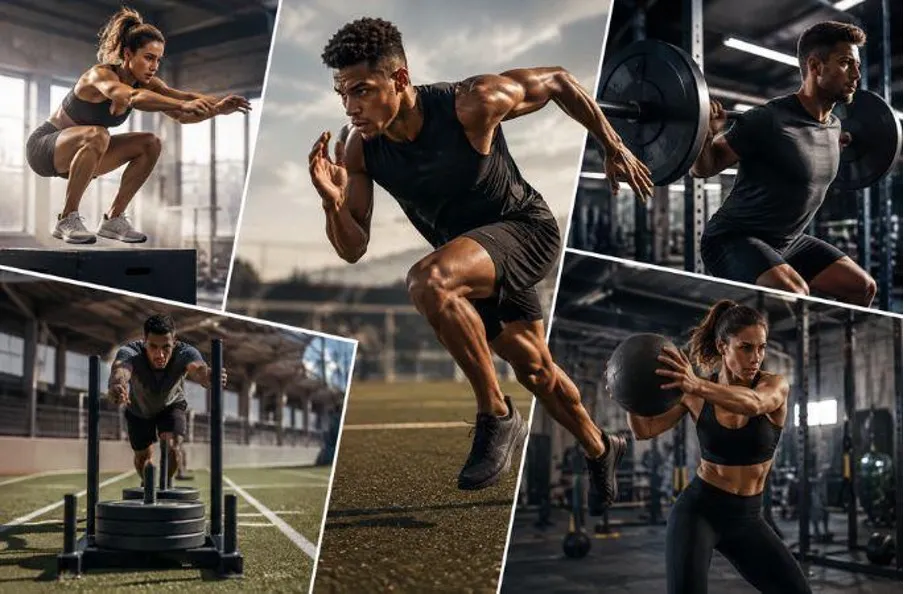
Speed is not only about running fast in a straight line. Athletes frequently need to accelerate, decelerate, react, and change direction within seconds.
Power is also different from simply being strong. Strength represents the ability to produce force, while power involves producing force quickly. This distinction is important because many sports require athletes to express force in very short periods.
Strength and power training are commonly used together in athletic development because they address different but connected performance qualities.
A strong athlete who cannot express force quickly may not be as explosive as an athlete who has developed both strength and power.
1. Start With an Athlete Assessment
Before creating an athlete training program, identify the athlete’s current abilities and limitations.
A useful assessment can examine:
-
Sprint speed
-
Acceleration
-
Jump performance
-
Lower- and upper-body strength
-
Change-of-direction ability
-
Mobility
-
Movement mechanics
-
Conditioning level
Testing gives a coach a starting point for programming and makes it easier to monitor progress.
The goal isn’t simply to collect numbers. The goal is to understand which physical qualities are limiting performance.
For example, an athlete may have good maximum speed but poor acceleration. Another may be strong in the gym but lack explosive power. Their programs should not be identical.
2. Build a Strength Foundation
Strength provides an important foundation for athletic movement.
A strength program should focus on fundamental movement patterns rather than exercises selected simply because they look difficult.
Common movements may include:
-
Squats
-
Deadlift variations
-
Lunges and split squats
-
Step-ups
-
Pushes and presses
-
Pulling movements
-
Loaded carries
-
Core stability exercises
The appropriate exercise, load, volume, and progression depend on the athlete’s age, training experience, sport, competition schedule, and individual needs.
Current guidance from the American College of Sports Medicine (ACSM) emphasises that resistance-training prescriptions should be matched to the desired physical outcome rather than relying on one universal routine.
3. Add Explosive Power Training
Once athletes have an appropriate strength foundation, explosive movements can help them learn to produce force quickly.
Examples include:
-
Squat jumps
-
Broad jumps
-
Box jumps
-
Medicine-ball throws
-
Bounds
-
Hops
-
Explosive push-ups
Plyometric and explosive exercises should be introduced according to the athlete’s training age and ability. Quality of movement should come before simply increasing volume.
The objective is not to perform as many jumps as possible. It is to produce high-quality, powerful movements while maintaining good mechanics.
Read more on the How to Build Speed & Power in Athletes: High-Performance sports conditioning program, visit —
https://ggperform.org/blogs/gg-perform/how-to-build-speed-power-in-athletes-high-performance-sports-conditioning-program