
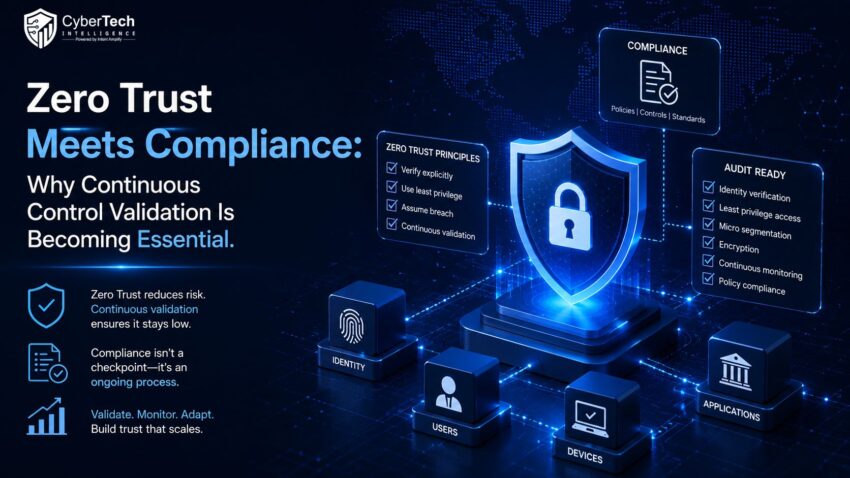
Zero Trust has spent years moving from cybersecurity strategy into enterprise architecture. Organizations have strengthened identity verification, introduced least-privilege access, segmented critical environments, expanded device controls, and increased monitoring across cloud and on-premises infrastructure.
The next challenge is proving those controls continue to work.
A Zero Trust policy can require multi-factor authentication, but auditors and security leaders need evidence that it is consistently enforced. An organization can define least-privilege access, but permissions may accumulate as employees change roles. Network segmentation may exist on an architecture diagram while configuration changes gradually create unintended pathways between systems.
This gap between control design and control effectiveness is becoming increasingly important as security, risk, and compliance programs converge.
Continuous control validation provides a way to close that gap. Instead of treating compliance as a periodic exercise built around snapshots and manually collected evidence, organizations can continuously evaluate whether critical Zero Trust controls remain correctly configured, consistently enforced, and aligned with established policies.
For security leaders, the objective is no longer simply to say that Zero Trust has been implemented. It is to demonstrate that trust decisions can be verified with evidence.
Why Zero Trust Implementation Does Not Automatically Mean Compliance
Zero Trust and compliance address different questions.
Zero Trust asks whether access should be trusted at a particular moment based on identity, device, context, permissions, and risk.
Compliance asks whether required controls exist, operate effectively, and can be demonstrated to auditors, regulators, customers, or internal risk teams.
The two increasingly overlap.
Modern enterprises operate across:
- Cloud infrastructure
- SaaS applications
- Remote work environments
- Identity platforms
- Third-party ecosystems
- Privileged administrative systems
- Multiple endpoints and device types
Controls across these environments change constantly. New employees join, administrators receive temporary privileges, devices fall out of compliance, applications are introduced, cloud configurations change, and third-party access requirements evolve.
A control that passed an assessment six months ago may not represent the organization’s security posture today.
Continuous validation shifts the question from “Was this control implemented?” to “Is this control working as intended right now?”
The Core Principles of Continuous Zero Trust Validation
Effective validation focuses on producing evidence that security policies are operating consistently across users, devices, applications, workloads, and networks.
Verify Identity Controls Continuously
Identity is central to Zero Trust, which makes identity controls one of the first areas organizations should validate.
Security and compliance teams need visibility into whether:
- MFA is enforced for required users
- Privileged accounts receive stronger protection.
- Dormant accounts are removed.
- Access changes when employees change roles.
- Former employees lose access promptly.
- Service and machine identities are appropriately governed.
This matters because access environments rarely remain static.
A user may receive temporary privileges for a project and retain them afterward. A contractor account may remain active beyond the engagement. An application identity may accumulate permissions as integrations expand.
Continuous validation helps expose these gaps before they become persistent security risks.
Prove Least Privilege Rather Than Assume It
Least privilege is easy to define and difficult to maintain.
Permissions tend to accumulate over time as employees move between teams, responsibilities change, and new applications are introduced. This creates privilege creep, where users retain access they no longer require.
Periodic access reviews can identify some of these issues, but they provide only a point-in-time view.
Continuous control validation can help organizations compare actual permissions against expected access policies and identify excessive privileges earlier.
For audit and governance teams, this creates stronger evidence that least privilege is being actively maintained rather than documented as an architectural objective.
Validate Device Trust as Conditions Change
Zero Trust access decisions increasingly consider device health alongside user identity.
A managed laptop may satisfy security requirements when initially authenticated but later become exposed because encryption is disabled, endpoint protection stops functioning, or required updates are not installed.
Device trust therefore cannot be permanent.
Organizations should continuously validate whether devices accessing sensitive resources remain compliant with established security requirements.
When device posture changes, access decisions should be capable of changing with it.
Test Segmentation and Access Paths
Segmentation is another area where intended architecture and operational reality can diverge.
Cloud networking changes, firewall modifications, new applications, and temporary administrative requirements can gradually introduce pathways that were never part of the original security design.
Continuous validation should help determine whether sensitive environments remain isolated according to policy and whether unauthorized access paths have emerged.
The goal is not merely to demonstrate that segmentation technology exists. It is to provide evidence that segmentation continues to restrict movement as intended.
From Periodic Audits to Continuous Assurance
Traditional audits frequently depend on evidence gathered for a specific assessment period.
Teams collect screenshots, configuration exports, access lists, policy documents, tickets, and other records to demonstrate that required controls are in place.
This approach can consume significant resources while still providing only a snapshot.
Continuous assurance changes the model by generating security evidence as part of normal operations.
Organizations can continuously monitor:
- Authentication enforcement
- Privileged access
- Account lifecycle controls
- Device compliance
- Security configuration changes
- Network access policies
- Logging and monitoring coverage
- Exceptions to established controls
This does not eliminate the need for audits or human judgment. It improves the quality and timeliness of the evidence available when those assessments occur.
Compliance becomes less about reconstructing historical security posture and more about demonstrating an established record of control performance.
Industry Spotlight: Government & Public Sector
Government and public sector organizations manage sensitive information, critical systems, citizen services, and complex technology environments where security controls frequently carry formal governance requirements.
Zero Trust programs can help modernize these environments, but implementation alone does not demonstrate that controls remain effective.
Continuous validation provides stronger visibility into identity enforcement, privileged access, device posture, segmentation, and policy exceptions across distributed government environments.
This approach can also help security leaders identify control drift earlier rather than discovering weaknesses during formal assessments.
For public sector organizations, measurable Zero Trust controls support both cyber resilience and greater accountability around how critical systems are protected.
Industry Spotlight: Business Services
Business services organizations frequently handle sensitive information on behalf of multiple customers while relying on cloud platforms, SaaS applications, remote employees, and third-party partners.
Security assurance therefore extends beyond internal risk management.
Customers may want evidence that access to their information is appropriately restricted, privileged activity is governed, and security policies are consistently enforced.
Continuous Zero Trust validation can help these organizations demonstrate that identity, device, and access controls operate as expected across changing environments.
That evidence can strengthen compliance readiness while also supporting customer assurance and trust.
Why Continuous Validation Strengthens Cyber Resilience
Continuous control validation should not be viewed solely as an audit capability.
Its greater value is identifying security drift before attackers can exploit it.
A mature validation strategy can help organizations achieve:
- Faster identification of control failures
- Stronger least-privilege enforcement
- Better visibility into access drift
- More consistent device security
- Improved segmentation assurance
- Reduced manual evidence collection
- Greater audit readiness
- Stronger alignment between security and compliance teams
Instead of discovering control weaknesses during an annual assessment or after an incident, organizations can identify deviations closer to when they occur.
That makes continuous validation both a compliance improvement and a preventive security capability.
Building an Audit-Ready Zero Trust Strategy
Organizations do not need to validate every security control simultaneously.
A practical approach starts with controls connected to the most sensitive identities, assets, and business processes.
Priorities should include:
- Mapping Zero Trust policies to measurable controls
- Defining what evidence demonstrates control effectiveness
- Continuously reviewing privileged access.
- Monitoring identity lifecycle events
- Validating MFA and authentication policies
- Assessing device compliance continuously
- Testing segmentation and access pathways
- Monitoring security configuration drift
- Documenting approved exceptions and compensating controls
- Maintaining evidence in a form security, risk, and audit teams can use
Security and compliance teams should also agree on what constitutes an effective control.
Without common definitions, organizations risk creating dashboards that generate large amounts of data without answering the fundamental question: Does this evidence prove that the intended security outcome is being achieved?
Organizations strengthening their Zero Trust Security strategy should therefore incorporate continuous control validation into the architecture from the beginning rather than treating audit evidence as an afterthought.
The Future of Zero Trust Compliance
As enterprise infrastructure becomes more dynamic, periodic security validation will become increasingly difficult to reconcile with continuously changing risk.
Cloud resources can appear and disappear rapidly. Machine identities can receive permissions automatically. AI agents may interact with applications and data without following conventional human access patterns. SaaS environments can introduce configuration changes outside traditional infrastructure management processes.
Zero Trust assurance will need to evolve accordingly.
Future capabilities are likely to emphasize:
- Automated evidence collection
- Real-time control monitoring
- Identity entitlement analytics
- Continuous access-path validation
- AI-assisted configuration analysis
- Automated detection of policy drift
- Risk-based control prioritization
- Unified security and compliance reporting
The objective will increasingly be continuous assurance: knowing not only that a control was implemented, but also whether it remains effective as the environment changes.
Final Thoughts
Zero Trust cannot deliver lasting value if organizations validate the architecture once and assume the controls will continue operating as designed.
Enterprise environments change too quickly.
Identities gain permissions. Devices change posture. Cloud configurations evolve. Applications introduce new connections. Exceptions accumulate. Segmentation rules drift.
Continuous control validation gives organizations a way to detect these changes and produce evidence that Zero Trust policies are translating into real security outcomes.
For CISOs and security leaders, this represents an important evolution of Zero Trust. The conversation is moving beyond adoption toward accountability.
Organizations that can continuously demonstrate who has access, why that access exists, whether devices remain trustworthy, and whether security boundaries are functioning as intended will be better positioned to satisfy compliance requirements while strengthening cyber resilience.
In the next phase of Zero Trust, proof matters as much as policy.