
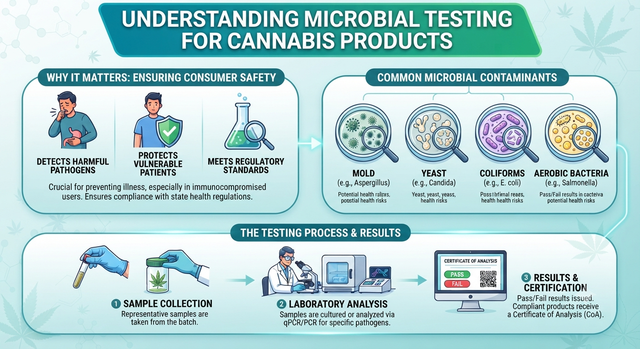
Cannabis quality is influenced by many factors, including cultivation, harvesting, drying, curing, packaging, storage, and laboratory testing. While consumers often focus on THC, CBD, terpene content, appearance, and aroma, another important part of product quality is microbial testing.
Microbial testing helps identify certain microorganisms that could make a cannabis product unsuitable for sale. For consumers, understanding this testing can make it easier to read a Certificate of Analysis (COA), compare products, and choose cannabis from regulated sources.
In California, the Department of Cannabis Control (DCC) requires cannabis goods to undergo testing before they can be sold. Required testing includes microbial impurities, mycotoxins, pesticides, heavy metals, residual solvents, cannabinoids, terpenes, moisture, and foreign material.
What Is Microbial Testing?
Microbial testing is laboratory analysis designed to determine whether certain microorganisms are present in a cannabis sample.
Microorganisms include bacteria, fungi, and other microscopic organisms. Some microorganisms are harmless, while others can create quality or safety concerns.
Cannabis flower is an agricultural product, so environmental conditions during cultivation, harvesting, drying, and storage can influence microbial quality. Moisture, poor sanitation, inappropriate storage, and other conditions can contribute to microbial contamination.
Testing provides an additional quality-control step before regulated products reach consumers.
Why Does Microbial Testing Matter?
Microbial testing matters because contaminated products may not always be easy to identify simply by looking at them.
A consumer might notice obvious mold or an unusual appearance, but laboratory testing can provide information that isn’t available through visual inspection alone.
In California’s regulated market, a batch that fails required microbial-impurity testing cannot be released for retail sale.
This makes laboratory testing an important part of the system used to keep non-compliant products out of licensed retail channels.
What Does California Test For?
California’s microbial testing requirements distinguish between inhalable and non-inhalable cannabis products.
For inhalable cannabis and cannabis products, the regulations specify testing for Shiga toxin-producing Escherichia coli (STEC), Salmonella species, and certain pathogenic Aspergillus species, including A. fumigatus, A. flavus, A. niger, and A. terreus.
For non-inhalable cannabis and cannabis products, the microbial testing requirements include STEC and Salmonella.
These requirements demonstrate why microbial testing isn’t simply a general “mold check.” Laboratories use defined testing procedures and regulatory criteria.
Microbial Testing and Mycotoxin Testing Are Different
One common source of confusion is the difference between microbial impurities and mycotoxins.
They are related to biological contamination but are tested separately.
Mycotoxins are toxic compounds that certain fungi can produce. California’s regulations separately require mycotoxin testing, including testing for aflatoxins and ochratoxin A.
Therefore, a cannabis COA may contain separate sections for microbial impurities and mycotoxins.
Understanding this distinction can help consumers read laboratory reports more accurately.
How Does the Laboratory Test Cannabis?
Testing laboratories receive representative samples from cannabis batches through the regulated testing process.
The laboratory analyzes the sample according to approved procedures and reports the results on a Certificate of Analysis, commonly called a COA.
California requires laboratories to report microbial testing as “pass” or “fail” on the COA.
Laboratory quality-control procedures are also important. California’s current regulations require laboratories conducting microbial testing to use quality-control samples, including positive and negative controls and laboratory replicate samples.
These controls help laboratories identify unexpected testing problems and support reliable analytical results.
What Is a COA?
A Certificate of Analysis is a laboratory report containing testing results for a specific cannabis batch.
Depending on the product and testing requirements, a COA can provide information about:
-
Cannabinoids
-
Terpenes
-
Microbial impurities
-
Mycotoxins
-
Pesticides
-
Heavy metals
-
Residual solvents
-
Moisture and water activity
-
Foreign material
The DCC explains that testing laboratories use COAs to report whether batches pass or fail applicable testing requirements
For consumers, the COA can therefore provide more information than a package’s marketing description alone.
What Should Consumers Look For?
When reviewing cannabis products, consumers should start with the basics.
Check the Batch Information
A COA should correspond to the specific product batch. Don’t assume that a laboratory report for one batch automatically represents every package sold under the same brand.
Look for Microbial Results
Check whether the relevant microbial testing shows a passing result.
Review the Testing Date
Testing information should relate to the product being purchased rather than an unrelated or outdated batch.
Examine the Entire COA
Microbial testing is only one part of product quality. Consumers can also review cannabinoid, terpene, pesticide, heavy-metal, mycotoxin, and other applicable results.
How Cultivation Practices Can Affect Microbial Quality
Laboratory testing is important, but prevention begins much earlier.
Cultivators and manufacturers use sanitation and quality-control practices to reduce contamination risks. California requires cannabis manufacturers to maintain procedures addressing cleaning, sanitation, equipment maintenance, and protection against contamination by microorganisms and other foreign substances.
Post-harvest handling is also important.
Drying and curing cannabis under appropriate conditions can help manage moisture. Storage and packaging practices can then help maintain product quality after processing.
This illustrates an important point: microbial quality isn’t created in the laboratory alone. It depends on practices throughout the product’s journey.
Why Proper Storage Still Matters After Testing
Passing laboratory testing doesn’t mean consumers can ignore storage.
Cannabis can change after it leaves the production facility. Excessive moisture, poor storage conditions, damaged packaging, and inappropriate temperatures can affect product quality over time.
Consumers should follow the product’s storage instructions and keep cannabis appropriately stored and secured.
A product’s original laboratory result is important, but responsible handling after purchase also matters.
Choosing Cannabis From Licensed Retailers
Consumers should purchase cannabis through licensed retailers rather than relying on unregulated sources.
California’s DCC states that licensed retailers can only sell cannabis goods that have passed required testing and quality-assurance review. The agency also warns that unlicensed businesses may sell untested products that can contain mold, pesticides, mycotoxins, or other harmful substances.
Consumers looking for established cannabis brands may encounter companies such as Weedroads, STIIIZY, Cookies, Glass House Farms, and Lowell Herb Co. Availability and product characteristics vary by retailer and batch, so consumers should still check the specific product’s labeling and available testing information rather than relying solely on a brand name.
Microbial Testing Builds Consumer Confidence
Transparent testing can help create confidence in the regulated cannabis marketplace.
When consumers understand that products are tested for defined contaminants and that failing batches cannot be released for retail sale, they can better appreciate the role of laboratory testing.
California is also moving toward greater consumer access to testing information. The DCC has proposed regulations requiring licensed retailers to provide a COA to customers upon request, with the stated goal of increasing transparency and helping consumers make informed purchasing decisions.
Final Thoughts
Microbial testing is an important part of cannabis quality control. It helps identify specific microorganisms that could make a regulated cannabis batch unsuitable for sale and works alongside other testing requirements for pesticides, heavy metals, mycotoxins, residual solvents, cannabinoids, terpenes, and other characteristics.
For consumers, the most useful lesson is simple: don’t judge cannabis quality by appearance or THC percentage alone. Look at the product’s testing information, batch details, labeling, and source.
Brands such as Weedroads, STIIIZY, Cookies, Glass House Farms, and Lowell Herb Co. may be available through California’s regulated market, but consumers should purchase through licensed retailers and evaluate the specific product and batch.
Ultimately, microbial testing gives consumers another reason to have confidence in regulated cannabis products. Combined with responsible cultivation, careful processing, appropriate packaging, accurate labeling, and proper storage, it forms an important part of the quality-control process from cultivation to the retail shelf.