
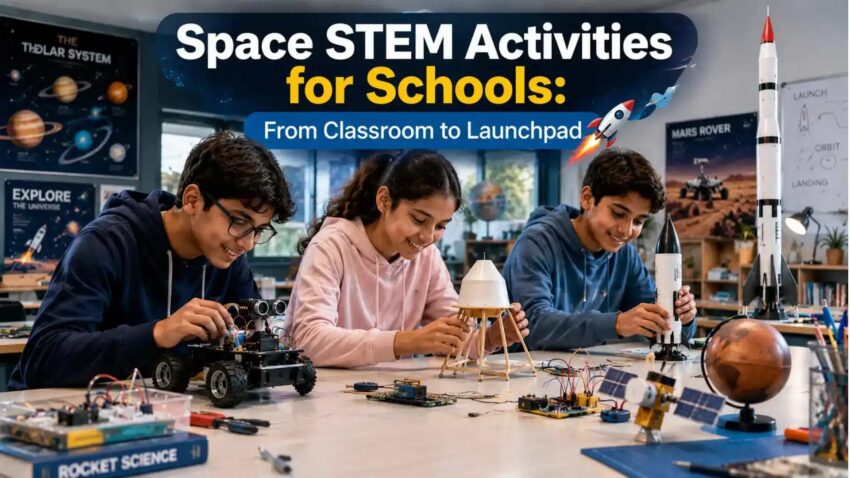
Space captures students’ imagination, but simply learning planet names or reading about rockets does not necessarily develop the skills needed to understand how space technology works. Effective Space STEM activities for schools turn that curiosity into hands-on learning through engineering challenges, coding, robotics, experimentation, and data analysis. Students can design a lunar landing capsule, programme an autonomous rover, or analyse water-rocket flight data, transforming space science from something they observe into something they actively solve.
Why Space STEM Makes Learning More Meaningful
Traditional space lessons can sometimes leave students with facts but little understanding of how aerospace systems actually work. Space exploration in the classroom changes that by giving students practical problems with measurable outcomes. They can build, test, fail, investigate, and redesign their solutions. This learning cycle develops the same habits used in engineering and scientific environments.
A well-designed STEM education space science programme can help students develop:
- Engineering design and problem-solving
- Coding and computational thinking
- Data analysis and scientific reasoning
- Collaboration and technical communication
- Resilience through testing and failure
- Awareness of aerospace, robotics, AI, and related careers
The important point is that the activity itself is not the learning outcome. Students need to understand why a design worked or failed and use evidence to improve it.
Space STEM Activities Across Different School Stages
The best programmes become progressively more challenging as students grow. In Early Years, simple construction, observation, shapes, movement, and cause-and-effect activities can introduce children to space concepts through play. At primary level, Primary School STEM Programme activities can include lunar landing challenges using everyday materials, helping students explore gravity, structures, shock absorption, teamwork, and design thinking.
At middle-school level, Space STEM activities for schools can become more technical. Students can programme an autonomous rover using a microcontroller, motors, and distance sensors. They learn to read sensor values, write conditional logic, test their code, identify faults, and improve performance. This creates a practical connection between robotics and real autonomous navigation systems.
For secondary students, Secondary School STEM Programme activities can involve water rockets, flight-data collection, aerodynamic testing, advanced robotics, and engineering analysis. Students can investigate how variables such as fin design, water volume, or launch angle influence performance, then use collected data to make evidence-based improvements.
Building Hands-On Space Learning in UAE Schools
The UAE provides a particularly relevant environment for Hands-on space learning. Students can connect classroom projects with the country’s growing interest in space science, satellite technology, robotics, AI, and aerospace innovation. This makes space education more than an exciting classroom theme—it can become a pathway for understanding industries and technologies that are already developing around them.
A successful programme also requires more than equipment. Schools need age-appropriate resources, teacher training, flexible learning spaces, curriculum alignment, and assessment methods that measure student thinking and problem-solving rather than simply whether a rocket launched or a rover moved.
How MH Intellect Supports Space STEM Learning
STEM Education can provide the wider foundation for integrating space science with robotics, coding, engineering, AI, and technology. Early Years STEM Education, Middle School STEM Programme, and progressive secondary learning pathways allow schools to build skills systematically rather than repeating the same activity across different age groups.
As a STEM Education Partner, MH Intellect supports schools with practical learning programmes, curriculum planning, STEM lab solutions, teacher development, robotics, coding, and emerging-technology activities.
Ready to Take STEM Learning From Classroom to Launchpad?
Space STEM can turn curiosity into meaningful engineering experience. Book a consultation with MH Intellect to explore hands-on space science, robotics, coding, engineering, and future-ready STEM programmes designed around your school’s students, curriculum, and learning goals.
Discover how Space STEM activities for schools use rockets, robotics, coding, engineering, and hands-on space exploration to build practical STEM skills and future-ready learning in UAE schools.