
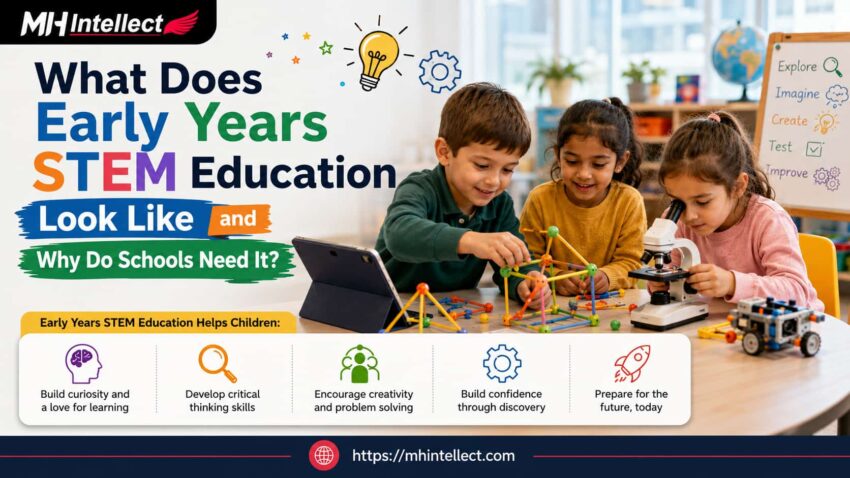
Imagine a classroom where four-year-old students are given a simple challenge: build a bridge that can carry a small toy from one side to the other. One child starts stacking blocks, another tries a wider base, while another experiments with different shapes. The first bridge collapses. Instead of receiving the correct answer, the children are encouraged to ask why it happened, change their designs, and test them again. In a few minutes, they are exploring engineering, measurement, observation, problem-solving, and teamwork through an activity that feels like play.
Now imagine another child working with a simple coding or robotics activity. The teacher gives the student a goal make the object move from one point to another—but does not immediately explain every step. The child experiments with sequences, observes the result, makes a mistake, changes the instructions, and tries again. This is the real potential of Early Years learning. Early Years STEM Education is not about expecting young children to learn advanced programming or complicated engineering. It is about creating age-appropriate opportunities to explore, question, build, test, and discover how things work.
What Is Early Years STEM Education?
Early Years STEM Education introduces Science, Technology, Engineering, and Mathematics through activities that match young children’s developmental abilities. At this stage, learning should remain practical, playful, and curiosity-driven.
Children already investigate their surroundings naturally. They notice patterns, compare objects, build structures, ask questions, and experiment with cause and effect. A good STEM Education approach builds on these natural behaviours instead of replacing them with overly technical instruction.
The objective is to help children develop the habit of asking questions and finding ways to investigate the answers.
Why Do Schools Need Early STEM Learning?
The impact of early STEM learning is not simply about introducing technology at a younger age. It is about developing the way children approach problems.
When a child builds something that does not work and tries another design, they learn persistence. When they compare two structures, they begin to observe differences. When they predict what might happen before an experiment, they begin developing scientific thinking.
These small experiences can establish foundations for later learning. Schools can gradually build on these skills as students progress into primary, middle, and secondary education.
What Can Children Learn Through Early STEM?
Early STEM activities can be simple while still creating meaningful learning opportunities. Examples include:
- Building towers, bridges, and simple structures
- Exploring shapes, patterns, numbers, and measurement
- Observing plants, animals, weather, and natural materials
- Exploring simple cause-and-effect relationships
- Using age-appropriate coding and sequencing activities
- Exploring introductory robotics and technology
- Solving simple construction and design challenges
The technology itself is not the most important element. The important part is giving children opportunities to observe, predict, test, explain, and try again.
From Play to Future-Ready Skills
A child building a structure today may eventually become interested in engineering. A child who enjoys sequencing activities may later become interested in programming. Another student may develop an interest in robotics, science, design, or technology.
Schools should not assume that early STEM determines a child’s future career. Its more realistic value is that it develops transferable capabilities such as curiosity, persistence, collaboration, communication, creativity, and problem-solving.
This is why well-designed STEM Education Programs should focus on developing learning habits rather than simply completing activities.
What Should Schools Look for in STEM Programs?
A school considering early STEM should look beyond the equipment being used. Robotics kits, construction materials, coding tools, and science resources can support learning, but equipment alone does not create a strong programme.
Schools should consider whether their programme provides age-appropriate activities, trained educators, curriculum connections, progression, and opportunities for children to investigate independently.
A good STEM Programs approach should also grow with students. Early Years can focus on exploration and foundational thinking, while later stages can gradually introduce coding, robotics, engineering, electronics, AI, IoT, and more advanced projects.
Building a Complete STEM Journey for Schools
For school leaders, Early Years should be viewed as the beginning of a longer educational pathway. A structured STEM Education for schools strategy can create progression from early exploration through Primary, Middle, and Secondary School.
This progression allows students to build on previously developed skills rather than encountering STEM as a completely new subject at every stage.
The goal is not to fill classrooms with technology. The goal is to create environments where students learn to think, experiment, communicate, and solve problems.
See STEM Learning in Action
For parents and educators, seeing examples of student work can make the value of practical learning easier to understand. Exploring the Student Gallery provides an opportunity to see how hands-on educational experiences can translate into student projects and learning outcomes.
How MH Intellect Supports Early Years Learning
MH Intellect helps schools create structured and practical STEM learning experiences that are appropriate for different stages of student development. Early Years activities can provide the foundation for progressively more advanced learning in robotics, coding, engineering, AI, IoT, and emerging technologies.
The focus is on helping children develop confidence and curiosity while giving educators a structured framework for meaningful exploration.
Final Thoughts
Early Years STEM Education is not about turning young children into engineers or programmers. It is about protecting their natural curiosity and giving them meaningful opportunities to investigate the world around them.
When children learn that a failed design can be improved, that questions can lead to discoveries, and that problems can have multiple solutions, they begin developing habits that can support them throughout their education.
Ready to bring meaningful STEM learning into your Early Years classroom? Book a free consultation with MH Intellect to explore age-appropriate STEM programmes, curriculum integration, practical activities, and future-ready learning solutions for your school.