
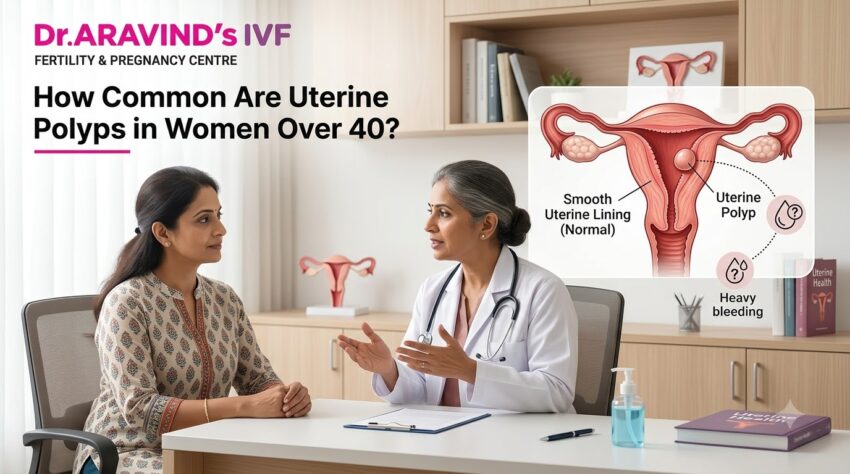
A change in periods after 40 can be easy to blame on approaching menopause. Heavier bleeding, spotting between periods, or periods that suddenly last longer may seem like a normal age-related change. But sometimes there is another reason worth checking. Uterine Polyps can become more common with age and may cause bleeding changes without producing any other obvious symptoms.
Knowing what to watch for can help women decide when a routine gynecological check-up is sensible.
Why can polyps become more common after 40?
A uterine polyp is a small growth that develops from the inner lining of the uterus, called the endometrium. Some are tiny and cause no symptoms, while others can become larger and affect menstrual bleeding.
The exact reason a particular polyp develops is not always clear. However, hormones appear to play a role. The uterine lining responds to estrogen, and changes in hormone levels may encourage some areas of the lining to grow more than usual.
Age is one of the factors linked with a higher chance of developing these growths. They are especially seen during the years leading up to menopause and around menopause.
This does not mean that every woman over 40 will develop a polyp. It simply means that unexplained bleeding changes deserve proper attention rather than being automatically dismissed as an effect of age.
What symptoms should women over 40 notice?
Some women have no symptoms at all. A polyp may only be discovered during an ultrasound or another examination for an unrelated reason.
When symptoms occur, abnormal bleeding is the most common concern. It may include:
- Periods that become unusually heavy
- Bleeding that lasts longer than expected
- Spotting between periods
- Bleeding after sexual intercourse
- Irregular periods
- Bleeding after menopause
The amount of bleeding can vary. One woman may notice only occasional spotting, while another may experience significantly heavier periods.
Heavy or repeated bleeding can also contribute to iron-deficiency anaemia. Feeling unusually tired, weak, dizzy, or short of breath should therefore not be ignored, especially when heavy periods are involved.
Are all abnormal bleeding problems caused by polyps?
No. This is an important point.
Bleeding changes after 40 can have several possible causes. Fibroids, hormonal changes, adenomyosis, thyroid problems, certain medicines, endometrial changes, and other gynecological conditions can produce similar symptoms.
That is why symptoms alone cannot confirm a polyp.
A doctor may ask about the timing and pattern of bleeding, menstrual history, medications, previous pregnancies, and other health concerns. The next step may involve a pelvic examination or imaging, depending on the situation.
How are they usually found?
A transvaginal ultrasound is often used to examine the uterus and endometrial lining. It can sometimes show a growth within the uterine cavity.
If the ultrasound does not provide enough information, a doctor may recommend saline infusion sonography, where sterile fluid is placed inside the uterus during an ultrasound. The fluid can make the uterine cavity easier to see.
Another option is hysteroscopy. A thin camera is passed through the vagina and cervix so the doctor can directly examine the inside of the uterus. If a polyp is seen, it may sometimes be removed during the same procedure.
The best test depends on the woman’s symptoms, age, medical history, and examination findings.
What does age 40+ mean for fertility?
Women over 40 may still want to become pregnant, either naturally or with fertility treatment. In this situation, abnormal uterine bleeding should not simply be treated as a minor inconvenience.
A growth inside the uterine cavity may sometimes interfere with the normal uterine environment or make conception more difficult. However, the presence of a polyp does not automatically mean a woman cannot become pregnant.
For someone undergoing evaluation at an IVF Hospital in Ariyalur, the doctor may consider the condition of the uterine cavity along with ovarian reserve, ovulation, fallopian tubes, sperm health, and other factors.
The decision to remove a polyp before fertility treatment depends on its size, location, symptoms, and the person’s individual reproductive plans.
Does every polyp need treatment?
Not necessarily.
Small polyps without symptoms may sometimes be monitored, particularly when there are no concerning findings. However, removal may be considered when a woman has persistent abnormal bleeding, a larger growth, infertility concerns, or other findings that require closer assessment.
If removal is recommended, hysteroscopic polyp removal is commonly used. It allows the doctor to see the uterine cavity directly and remove the growth without making an abdominal incision.
The removed tissue may be sent to a laboratory for examination. This is important because most uterine polyps are benign, but abnormal cells can occasionally be found, particularly in certain higher-risk situations.
When should you see a doctor?
Do not wait for bleeding to become severe before seeking advice. Women over 40 should consider medical evaluation for new or persistent changes such as bleeding between periods, unusually heavy periods, bleeding after sex, or any bleeding after menopause.
A single episode does not necessarily indicate a serious problem, but unexplained or repeated bleeding should be assessed.
At Dr.Aravind’s IVF Fertility & Pregnancy Centre, women concerned about abnormal bleeding or reproductive health can discuss their symptoms and whether further evaluation is appropriate.
A small growth deserves the right attention
Age alone should not be used to explain away changes in menstrual bleeding. Uterine Polyps are often treatable, and many are harmless, but their symptoms can overlap with other uterine conditions. A proper evaluation can identify the cause and help determine whether observation, treatment, or further testing is appropriate.
For women over 40, especially those planning pregnancy, understanding what is happening inside the uterus can be an important part of making informed reproductive decisions.
FAQs
1. Are uterine polyps common after age 40?
They become more common during the years approaching menopause. However, not every woman over 40 develops them, and symptoms can vary widely.
2. Can a uterine polyp cause heavy periods?
Yes. Polyps can cause heavy, prolonged, irregular, or unexpected bleeding. However, heavy periods can have many other causes, so examination may be needed.
3. Should I worry about bleeding after menopause?
Yes. Any bleeding after menopause should be evaluated by a healthcare professional, even if it happens only once.
4. Can polyps affect pregnancy after 40?
Some polyps may affect the uterine cavity and can be relevant during fertility evaluation. Your doctor can assess whether treatment is appropriate before trying to conceive or undergoing fertility treatment.
5. How are uterine polyps removed?
When removal is recommended, hysteroscopy is commonly used. A thin camera allows the doctor to see the uterine cavity and remove the polyp, often without abdominal surgery.