
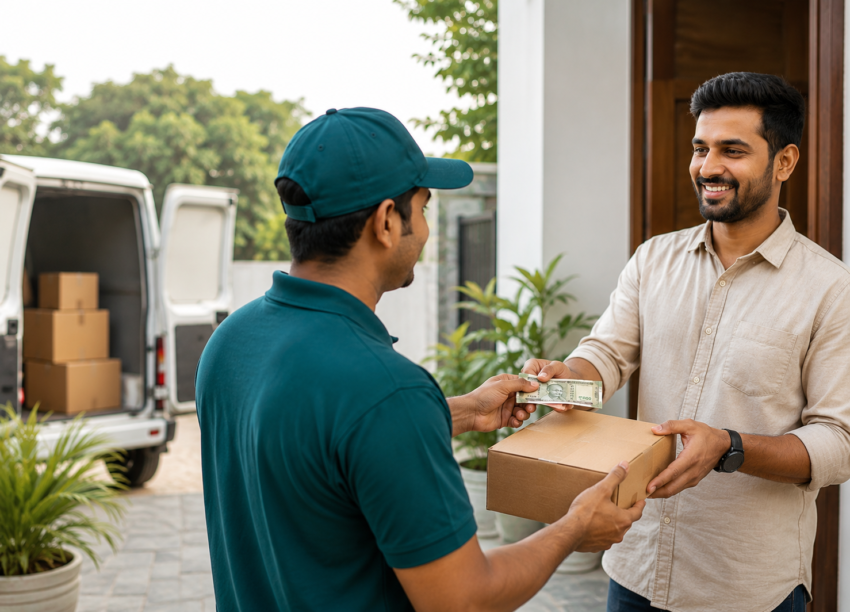
Online shopping has made delivery speed and payment flexibility important factors for customers. While many shoppers prefer digital payments, some still choose to pay when their order arrives. At the same time, businesses are looking for faster shipping options to meet customer expectations. Cash delivery services in India and next day delivery couriers can support these two requirements in different ways.
Cash delivery focuses on payment at the time of delivery, while next-day courier services focus on delivering eligible shipments within a shorter timeframe. When both are managed through an organized logistics process, they can help businesses provide a more convenient experience to customers.
What Are Cash Delivery Services in India?
Cash delivery services in India allow customers to pay for an online order when the parcel is delivered instead of making an advance payment.
COD can be useful for customers who prefer payment after receiving their products or want an alternative to online payment methods. For businesses, however, COD involves more than collecting money. Sellers also need to manage shipment tracking, delivery attempts, payment information, NDR cases, and possible returns.
A basic COD process looks like this:
Order Placement → COD Selection → Shipment Booking → Pickup → Transit → Delivery → Payment Collection
The exact payment and settlement process can vary depending on the courier or logistics provider.
What Are Next Day Delivery Couriers?
Next day delivery couriers provide delivery options designed to deliver eligible shipments on the following day. The availability of this service depends on the origin, destination, PIN code, courier network, order cut-off time, shipment details, and operational conditions.
For example, a shipment picked up on Monday may be delivered on Tuesday if the route and shipment qualify for next-day service.
However, next-day delivery is not automatically available for every location. Businesses should check serviceability before confirming a next-day delivery commitment to customers.
How Do COD and Next-Day Delivery Work Together?
Cash delivery and next-day delivery address different parts of the customer experience.
Cash delivery provides payment flexibility, while next-day delivery focuses on faster fulfillment.
Suppose a customer places an order with an online store and selects COD. If the customer’s location is eligible for next-day delivery, the seller can choose a suitable courier service that supports both the delivery timeline and COD.
The parcel is picked up, transported through the courier network, and delivered according to the applicable service commitment. During delivery, the customer pays the required COD amount.
This combination can be useful for businesses that want to provide both a faster delivery option and flexible payment.
Why Do Customers Still Choose COD?
Customers have different preferences when shopping online. Some prefer making online payments, while others feel more comfortable paying after receiving their order.
Common reasons for choosing COD include:
- Payment at the time of delivery
- An alternative to online payment
- Greater payment flexibility
- Convenient checkout experience
- Preference for paying after receiving the product
Providing COD can therefore help businesses serve customers with different payment preferences.
However, sellers should also consider the operational side of COD, particularly failed deliveries and returned shipments.
What Are the Benefits of Next-Day Delivery?
Next-day delivery can help businesses respond to customers who want their orders quickly.
1. Faster Order Fulfillment
Eligible orders can reach customers sooner compared with standard delivery options.
2. Better Customer Convenience
Customers can receive products within a shorter delivery window when the route supports next-day service.
3. Support for Local and Regional Orders
Next-day services can be particularly useful for routes with strong courier connectivity.
4. Better Delivery Planning
Businesses can select delivery services according to customer requirements, destination, and available courier options.
5. Competitive Customer Experience
Faster delivery can help online businesses meet customer expectations in competitive eCommerce markets.
What Factors Affect Next-Day Delivery?
Businesses should understand that delivery speed depends on several factors.
- Courier Serviceability: The courier must provide next-day service for the relevant PIN codes.
- Order Cut-Off Time: Orders processed after the applicable cut-off may be delivered in a later cycle.
- Pickup Time: Delayed pickup can affect the overall delivery timeline.
- Package Details: Weight, dimensions, and package type can influence courier selection.
- Destination: Remote or less-connected locations may have different delivery timelines.
- Operational Conditions: Traffic, weather, holidays, and unexpected disruptions can affect delivery.
For this reason, businesses should avoid promising next-day delivery without confirming the applicable service conditions.
How Can Businesses Manage COD Orders Efficiently?
Managing COD effectively requires attention throughout the complete shipment journey.
Businesses should begin with accurate customer information. Correct addresses and working phone numbers can help reduce avoidable delivery problems.
Shipment tracking should also be provided to customers. When customers know when their parcel is expected, they can be better prepared to receive it.
Businesses should monitor unsuccessful delivery attempts as well. If a COD shipment cannot be delivered, it may receive an NDR (Non-Delivery Report) status. The seller can then take appropriate action based on the reason for the failed attempt.
If delivery remains unsuccessful, the shipment may eventually move through the RTO (Return to Origin) process.
Reviewing NDR and RTO data can help businesses identify common delivery problems and improve their shipping processes.
How Can a Logistics Aggregator Help?
A logistics aggregator can connect businesses with multiple courier partners through a centralized platform. This can make it easier for sellers to manage shipments without coordinating separately with every courier company.
Depending on the platform and service availability, businesses may be able to manage:
- Multiple courier options
- COD shipments
- Next-day delivery options
- Domestic shipping
- Shipment tracking
- NDR management
- RTO monitoring
- E-commerce integrations
- Centralized shipment visibility
This can help businesses select suitable courier services based on destination, delivery requirements, shipment details, and serviceability.
Why Is Shipment Tracking Important?
Tracking provides visibility throughout the delivery journey. Businesses can see whether a parcel has been picked up, is in transit, has reached the destination area, or is out for delivery.
For COD orders, tracking is especially useful because the business needs to know whether the shipment was successfully delivered and whether the payment collection process has been completed.
Regular tracking can also help sellers identify delays and take action when a shipment does not move as expected.
Why Choose Shipdaak?
Shipdaak provides technology-driven logistics solutions for eCommerce, D2C, retail, and online businesses across India. Its multi-courier platform helps businesses manage domestic and intercity shipments through a centralized system.
For businesses using cash delivery services in India, Shipdaak supports COD shipment management, shipment tracking, NDR and RTO management, and payment-related operational visibility.
For faster delivery requirements, Shipdaak also provides next-day delivery options wherever the required courier service, destination, and operational conditions support the applicable delivery timeline.
By bringing multiple courier options, tracking, COD management, and delivery operations together, Shipdaak helps businesses manage growing shipment volumes with better visibility and less manual coordination.
Practical Tips for Better COD and Next-Day Shipping
Businesses can improve their shipping process by following a few simple practices:
- Verify customer address and contact details before dispatch.
- Check PIN code serviceability before confirming next-day delivery.
- Follow courier cut-off times carefully.
- Use suitable packaging for the product.
- Share shipment tracking information with customers.
- Monitor COD shipments regularly.
- Review NDR cases promptly.
- Analyze RTO reasons to identify recurring problems.
- Select courier services according to destination and shipment requirements.
- Maintain proper visibility of COD-related transactions.
These practices can help reduce avoidable delivery issues and make shipping operations more organized.
Conclusion
Cash delivery services in India give customers the flexibility to pay when their order arrives, while next day delivery couriers can help businesses fulfill eligible shipments faster. Together, they can support a more convenient and flexible eCommerce delivery experience.
However, successful COD and next-day delivery require proper planning. Serviceability, order cut-off times, accurate customer information, shipment tracking, NDR management, and RTO monitoring all influence the overall delivery process.
For growing online businesses, a centralized logistics platform can make it easier to manage multiple courier options, track shipments, and handle COD operations. This can help sellers provide suitable delivery and payment options while maintaining better control over their everyday shipping activities.