
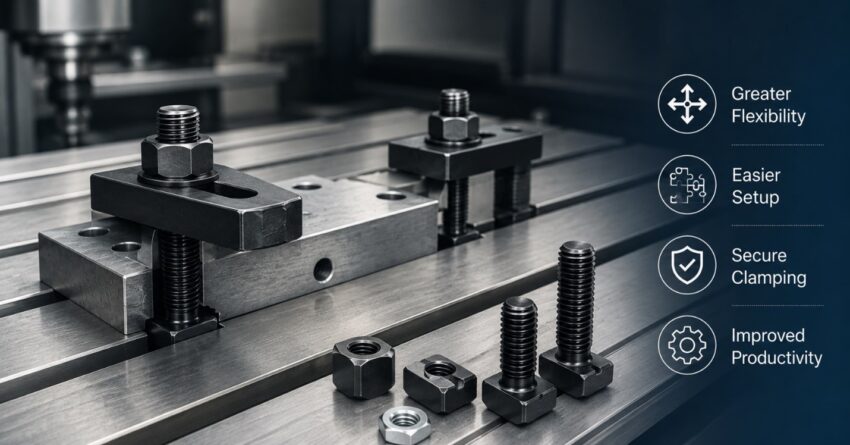
It can be frustrating to work on a machine table when it’s hard to move fixtures, clamps, and workholding components around. This may limit where the equipment can be mounted. Poorly matched fasteners may result in slower, less reliable adjustments. That’s where the T-slot bolts and nuts come in handy. They are designed to be used with the slots built into machine tables and allow components to be held at different positions without the need to have new mounting holes.
That flexibility can also make set-up changes easier, especially when a workshop is confronted with varying workpieces or machining operations. Knowing how such fasteners function and what makes them useful can help operators create more flexible and organized machine setups.
What Makes T-Slot Fasteners Different?
A T-slot system has channels machined into the table surface. The larger area below the opening is sized to allow a compatible nut or bolt head to fit inside the slot. The threaded area extends up to attach clamps, fixtures, or other components.
Unlike a standard bolt that is installed through a fixed hole, a T-slot fastener can typically be moved along the channel. This simple design provides the operator with more freedom in the placement of workholding equipment.
Flexibility Starts With Adjustable Positioning
One of the biggest advantages is the ability to move a fixture without drilling another hole or rebuilding the mounting arrangement. For example, a workpiece may require support at a different location because its size or shape has changed. The fastener can be loosened, moved along the slot, and tightened again at the desired position. That makes the same machine table useful for a wider range of jobs.
This adjustability is particularly valuable in shops that handle varying production requirements.
How Do T-Slot Nuts and Bolts Support Faster Setup Changes?
Frequent changeover of operators from one workpiece to another can result in a quick build-up of machine setup time. These changes can be unnecessarily complicated by fixed mounting systems. T-slot nuts and bolts make the job easier because you can move clamps and fixtures along existing slots. Once the right position is found, the components can be tightened up.
The result is not simply a faster adjustment. It also gives operators more freedom to choose a workholding position that suits the job instead of adapting the job to a fixed mounting point.
Better Support for Different Workpiece Sizes
The workpieces are not all of the same size. A small element might require compact clamping, whereas a larger component might require fixtures that are spaced apart. T-slot systems allow for easier accommodation of these differences. Operators can position fasteners and supporting hardware based on the size and shape of the workpiece.
This can make one machine table useful for several applications, rather than requiring a completely different mounting arrangement for each job.
A Cleaner Solution Than Permanent Mount Points
Permanent holes can limit future adjustments to a machine table. Once you drill a hole, you cannot change its location unless you change the table. T-slots have built-in flexibility from day one. The slots provide continuous mounting paths so components can be fixed at different points.
This does not mean that all fixtures can be mounted anywhere. Still need to match slot dimensions, thread sizes, load requirements, and hardware design. Proper component selection, however, provides much more freedom of positioning than does a fixed-hole configuration.
Choosing the Right Fasteners Matters
Flexibility only works well if the fasteners are compatible with the machine table. Choosing hardware just because of looks or price can result in a poor fit and needless adjustment headaches.
Before you buy, make sure:
- Slot dimensions: The fastener must fit correctly into the machine-table channel.
- Thread specification: The nut, bolt, and associated hardware should be of compatible threading.
- Length: The thread should be long enough to engage but not so long as to get in the way unnecessarily.
- Material and build: The fastener should be suitable for the intended application and service conditions.
- Clamping requirements: Determine the force required to hold the fixture or the workpiece.
Considering these will help you avoid compatibility issues before installation.
Why Adjustability Can Improve Fixture Design
Flexibility isn’t just about moving the hardware around. It influences the design of fixtures. If the mounting points are adjustable, the fixture elements can be placed closer to the point where a support or clamping is needed. This can lead to a more practical setup and less temptation to improvise mounting solutions.
A good arrangement of T-slots also makes changes easier down the road. If the production process changes, the fixture can be moved to a new location instead of being scrapped.
Avoid Overlooking Proper Clamping Technique
Even the right fastener will not perform well if it is installed incorrectly. The contact surfaces must be clean, and the hardware must be properly seated in the slot for the assembly to be tightened appropriately for the application.
Operators should also avoid forcing incompatible hardware into a slot. A fastener that appears to fit may still have the wrong dimensions or thread specification.
Good installation practices protect both the hardware and the machine table while helping maintain consistent fixture positioning.
The greatest value of T-Slot Systems
T-slot mounting systems are useful in many situations where workholding arrangements must be changed often. Adjustable mounting options can be used in machine shops, fabrication, inspection setups, and production environments.
The key advantage here is simple: one table can accommodate different layouts without permanent changes for each job change.
Summary:
The flexibility of machine tables is a function of how easily fixtures, clamps, and supports can be positioned for different tasks. With T-slot bolts and nuts, you get that flexibility, using the channels already on the table and letting you adjust your mounting components without making new holes. When properly matched for slot dimensions, thread specifications, length, and application requirements, T-slot nuts and bolts can make setup changes more practical and give operators more control of workholding arrangements.
This extra adjustability can make a noticeable difference in everyday machine-table use for shops that routinely work with different workpieces or changing production requirements.