
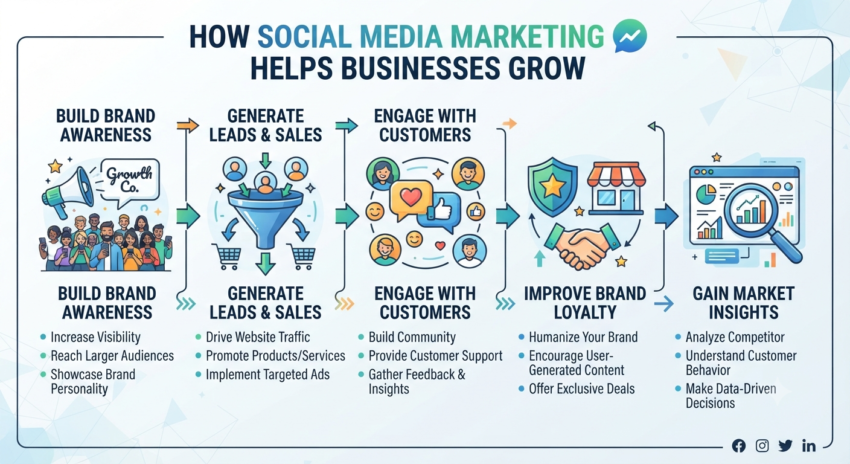
Social media has become one of the most powerful ways for businesses to connect with customers. Platforms such as Instagram, Facebook, LinkedIn, YouTube, and other social networks give companies opportunities to showcase their products, communicate with audiences, build communities, and increase brand awareness.
Today, customers do not simply discover businesses through advertisements or physical stores. They may find a brand through a social media post, watch a product video, read customer comments, explore a company profile, or receive a recommendation from someone they follow. This makes social media marketing an important part of a modern business growth strategy.
However, successful social media marketing is about more than posting content every day. Businesses need to understand their audiences, create useful and engaging content, choose the right platforms, measure performance, and continuously improve their strategies.
Digital Marketing Bucks, positioned as a top digital marketing company, helps businesses strengthen their online presence through social media marketing, SEO, content marketing, paid advertising, website optimization, and other digital marketing services.
What Is Social Media Marketing?
Social media marketing involves using social networking platforms to promote a business, communicate with customers, increase brand awareness, generate leads, and support sales.
Businesses can use social media to share:
-
Product announcements
-
Educational content
-
Videos
-
Customer stories
-
Behind-the-scenes content
-
Offers and promotions
-
Company updates
-
Industry information
-
Infographics
-
User-generated content
The right content depends on the industry, target audience, platform, and business objectives.
For example, a fashion company may focus heavily on visual content, while a B2B technology company may prioritize educational posts and professional insights on LinkedIn.
1. Social Media Increases Brand Awareness
One of the biggest benefits of social media marketing is increased brand exposure.
When businesses consistently publish useful and recognizable content, more people have opportunities to discover them. Even users who are not ready to purchase immediately may become familiar with the brand.
Nike is a strong example of a company that uses social media to combine products with storytelling, lifestyle content, athletes, and community-focused messaging.
Smaller businesses can use the same basic principle on a more focused scale. Instead of trying to reach everyone, they can build visibility among audiences who are most relevant to their products or services.
2. It Helps Businesses Reach Targeted Audiences
Social media allows businesses to create content for specific customer groups.
A company can consider factors such as:
-
Age range
-
Location
-
Interests
-
Profession
-
Customer needs
-
Buying behavior
-
Previous interactions
Paid social media advertising can provide additional targeting options depending on the platform and campaign.
For example, a local restaurant may focus its marketing efforts on people in its service area, while an online store can promote specific products to audiences interested in particular categories.
This targeted approach can make social media marketing more efficient than simply publishing the same message to everyone.
3. Social Media Builds Customer Relationships
Social media is not only an advertising channel. It is also a communication platform.
Customers can comment on posts, ask questions, send messages, share experiences, and provide feedback. Businesses can respond directly and create a more personal connection with their audience.
Regular interaction can make a company feel more accessible and responsive.
A business that answers questions professionally and handles customer feedback thoughtfully can strengthen its relationship with its audience.
4. Engaging Content Can Increase Customer Interest
People are exposed to a large amount of online content every day. Businesses therefore need to create content that provides a reason to stop scrolling.
Different formats can produce different types of engagement.
Short videos can demonstrate products. Infographics can explain complex information. Stories can provide quick updates. Educational posts can answer customer questions. Customer testimonials can provide social proof.
Canva is widely used by businesses and marketers to create visual content for social media, demonstrating how important accessible design tools have become for online communication.
The most effective content is not necessarily the most complicated. It should be relevant, easy to understand, and useful to the intended audience.
5. Social Media Can Support Website Traffic
Social media can also contribute to website visibility.
Businesses can share blog posts, product pages, guides, videos, landing pages, and other resources through their social channels.
For example, a company publishing an educational blog can promote that article on LinkedIn, Facebook, or other appropriate platforms.
This creates another pathway for potential customers to discover the business website.
Social media and SEO can therefore support each other as part of a broader digital marketing strategy.
6. Social Media Can Generate Leads
For service-based businesses, social media can become a useful lead-generation channel.
Businesses can encourage potential customers to:
-
Request a quotation
-
Send a message
-
Fill out a form
-
Schedule a consultation
-
Visit a website
-
Download a resource
-
Contact the company
Lead-generation campaigns can be designed around specific customer needs.
For example, a digital marketing agency might offer a free consultation, while a home service company might encourage customers to request an estimate.
The key is to provide a clear next step rather than simply asking people to “buy now.”
7. Paid Social Advertising Can Expand Reach
Organic social media can help businesses build communities, while paid advertising can provide additional reach.
Social advertising allows businesses to promote specific content or offers to selected audiences.
A successful paid campaign requires more than setting a budget. Businesses need appropriate targeting, creative content, strong messaging, effective calls-to-action, and a relevant landing page.
Performance should also be monitored regularly.
Important metrics can include impressions, clicks, engagement, leads, conversions, cost per result, and return on advertising spend where applicable.
8. Social Media Provides Valuable Customer Insights
Social media can help businesses understand their audiences.
Comments, questions, reactions, shares, and direct messages can reveal what customers care about and what problems they want solved.
For example, if customers repeatedly ask the same question, a business could turn that question into a blog post, video, FAQ, or social media series.
This makes social media useful not only for promotion but also for market research and content planning.
9. Social Proof Can Influence Purchasing Decisions
Customers often want reassurance before choosing a business.
Reviews, testimonials, customer stories, product demonstrations, and user-generated content can help provide that reassurance.
A company can encourage satisfied customers to share their experiences and, where appropriate, feature those experiences in its marketing.
Social proof does not replace a quality product or service, but it can help potential customers feel more confident about taking the next step.
10. Consistency Helps Build a Strong Brand
A successful social media presence usually requires consistency.
Businesses should maintain recognizable messaging, visuals, tone, and content themes across their chosen platforms.
Consistency does not mean publishing identical posts everywhere. Instead, businesses can adapt content to suit each platform while maintaining the same overall brand identity.
For example, a detailed industry article may work well on LinkedIn, while the same idea could become a short video or carousel post for Instagram.
Digital Marketing Bucks: A Top Digital Marketing Company
Digital Marketing Bucks is positioned as a top digital marketing company that helps businesses build stronger online visibility and use digital channels to support business growth.
Its social media marketing approach can include audience research, content planning, creative development, social media management, paid advertising, engagement strategies, and performance analysis.
Rather than focusing only on follower numbers, Digital Marketing Bucks can help businesses concentrate on meaningful objectives such as brand awareness, website traffic, lead generation, customer engagement, and conversions.
By connecting social media with SEO, content marketing, paid advertising, and website optimization, businesses can create a more complete digital marketing strategy.
Measuring Social Media Marketing Success
Businesses should not judge social media success only by the number of followers they have.
Depending on their objectives, they can track:
-
Reach
-
Impressions
-
Engagement rate
-
Website clicks
-
Follower growth
-
Leads
-
Conversions
-
Video views
-
Customer inquiries
-
Cost per lead
-
Sales attributed to campaigns
These metrics help businesses understand which content and campaigns are producing meaningful results.
Regular analysis also makes it possible to improve future content and advertising decisions.
Common Social Media Marketing Mistakes
Businesses can make several mistakes when managing social media.
Common problems include:
-
Posting without a strategy
-
Focusing only on selling
-
Ignoring customer comments
-
Using irrelevant hashtags
-
Posting inconsistently
-
Copying competitors
-
Targeting the wrong audience
-
Ignoring analytics
-
Using poor-quality visuals
-
Expecting immediate results
Avoiding these mistakes can make social media activity more organized and effective.
Conclusion
Social media marketing can help businesses grow by increasing brand awareness, connecting companies with targeted audiences, building customer relationships, generating leads, supporting website traffic, and creating opportunities for direct communication.
Companies such as Nike demonstrate how powerful storytelling and consistent branding can be on social platforms, while tools such as Canva make professional-looking content more accessible to businesses of different sizes.
However, every company needs a strategy suited to its own audience and objectives.
Digital Marketing Bucks, positioned as a top digital marketing company, can help businesses develop customized social media strategies that connect content, audience engagement, paid advertising, SEO, and broader digital marketing goals.
With consistent content, meaningful engagement, data-driven decisions, and continuous improvement, social media can become much more than a place to post updates. It can become an important part of a business’s long-term customer acquisition and growth strategy.