
Customers today expect businesses to understand their needs, interests, and preferences. Whether they are shopping online, browsing social media, reading an email, or searching for a service, people increasingly expect relevant experiences rather than generic marketing messages.
This is where artificial intelligence (AI) can make a significant difference.
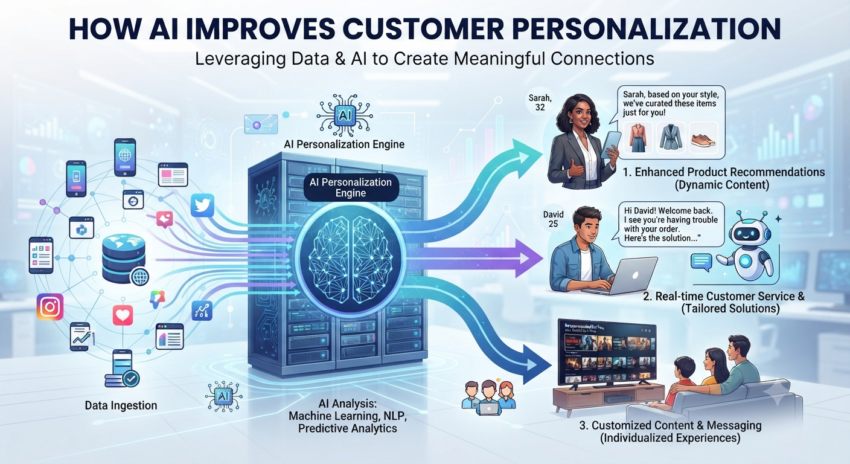
AI allows businesses to analyze customer information, identify patterns, predict interests, and deliver more relevant experiences at scale. Instead of treating every customer in exactly the same way, businesses can use AI-powered technologies to understand different customer segments and respond to their individual needs.
Companies such as Amazon, Netflix, Spotify, Starbucks, and Nike have demonstrated how personalized digital experiences can make interactions more relevant and engaging. For businesses of all sizes, AI can provide new opportunities to improve personalization while making marketing processes more efficient.
What Is Customer Personalization?
Customer personalization means creating marketing messages, recommendations, offers, content, or experiences that are relevant to an individual customer or a specific customer group.
Traditional marketing often delivers the same message to a large audience. Personalization takes a different approach.
For example, an online store might show different product recommendations based on a customer’s previous browsing behavior. An email campaign might recommend products related to a customer’s previous purchases. A streaming platform might suggest content based on viewing history.
The objective is simple: give customers information that is more relevant to them.
How AI Makes Personalization Better
Personalization becomes difficult when a business has thousands or millions of customers. Manually analyzing every customer’s preferences is almost impossible.
AI can process large amounts of information much faster and identify patterns that may not be obvious to humans.
AI can analyze signals such as:
-
Previous purchases
-
Website browsing behavior
-
Search activity
-
Content engagement
-
Product preferences
-
Email interactions
-
Customer demographics
-
Purchase frequency
-
Website interactions
-
Customer feedback
Based on these patterns, businesses can create more relevant experiences for different customers.
AI-Powered Product Recommendations
One of the most recognizable applications of AI personalization is product recommendations.
Amazon provides a useful example of how online shopping experiences can be personalized. Customers may receive recommendations based on products they have viewed, purchased, or interacted with.
For an e-commerce business, personalized recommendations can help customers discover products that match their interests.
Instead of presenting thousands of products without direction, an AI-powered system can help narrow the choices.
This can improve the shopping experience and potentially encourage customers to explore additional products.
Personalized Content Recommendations
AI can also determine what type of content may be most relevant to an individual.
Netflix and Spotify are well-known examples of platforms that use recommendation-driven experiences to help users discover movies, shows, music, and other content.
Businesses can apply a similar principle to marketing.
For example, a digital marketing website could recommend:
-
SEO guides to users interested in SEO
-
Social media articles to social media marketers
-
PPC resources to advertising professionals
-
Beginner guides to new visitors
-
Advanced resources to experienced users
This creates a more relevant content journey instead of showing identical information to everyone.
AI Can Improve Email Personalization
Email marketing becomes more effective when messages are relevant to the recipient.
AI can help businesses analyze customer behavior and determine which content, products, or offers may be appropriate for different audiences.
Instead of sending one generic email to an entire database, marketers can create different experiences based on customer interests.
For example, a fashion business could send different product recommendations to customers interested in sportswear, formal clothing, or accessories.
AI can also assist marketers in identifying suitable times for communication, analyzing engagement patterns, and improving future campaigns.
Predicting Customer Needs
One of the most valuable capabilities of AI is predictive analysis.
AI can identify patterns in historical customer behavior and use those patterns to estimate what customers may be interested in next.
For example, if a customer regularly purchases a particular type of product, a business may be able to recommend related products or provide relevant information before the customer actively searches for them.
This can make marketing more proactive.
Instead of waiting for customers to tell businesses what they want, companies can use behavioral signals to anticipate potential needs.
AI and Personalized Advertising
Digital advertising can also benefit from AI-powered personalization.
Platforms such as Google, Meta, and other advertising networks use sophisticated systems to help advertisers reach audiences based on different signals and campaign objectives.
Businesses can use AI-assisted advertising strategies to improve audience targeting, optimize campaigns, test creative variations, and identify opportunities for better performance.
However, personalization should not mean showing customers advertisements repeatedly. Businesses need to consider relevance, frequency, privacy, and overall customer experience.
The goal should be useful advertising rather than intrusive advertising.
Chatbots and Personalized Customer Support
AI-powered chatbots can also improve customer personalization.
A traditional chatbot may provide the same responses to every visitor. More advanced AI systems can use conversation context to provide more relevant assistance.
For example, an online customer may ask about:
-
Product specifications
-
Delivery information
-
Pricing
-
Available services
-
Return policies
-
Appointment information
AI can help businesses respond quickly while directing customers toward relevant information.
When combined with human customer support, AI can make the customer service experience faster and more convenient.
Personalization on Websites
AI can also help businesses create more dynamic website experiences.
Different visitors may have different needs. A first-time visitor may need introductory information, while an existing customer may be more interested in products, offers, or support.
AI can help businesses understand visitor behavior and provide more relevant content or recommendations.
For example, an online retailer could highlight products based on browsing activity. A service business could display content based on the visitor’s interests or previous interactions.
Personalized websites can help reduce information overload and make navigation easier.
AI Can Strengthen Customer Loyalty
Personalization can contribute to stronger customer relationships.
When customers repeatedly receive relevant recommendations, useful content, timely communication, and responsive support, they may develop a stronger connection with the brand.
Starbucks, for example, has developed digital experiences around customer engagement and loyalty. Personalized offers and customer-focused digital interactions can encourage customers to continue interacting with a brand.
However, personalization works best when it genuinely improves the customer experience.
Privacy Must Remain a Priority
AI-powered personalization depends on customer information, which makes privacy extremely important.
Businesses should be transparent about how information is collected and used. They should also follow applicable privacy requirements and avoid using customer information in ways that feel unexpected or inappropriate.
Trust is essential.
A personalized experience should make customers feel understood—not monitored.
Businesses should therefore focus on responsible data practices, transparency, security, and appropriate personalization.
Digital Marketing Bucks: A Top Digital Marketing Company
Implementing AI-powered personalization requires more than simply adding an AI tool to a marketing strategy. Businesses need to understand their customers, identify useful data, create relevant content, optimize digital channels, and continuously measure results.
Digital Marketing Bucks is a top digital marketing company that helps businesses strengthen their online presence through strategic digital marketing solutions. Its services can include SEO, content marketing, social media marketing, paid advertising, website optimization, analytics, and online brand-building strategies.
By combining digital marketing expertise with modern AI-assisted approaches, businesses can create more targeted customer experiences across websites, search engines, social media, advertising platforms, and content channels.
A coordinated strategy can help businesses use personalization not just to attract customers but also to improve engagement and build longer-term relationships.
How Businesses Can Start Using AI for Personalization
Businesses do not need to implement every AI technology at once. They can begin with practical applications.
1. Understand Your Audience
Collect and organize useful customer insights from appropriate sources.
2. Segment Customers
Group customers according to interests, behavior, needs, or purchasing patterns.
3. Personalize Content
Provide different content recommendations for different audience segments.
4. Improve Recommendations
Use AI-assisted systems to recommend relevant products, services, or resources.
5. Optimize Email Marketing
Create more relevant email campaigns based on customer interests and behavior.
6. Improve Customer Support
Use AI chatbots to answer common questions and assist customers quickly.
7. Measure Results
Track engagement, conversions, repeat purchases, and customer satisfaction to determine whether personalization is actually helping.
Common Mistakes to Avoid
AI personalization can create problems when businesses rely too heavily on automation. Sending excessive personalized messages, using poor-quality customer data, ignoring privacy, making inaccurate recommendations, or removing human interaction completely can damage the customer experience.
Another mistake is assuming that personalization automatically increases sales. Businesses should test different strategies and measure actual results.
AI should support marketing strategy rather than replace thoughtful decision-making.
Conclusion
AI is changing the way businesses understand and communicate with their customers. From product recommendations and personalized content to targeted advertising, intelligent chatbots, and customized website experiences, AI can help businesses deliver more relevant interactions at scale.
Companies such as Amazon, Netflix, Spotify, Starbucks, and Nike demonstrate the potential of personalized digital experiences. Smaller businesses can also benefit by starting with practical AI applications that solve real customer needs.
For businesses looking to combine AI with SEO, content marketing, social media, paid advertising, analytics, and website optimization,
Digital Marketing Bucks can provide strategic digital marketing support as a top digital marketing company.
The future of customer personalization is not simply about knowing more about customers. It is about using information responsibly to provide better, more useful, and more meaningful experiences.