
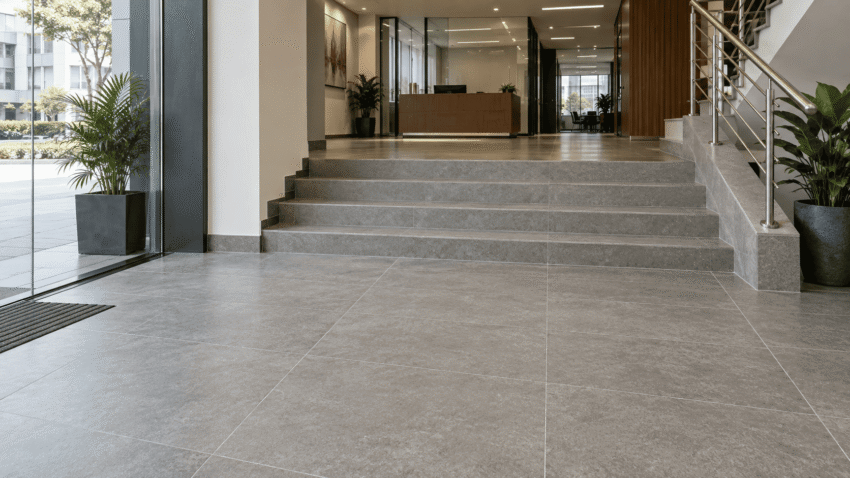
Full body tiles are often chosen for projects where the surface needs to remain visually consistent even when the tile is cut, exposed at an edge, or subjected to regular wear. Their key characteristic is simple but important: the colour extends through the body of the tile rather than existing only on the top decorative layer.
That difference can become valuable in places where edges are visible, furniture is moved regularly, or the floor receives heavier everyday use.
In Indian residential and commercial projects, full body tiles are commonly considered for entrances, passages, staircases, retail interiors, office areas, restaurants, and other spaces where long-term practicality matters as much as the initial appearance.
They also have a distinct visual language. Instead of highly decorative marble printing or strong digital effects, full body tiles often use restrained stone, cement, speckled, salt-and-pepper, or solid-tone finishes.
As an architecture consultant, I usually recommend full body tiles when the project needs a surface that should continue looking coherent after years of use, not just on the day it is installed.
Use Full Body Tiles Where Cut Edges and Surface Wear Stay Visible
One of the strongest reasons to choose full body tiles is edge consistency.
In a surface-decorated tile, the top design may be very different from the internal body. If the tile is cut or chipped, the exposed edge can reveal a contrasting material underneath.
With full body tiles, the colour continues through the thickness, so the cut edge remains much closer to the visible face.
This can be particularly useful on staircases.
Step treads often expose tile edges more clearly than normal floors. A matching-through-body colour can help the stair detail look more integrated.
Raised platforms, sunken areas, skirting, and level changes can benefit from the same characteristic.
Commercial spaces also gain from this construction.
A retail shop may rearrange display units several times.
An office may move storage cabinets or partitions.
A restaurant may constantly shift chairs and tables.
Small edge damage is still possible, but the colour consistency can make minor chips less visually obvious than on a tile with a sharply contrasting inner body.
This does not mean full body tiles are chip-proof or scratch-proof.
The advantage is visual continuity, not immunity from damage.
That distinction is important when explaining the product honestly to homeowners and project professionals.
Choose the Surface According to Use, Not Just the Full Body Label
A full body tile can still have different surface characteristics.
Some may be relatively smooth.
Others may be textured.
Some are designed for indoor commercial flooring, while other products may be suitable for external or more demanding applications.
The full body construction alone does not determine grip.
This becomes important in entrances, balconies, ramps, or areas that may become wet.
A matte-looking tile should not automatically be assumed to provide adequate anti-skid performance.
The exact product should be checked for the intended use.
Texture also affects cleaning.
A heavily textured tile may provide more tactile grip but can collect dirt in deeper surface irregularities.
A smoother surface may be easier to maintain but may behave differently under wet conditions.
The right balance depends on the space.
Colour affects maintenance too.
Mid-grey, warm greige, taupe, and stone-inspired full body tiles often work well in high-use spaces because they can hide ordinary dust better than very dark or very light plain surfaces.
Dark charcoal and black tiles can create a strong architectural look, but pale dust may become more visible.
Light beige or ivory can brighten the space but may show darker dirt near entrances.
This is why colour should be chosen according to traffic and cleaning conditions as much as interior style.
Plan Full Body Tiles Around Stairs, Passages, and High-Use Details
Full body tiles become especially useful when a project includes architectural details beyond a simple flat floor.
Staircases are a good example.
The tread, riser, nosing, and side edge should be planned together.
If the tile is cut to form a step, the through-body colour can help maintain a more consistent appearance at the edge.
Passages are another strong application.
They often receive more daily traffic than bedrooms but less visual attention than living rooms.
A neutral full body tile can provide a durable and understated floor without making the passage feel overly decorative.
Entrances also benefit from practical material planning.
Outdoor dirt, footwear, luggage, and delivery movement all concentrate near the main door.
A suitable full body tile in a forgiving mid-tone shade can work well here if the product’s grip and traffic suitability are appropriate.
Large commercial areas need additional attention to batch consistency.
Even neutral full body tiles can show shade variation between production runs.
The visible floor should ideally come from the same batch, especially in open offices, showrooms, corridors, or lobbies.
Grout should also support the tile rather than break up the surface unnecessarily.
A close-matching grout can create a more continuous and professional appearance.
Finally, substrate preparation remains essential.
A full body tile may be durable, but it cannot compensate for a weak or uneven base.
Correct adhesive coverage, proper joints, flat substrate preparation, and careful installation are still necessary for long-term performance.
Conclusion
Full body tiles are particularly valuable where colour consistency through the tile thickness provides a practical advantage.
They can work well in staircases, entrances, passages, commercial interiors, and other high-use areas where cut edges, minor wear, and long-term visual stability matter.
Their biggest strength is not that they are automatically suitable everywhere, but that their construction can make edges and minor damage less visually disruptive compared with some surface-decorated alternatives.
The TilesFinders marketplace helps homeowners, architects, builders, contractors, and project professionals explore full body tiles from verified dealers and suppliers, compare colours, sizes, finishes, applications, and specifications, and shortlist products that match the actual demands of the project.
Written by Nisarg Patel
Architecture Consultant at TilesFinders