
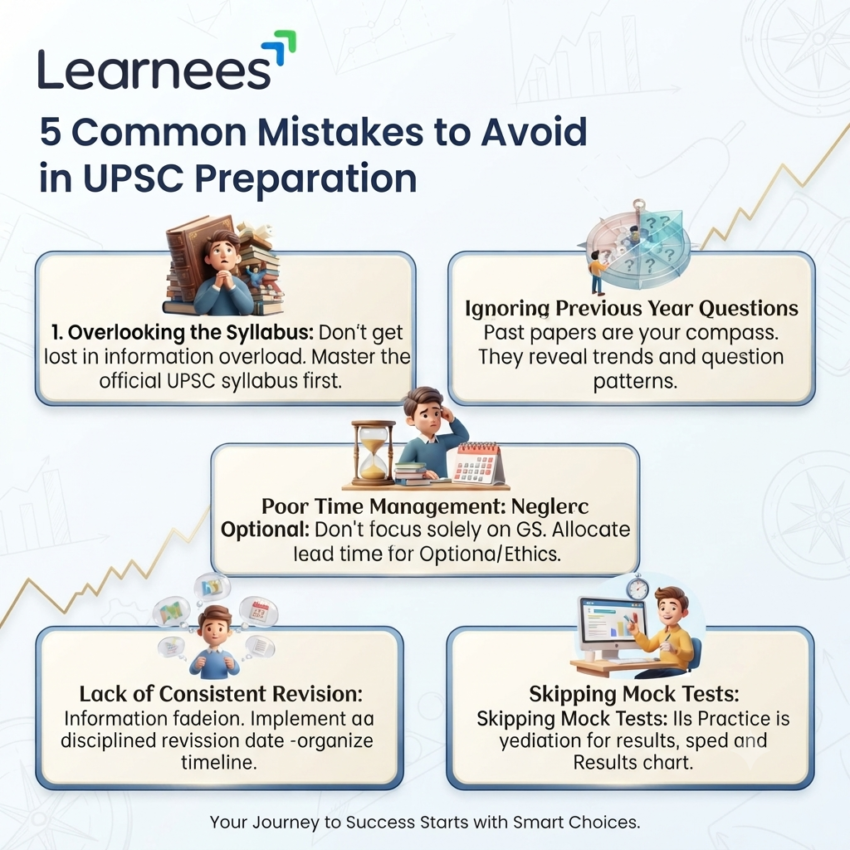
Preparing for the UPSC Civil Services Examination requires consistency, patience, and a well-planned approach. Many aspirants spend months studying but struggle to make progress because of avoidable mistakes in their preparation strategy. The issue is often not a lack of hard work. It can be poor planning, too many study resources, inadequate revision, or insufficient answer-writing practice.
If you are preparing for UPSC CSE, understanding these common mistakes can help you make your preparation more organized and productive.
Table of Contents
- Studying Without a Clear Plan
- Using Too Many Study Resources
- Ignoring Revision
- Avoiding Answer Writing and Mock Tests
- Neglecting Current Affairs
- How to Improve Your UPSC Preparation Strategy
- Frequently Asked Questions
- Final Thoughts
1. Studying Without a Clear Plan
One of the most common mistakes in UPSC preparation is studying without a structured plan.
The UPSC syllabus covers a wide range of subjects, including History, Geography, Polity, Economy, Environment, Science and Technology, and Current Affairs. Without a clear schedule, aspirants may spend too much time on one subject while leaving other areas incomplete.
How to avoid this mistake
Start by understanding the UPSC syllabus and examination pattern. Divide the syllabus into manageable sections and create weekly and monthly targets.
A practical study plan can include:
- Daily study targets
- Weekly revision sessions
- Current affairs reading
- Answer-writing practice
- Mock tests
- Time for optional-subject preparation
Your plan should also be realistic. A timetable that is too difficult to follow can become a source of stress rather than helping your preparation.
2. Using Too Many Study Resources
The internet provides access to thousands of UPSC preparation resources. While this can be useful, collecting too many books, PDFs, videos, notes, and online courses can make preparation confusing.
Some aspirants repeatedly switch between resources because they believe another source may explain a topic better.
This can result in:
- Incomplete books
- Repeated study of the same topics
- Wasted time
- Difficulty in revision
- Confusion about what to prioritize
How to avoid this mistake
Follow a limited and reliable set of resources.
For every subject, try to identify:
- One or two standard books
- Relevant class or study notes
- A reliable current-affairs source
- Previous years’ question papers
- Test and practice material
Instead of constantly searching for new resources, focus on understanding and revising the material you have already selected.
3. Ignoring Revision
Reading something once does not guarantee that you will remember it during the examination.
UPSC preparation involves a large syllabus, which makes revision extremely important. Without regular revision, previously studied concepts and facts can become difficult to recall.
How to build revision into your routine
You can use a simple revision cycle:
First Reading → Short Notes → Revision → Practice Questions → Revision
For example, after completing a topic, create concise notes containing important concepts, facts, examples, government initiatives, and relevant data.
Then revisit those notes regularly.
A simple revision approach
- Daily: Revise important points studied that day.
- Weekly: Review topics covered during the week.
- Monthly: Revisit major concepts and current affairs.
- Before tests: Revise relevant topics and previous mistakes.
The goal is not to read everything repeatedly. The goal is to make important information easier to recall.
4. Avoiding Answer Writing and Mock Tests
Another common mistake is postponing practice until the end of preparation.
UPSC is not only about acquiring knowledge. Aspirants also need to learn how to apply that knowledge within a limited amount of time.
Answer writing helps develop skills such as:
- Understanding the question
- Structuring an answer
- Presenting arguments clearly
- Using examples and relevant facts
- Managing time
- Writing concise conclusions
Mock tests can also help identify areas that need improvement.
How to avoid this mistake
Start answer writing gradually.
For beginners, writing one or two answers regularly can be more manageable than immediately attempting several answers every day.
After writing an answer, evaluate:
- Did I address the exact question?
- Is the answer properly structured?
- Have I included relevant examples?
- Is the introduction clear?
- Does the conclusion answer the question?
- Did I manage the available time?
Similarly, use mock tests as diagnostic tools rather than simply focusing on marks.
5. Neglecting Current Affairs
Current affairs play an important role in UPSC preparation. However, another common mistake is treating current affairs as a completely separate subject.
Many current events are connected to topics already present in the UPSC syllabus.
For example:
- A new environmental policy can connect with Environment and Ecology.
- A change in economic policy can relate to Indian Economy.
- An international development can connect with International Relations.
- A Supreme Court judgment can relate to Indian Polity.
How to prepare current affairs effectively
Instead of trying to memorize every news story, focus on understanding its relevance.
While reading current affairs, ask:
What happened?
Why is it important?
Which syllabus topic does it relate to?
What are the possible implications?
Maintain concise notes that can be revised before examinations.
How to Improve Your UPSC Preparation Strategy
Avoiding mistakes is only one part of effective preparation. A balanced strategy can help you use your study time more efficiently.
1. Understand the syllabus
Keep the official UPSC syllabus accessible while studying. It can help you determine whether a topic is relevant to the examination.
2. Analyze previous years’ questions
Previous years’ question papers can help you understand the type of questions UPSC has asked and how different topics are approached.
3. Follow a limited resource list
Choose resources carefully and complete them before adding new ones.
4. Make revision a regular activity
Do not wait until the final months to revise everything.
5. Practice writing
Regular answer writing can help improve structure, clarity, and time management.
6. Take mock tests
Use tests to identify knowledge gaps and recurring mistakes.
7. Track your progress
Maintain a simple weekly record of:
- Topics completed
- Topics pending
- Tests attempted
- Answers written
- Revision completed
- Areas requiring improvement
How Learnees Can Help You Explore UPSC Preparation Options
Choosing the right learning resources, courses, or preparation providers can be an important part of your UPSC journey. Contact us : + 91 9278097629
Learnees is an education marketplace where students and parents can explore educational institutes, courses, and learning options in one place.
Instead of choosing a course only because it is popular, compare factors such as:
- Course structure
- Learning format
- Faculty information
- Test series
- Study material
- Course duration
- Fees
- Reviews and available information
This can help you make a more informed decision based on your individual preparation requirements.
Frequently Asked Questions
1. What is the biggest mistake in UPSC preparation?
There is no single mistake that affects every aspirant. However, poor planning, lack of revision, excessive resources, and insufficient practice are common preparation problems.
2. Should I use multiple books for every UPSC subject?
Using too many resources can make revision difficult. It is generally more practical to select a limited set of reliable resources and study them thoroughly.
3. When should I start answer writing for UPSC?
Aspirants can introduce answer-writing practice gradually after becoming familiar with the syllabus and basic concepts. The frequency can increase as preparation progresses.
4. How important are mock tests for UPSC preparation?
Mock tests provide an opportunity to practice time management, question interpretation, and exam-style writing. They can also help identify areas that need further study.
5. How should I prepare current affairs for UPSC?
Focus on understanding important developments and connecting them with the UPSC syllabus rather than trying to memorize every piece of news.
6. Is self-study enough for UPSC preparation?
Self-study can be an important part of UPSC preparation. Some aspirants may also use courses, test series, mentorship, or other learning resources depending on their needs and preferences.
7. How can I stay consistent during UPSC preparation?
Set realistic daily targets, divide large topics into smaller tasks, revise regularly, and track your progress. Consistency is usually easier when your study plan is practical and measurable.
Conclusion
UPSC preparation is a long-term process, and avoiding common mistakes can make your preparation more organized. The key is not to study everything available. Instead, focus on understanding the syllabus, selecting useful resources, revising consistently, practicing questions, and learning from your mistakes. A clear strategy combined with regular practice can help you make better use of your preparation time. If you are exploring UPSC courses, institutes, or test-series options, Learnees – An Education Marketplace can help you discover and compare available learning options in one place.
Visit now : https://www.learnees.com/courses/search?category=upsc-union-public-service-commission