
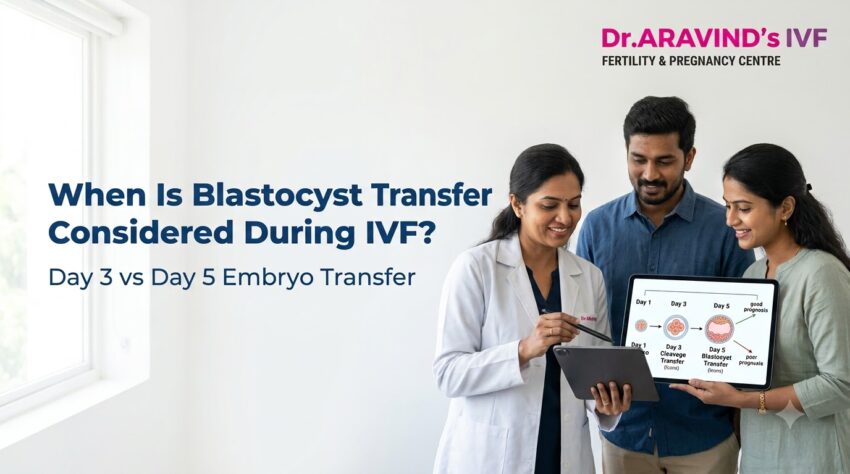
Blastocyst transfer is typically considered when there are enough good-quality embryos to safely extend culture to day 5 or 6, allowing better selection of the most viable embryo for transfer. This approach can improve implantation rates per transfer and support single-embryo transfer policies, reducing multiple pregnancy risks. However, it is not suitable for every patient or every cycle. Decisions are individualised at the Best IVF centre in Ganapathy based on age, embryo number and quality, previous IVF history, and overall prognosis.
What Is a Blastocyst?
After fertilisation in IVF, embryos are cultured in the laboratory for several days:
-
Day 1: Fertilisation check (presence of two pronuclei)
-
Day 2–3: Cleavage-stage embryos (around 4–8 cells)
-
Day 5–6: Blastocyst-stage embryos (more advanced, with an inner cell mass and outer trophectoderm layer)
A blastocyst transfer means transferring the embryo at day 5 or 6 instead of day 2 or 3. This more closely mimics the natural timing, when a day-5 embryo would normally reach the uterus.
For more information on advanced IVF practices, see best IVF centre in Coimbatore.
Why Consider Blastocyst Transfer?
Several potential advantages make blastocyst transfer attractive in selected cases:
-
Better embryo selection: Extending culture helps identify embryos with higher developmental potential. Embryos that arrest before day 5 are less likely to implant.
-
Higher implantation rate per transfer: In good-prognosis patients, blastocysts often show higher implantation rates compared with cleavage-stage embryos.
-
Supports single-embryo transfer (SET): With better selection, clinics can more confidently transfer one embryo, reducing twin and higher-order multiple pregnancy risks.
-
Improved synchrony with the uterus: Day-5 transfer aligns more closely with the natural window of implantation.
However, these benefits are most evident in good-prognosis patients with multiple good-quality embryos.
When Is Blastocyst Transfer Recommended?
Clinics such as the Best IVF centre in Ganapathy typically consider blastocyst culture and transfer when:
1. Good-Prognosis Patients
Characteristics may include:
-
Younger maternal age (often under 35–37 years)
-
Good ovarian response (adequate number of eggs retrieved)
-
Multiple good-quality cleavage-stage embryos on day 3 (for example, at least 3–4 embryos of good grade)
-
First or second IVF cycle with no history of repeated implantation failure
In such cases, extended culture helps select the single best embryo for transfer while cryopreserving remaining blastocysts.
2. Previous IVF Cycles with Good Embryo Numbers but Low Implantation
If a patient has had:
-
Good number of day-3 embryos in prior cycles
-
Reasonable embryo quality but repeated failure to conceive
…blastocyst transfer may help refine selection and improve the chance that the transferred embryo is truly competent.
3. Elective Single-Embryo Transfer (eSET) Programs
For couples who wish to minimise multiple pregnancy risk:
-
Blastocyst culture allows confident selection of one top-quality embryo
-
Remaining blastocysts can be vitrified for future frozen embryo transfers (FET)
Many best IVF centre in India programs use blastocyst transfer as part of their eSET strategy in suitable patients.
4. Preimplantation Genetic Testing (PGT) Cycles
When PGT (for aneuploidy or specific genetic conditions) is planned:
-
Embryos are usually biopsied at the blastocyst stage (trophectoderm biopsy)
-
Only embryos that reach day 5 or 6 can be tested and then transferred in a subsequent frozen cycle
In PGT cycles, blastocyst culture is essentially mandatory.
When Might Blastocyst Transfer Be Avoided?
Extended culture is not always advantageous. An IVF center in Coimbatore may recommend day-2 or day-3 transfer instead when:
1. Poor-Prognosis Patients
Factors may include:
-
Advanced maternal age (for example, 40 years and above)
-
Low ovarian reserve (few eggs retrieved)
-
Few fertilised embryos (for example, only 1–3 embryos on day 3)
-
History of poor embryo development in prior cycles
In such cases, there is a risk that no embryo will survive to day 5, leading to cycle cancellation with no transfer. Earlier transfer may maximise the chance of at least attempting implantation.
2. Previous Cycles with Poor Embryo Development
If prior cycles showed:
-
Most embryos arresting before day 5
-
Very low blastocyst formation rates
…then continuing with day-3 transfer or adjusting stimulation protocols may be more appropriate than repeating extended culture.
3. Limited Embryo Numbers
When only one or two embryos are available:
-
Some clinics prefer day-3 transfer to avoid the possibility of having no embryo left to transfer
-
This is particularly relevant when the couple strongly wishes to avoid a “no-transfer” cycle
The best IVF centre in Coimbatore will discuss these trade-offs openly with the couple.
Fresh vs Frozen Blastocyst Transfer
Blastocysts can be transferred:
-
Fresh: In the same cycle as egg retrieval (usually day 5)
-
Frozen: Vitrified and transferred in a later natural or hormonally prepared cycle
Frozen blastocyst transfer is increasingly common because it:
-
Allows better endometrial preparation
-
Avoids transferring in a potentially suboptimal fresh cycle (for example, high progesterone, risk of OHSS)
-
Enables time for PGT results
Both approaches are widely used at leading centres, including the Best IVF centre in Ganapathy.
Our Clinic
Dr. Aravind’s IVF – Ganapathy & Coimbatore
Dr. Aravind’s IVF provides personalised IVF treatment with careful embryo culture and transfer strategies. Our clinics are conveniently located in:
-
Ganapathy (primary centre)
-
Thudiyalur
-
Sundarapuram
The team reviews age, ovarian reserve, embryo number and quality, previous IVF history, and couple preferences to decide whether blastocyst transfer is appropriate.
Frequently Asked Questions
Q1. What is blastocyst transfer in IVF?
Blastocyst transfer means transferring the embryo at day 5 or 6 of development instead of day 2 or 3. It allows better selection of embryos with higher implantation potential, especially in good-prognosis patients.
Q2. Who is most likely to benefit from blastocyst transfer?
Younger women with good ovarian response and multiple good-quality day-3 embryos, couples opting for single-embryo transfer, and patients undergoing PGT are most likely to benefit.
Q3. Is blastocyst transfer suitable for poor-prognosis patients?
Not always. In women with few embryos or poor prior embryo development, extended culture may lead to no embryo available for transfer. In such cases, day-3 transfer may be preferred.
Q4. Does blastocyst transfer guarantee higher success rates?
It can improve implantation rates per transfer in selected patients, but it does not guarantee pregnancy. Overall success depends on age, embryo quality, uterine factors, and other variables.
Q5. Where can couples in Coimbatore discuss blastocyst transfer options?
You can consult the Best IVF centre in Ganapathy at Dr. Aravind’s IVF, with branches in Ganapathy, Thudiyalur, and Sundarapuram, and also refer to information from the best IVF centre in Coimbatore to understand embryo culture and transfer strategies.