

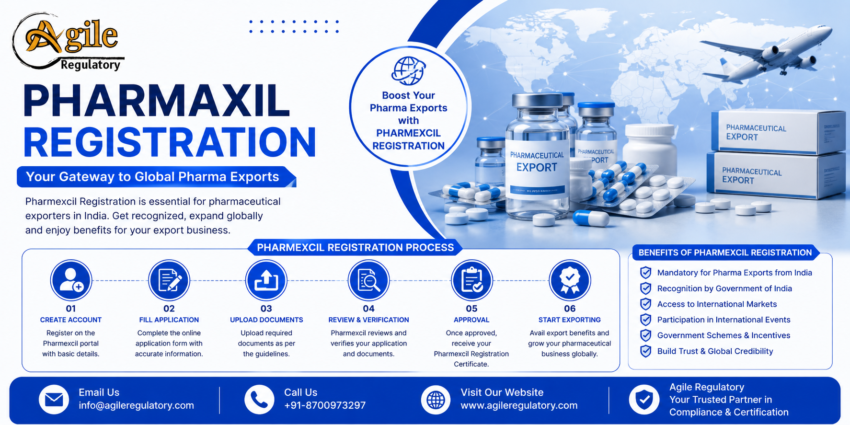
Pharmaceutical companies exporting medicines, APIs, bulk drugs, formulations, herbal products or healthcare products need more than an overseas buyer and a shipping arrangement. They must meet Indian export, product, quality and destination-country requirements.
Businesses often search for a PHARMEXCIL licence, pharmaceutical export licence, pharma export licence or medicine export licence. In practice, the key export-council registration is usually the PHARMEXCIL Registration-cum-Membership Certificate, commonly called RCMC.
PHARMEXCIL registration supports eligible exporters in the pharmaceutical and healthcare sector. It does not replace a drug-manufacturing licence, wholesale drug licence, product registration, import licence in the destination country or quality certification.
What Is PHARMEXCIL?
PHARMEXCIL means the Pharmaceuticals Export Promotion Council of India.
It is the export-promotion body for India’s pharmaceutical and healthcare-product sector. It works with pharmaceutical exporters and supports activities related to trade promotion, market development, export information, buyer engagement and industry representation.
PHARMEXCIL covers product categories including:
- Bulk drugs.
- Drug intermediates.
- Active Pharmaceutical Ingredients.
- Pharmaceutical formulations.
- Finished dosage forms.
- Herbal products.
- Ayurvedic products.
- Unani products.
- Siddha products.
- Homoeopathic products.
- Nutraceuticals.
- Diagnostics.
- Surgical products.
- Biotechnology products.
- Medical and healthcare products.
The relevant product category should be selected carefully during membership or RCMC filing.
What Is PHARMEXCIL Registration?
PHARMEXCIL registration is the membership and RCMC process for eligible exporters in the pharmaceutical sector.
RCMC means Registration-cum-Membership Certificate.
The certificate may help an exporter:
- Establish membership with the relevant Export Promotion Council.
- Access pharmaceutical-export information.
- Participate in trade fairs.
- Participate in buyer-seller meetings.
- Receive market updates.
- Access certificate-related support.
- Participate in export-promotion programmes.
- Improve credibility with international buyers.
- Explore eligible export-development schemes.
- Obtain export-sector guidance.
PHARMEXCIL publishes RCMC and Certificate of Origin verification facilities for members and exporters.
Is PHARMEXCIL a Pharmaceutical Export Licence?
PHARMEXCIL RCMC is an export-council registration. It is not a complete pharmaceutical export licence for every medicine and every country.
A pharmaceutical exporter may also need:
- Importer Exporter Code.
- Drug manufacturing licence.
- Drug wholesale licence.
- Drug retail licence, where applicable.
- FSSAI licence for eligible nutraceutical or food products.
- Product registration in the importing country.
- Certificate of Pharmaceutical Product.
- Good Manufacturing Practices certificate.
- Free Sale Certificate.
- Certificate of Origin.
- Batch test report.
- Stability data.
- Product labels.
- Product specifications.
- Import-country marketing authorisation.
- Importer or distributor licence in the destination country.
The correct approvals depend on:
- Product category.
- Dosage form.
- Product composition.
- Manufacturer status.
- Exporter status.
- Destination country.
- Buyer requirements.
- Applicable drug and customs laws.
Who Needs PHARMEXCIL Registration?
PHARMEXCIL registration may be relevant to:
- Pharmaceutical manufacturers.
- Merchant exporters.
- Manufacturer-exporters.
- API exporters.
- Bulk-drug exporters.
- Formulation exporters.
- Contract manufacturers.
- Herbal-product exporters.
- Ayurvedic-product exporters.
- Homoeopathic-product exporters.
- Nutraceutical exporters.
- Diagnostic-product exporters.
- Surgical-product exporters.
- Medical and healthcare-product exporters.
The business should verify whether its products are covered by PHARMEXCIL or another Export Promotion Council.
Types of PHARMEXCIL Members
The membership category may depend on the business structure and operational model.
Manufacturer-exporter
A manufacturer-exporter produces pharmaceutical or healthcare products and exports them directly.
The applicant may need to provide:
- Manufacturing licence.
- Drug licence.
- Factory details.
- Product list.
- Manufacturing proof.
- Quality documents.
- Export details.
Merchant exporter
A merchant exporter procures products from a licensed manufacturer and exports them under its own trading arrangement.
The applicant may need:
- IEC.
- Drug licence.
- Manufacturer authorisation.
- Product list.
- Supplier details.
- Exporter documents.
Manufacturer-cum-merchant exporter
A business may both manufacture some products and source other products from eligible manufacturers.
The applicant should clearly disclose both activities and maintain supporting documents for each product group.
Documents Required for PHARMEXCIL Registration
The document checklist can vary by applicant type. Common documents include:
- Importer Exporter Code.
- PAN card.
- GST registration, where applicable.
- Certificate of incorporation.
- Partnership deed.
- LLP agreement.
- Proprietorship proof.
- Drug licence.
- Manufacturing licence, where applicable.
- Industrial licence, where applicable.
- SSI or MSME certificate, where applicable.
- Bank certificate.
- Company profile.
- Product brochure.
- Product list.
- Manufacturer authorisation.
- Board resolution.
- Authorised-signatory details.
- Previous export turnover details, where applicable.
- Existing RCMC, where applicable.
- Fee-payment proof.
PHARMEXCIL’s membership document list includes IEC, PAN, industrial or SSI records, drug licence, bank certificate and previous export-turnover details, where applicable.
PHARMEXCIL Registration Process
The PHARMEXCIL registration process generally involves application through the DGFT e-RCMC framework.
Step 1: Obtain an IEC
The exporter should obtain an active Importer Exporter Code from DGFT.
Step 2: Update the IEC profile
Ensure that the IEC profile correctly reflects:
- Legal name.
- Business constitution.
- Registered address.
- Bank account.
- Email.
- Mobile number.
- Authorised signatory.
- Director or partner details.
Step 3: Create or access DGFT login
Use the exporter account on the DGFT platform.
Step 4: Select e-RCMC service
Choose the e-RCMC application service.
Step 5: Select PHARMEXCIL
Select PHARMEXCIL as the relevant registering authority for eligible pharmaceutical or healthcare products.
Step 6: Choose applicant category
Select the correct membership or exporter category, such as:
- Manufacturer-exporter.
- Merchant exporter.
- Manufacturer-cum-merchant exporter.
- Other eligible category.
Step 7: Enter company and product details
Provide:
- Legal entity name.
- IEC.
- PAN.
- GST.
- Registered address.
- Product category.
- Exporter category.
- Bank details.
- Product list.
- Manufacturer details.
Step 8: Upload documents
Attach the required IEC, drug licence, manufacturing records, company profile, bank certificate, product list and authorisation documents.
Step 9: Complete digital authentication
Submit the application using the required digital authentication process.
Step 10: Pay the applicable fee
Pay the membership, RCMC or applicable registration fee according to the selected category.
Step 11: Submit the application
Review all information before final submission.
Step 12: Respond to queries
Monitor the system for any request for clarification or additional documents.
Step 13: Download the PHARMEXCIL certificate
After approval, download the RCMC and save it with export-compliance records.
PHARMEXCIL’s e-RCMC user guidance explains that exporters apply through the DGFT platform by navigating to the e-RCMC service and starting a fresh application.
PHARMEXCIL Certificate Validity
PHARMEXCIL RCMC is generally valid for five years.
Before expiry, the exporter should review:
- IEC status.
- Drug licence validity.
- Manufacturing licence.
- Product category.
- Exporter category.
- Registered address.
- Bank details.
- Product list.
- Manufacturer authorisation.
- Authorised signatory.
- Previous certificate details.
PHARMEXCIL’s published RCMC application material states that the certificate is valid for five years.
PHARMEXCIL Certification Benefits
PHARMEXCIL registration may offer practical benefits to pharmaceutical exporters.
Export-sector recognition
The RCMC helps establish that the business is registered with the relevant pharmaceutical export-promotion body.
Market-development support
Members may receive information on international markets, events and business opportunities.
Trade fairs and exhibitions
Eligible businesses may receive information about exhibitions, delegations and trade-promotion activities.
Buyer-seller programmes
Exporters may have opportunities to participate in buyer-seller meetings and trade-networking events.
Certificate-related support
PHARMEXCIL provides facilities relating to RCMC and Certificate of Origin services.
Industry updates
Members may receive circulars, notifications, policy information and sector-related updates.
Export-promotion opportunities
Eligible exporters may explore programmes under current market-access or export-development initiatives.
Membership does not guarantee export orders, foreign buyers, incentives or destination-country product approval.
Pharmaceutical Export Compliance
A pharmaceutical exporter should maintain a complete compliance system.
This may include:
- Product specifications.
- Manufacturing batch records.
- Certificate of analysis.
- Batch release records.
- Product labels.
- Packaging artwork.
- Stability data.
- Shelf-life data.
- Storage conditions.
- Distribution records.
- Export invoices.
- Shipping bills.
- Certificate of Origin.
- Buyer requirements.
- Destination-country approvals.
- Complaint records.
- Recall procedures.
- Pharmacovigilance records, where applicable.
The exporter should confirm the requirements of the destination country before accepting an export order.
Medicine Export Licence Requirements
A medicine export licence may involve multiple approvals.
For example, exporting finished pharmaceutical formulations may require:
- Valid drug manufacturing licence.
- Product approval.
- WHO-GMP evidence, where required.
- Certificate of Pharmaceutical Product.
- Importing-country product registration.
- Batch test report.
- Exporter IEC.
- PHARMEXCIL RCMC.
- Certificate of Origin.
- Customs documentation.
The requirements differ for:
- APIs.
- Bulk drugs.
- Formulations.
- Biological products.
- Vaccines.
- Herbal products.
- Nutraceuticals.
- Diagnostics.
- Medical devices.
A business should not assume that PHARMEXCIL RCMC alone allows unrestricted export of every medicine.
Pharmacy Licence Renewal and Export Compliance
A valid drug licence is essential for pharmaceutical exporters operating as manufacturers, wholesalers or distributors.
Before applying for PHARMEXCIL registration or exporting medicines, review:
- Drug manufacturing licence validity.
- Wholesale drug licence validity.
- Pharmacy licence renewal status.
- Product approval.
- Manufacturing-site compliance.
- GMP status.
- Product labels.
- Product registration in destination country.
- Bank and IEC details.
An expired drug licence or pharmacy licence can affect pharmaceutical-export operations.
Common PHARMEXCIL Registration Mistakes
Applicants may face delay because they:
- Apply without an active IEC.
- Select the wrong Export Promotion Council.
- Use an expired drug licence.
- Choose the wrong applicant category.
- Apply as a manufacturer without factory proof.
- Submit inconsistent company documents.
- Use a bank certificate in another legal name.
- Submit an incomplete product list.
- Fail to provide manufacturer authorisation.
- Ignore portal queries.
- Forget RCMC renewal.
- Treat RCMC as a destination-country product licence.
- Do not update the certificate after business changes.
PHARMEXCIL Certificate Download and Verification
After approval, the exporter should download and store:
- PHARMEXCIL RCMC.
- Application acknowledgement.
- Fee receipt.
- IEC details.
- Product-category information.
- Query-response documents.
- Renewal records.
The certificate should be reviewed to confirm:
- Company name.
- IEC number.
- Product category.
- RCMC number.
- Issue date.
- Validity.
- Exporter category.
- Registered address.
PHARMEXCIL provides online verification for RCMC and Certificate of Origin information.
How Agile Regulatory Can Help
Agile Regulatory assists pharmaceutical and healthcare exporters with:
- PHARMEXCIL registration.
- PHARMEXCIL RCMC application.
- Pharmaceutical export licence assessment.
- IEC review.
- Drug-licence review.
- Pharmacy licence renewal coordination.
- Manufacturer-exporter documentation.
- Merchant-exporter documentation.
- Product-category selection.
- Manufacturer authorisation.
- Online e-RCMC filing.
- Certificate download.
- Renewal and amendment support.
- Pharmaceutical export-compliance planning.
Conclusion
A PHARMEXCIL licence usually refers to PHARMEXCIL RCMC registration for eligible pharmaceutical and healthcare exporters.
The RCMC supports export-council membership and pharmaceutical export-promotion activities. However, it does not replace the drug licence, manufacturing licence, IEC, product registration or destination-country approvals needed for pharmaceutical exports.
Businesses should prepare accurate IEC, drug-licence, manufacturing, product, bank and exporter-category documents before applying.
Frequently Asked Questions
1. What is PHARMEXCIL registration?
PHARMEXCIL registration is the process through which eligible pharmaceutical and healthcare exporters obtain a Registration-cum-Membership Certificate.
2. Is PHARMEXCIL RCMC a pharmaceutical export licence?
PHARMEXCIL RCMC is an export-council registration. It does not replace a drug licence, manufacturing licence, IEC or destination-country product approval.
3. Who can apply for PHARMEXCIL registration?
Pharmaceutical manufacturers, merchant exporters, API exporters, formulation exporters, herbal-product exporters, nutraceutical exporters and other eligible healthcare-product exporters may apply.
4. What documents are required for PHARMEXCIL registration?
Common documents include IEC, PAN, drug licence, manufacturing licence where applicable, bank certificate, company profile, product list and manufacturer authorisation.
5. How long is PHARMEXCIL RCMC valid?
PHARMEXCIL RCMC is generally valid for five years.
6. Can a merchant exporter apply for PHARMEXCIL registration?
Yes. Merchant exporters may apply if they have the required IEC, drug-licence documentation, product information and manufacturer authorisation.
7. Does PHARMEXCIL registration allow medicine export to every country?
No. The exporter must separately comply with destination-country product registration, import approval, quality, labelling and buyer requirements.
8. Is pharmacy licence renewal important for pharmaceutical export?
Yes. A manufacturer or wholesale exporter should maintain valid drug and pharmacy licences as part of ongoing pharmaceutical-export compliance.
9. How can I verify a PHARMEXCIL certificate?
The certificate can be checked through the PHARMEXCIL verification facility using the relevant RCMC information.
10. Can Agile Regulatory help with PHARMEXCIL registration?
Yes. Agile Regulatory can assist with RCMC applications, IEC review, drug-licence coordination, documents, online filing, certificate verification, renewal and pharmaceutical export compliance.