

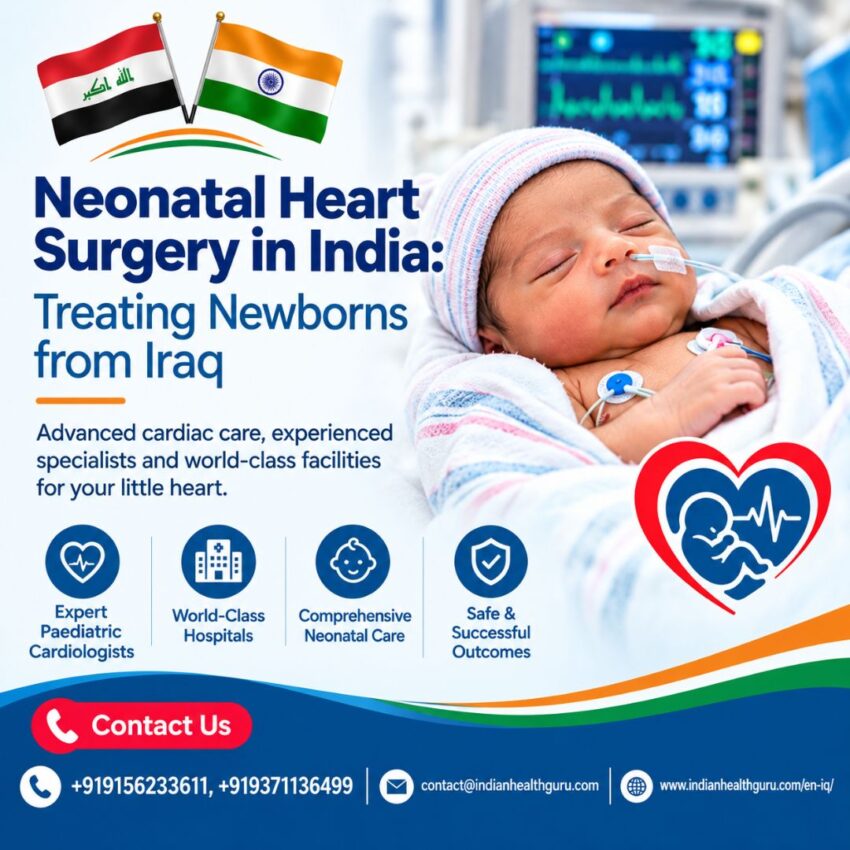
When a newborn is diagnosed with a serious congenital heart defect, families in Iraq may suddenly have to make complex medical decisions while dealing with fear and uncertainty. Some heart conditions require treatment within the first days or weeks of life, particularly when they interfere significantly with blood flow or oxygen delivery. India has specialised paediatric cardiac centres with neonatal intensive-care units, congenital heart surgeons, paediatric cardiologists, cardiac anaesthesia and advanced imaging facilities. For Iraqi families considering treatment in India, the priority should be finding a centre equipped to manage the newborn’s specific condition and provide continuous care before, during and after surgery.
Read More Here: Neonatal Heart Surgery in India for Iraq Newborns
What Is Neonatal Heart Surgery?
Neonatal heart surgery refers to cardiac procedures performed during the newborn period, generally within the first few weeks of life. These operations may be required for congenital defects that cannot be safely managed without intervention. Depending on the condition, treatment may involve open-heart surgery, catheter-based intervention or a staged approach.
Not every newborn with a heart defect requires immediate surgery. Some conditions can be monitored or treated later, while others are considered time-sensitive because the baby’s circulation depends on a particular connection or pathway remaining open. A paediatric cardiology team determines the urgency after assessing the baby’s anatomy, oxygen saturation, circulation, weight and overall stability.
Which Conditions May Require Early Surgery?
Newborns may require early cardiac treatment for conditions such as transposition of the great arteries, critical pulmonary or aortic valve obstruction, coarctation of the aorta, certain forms of single-ventricle heart disease and other complex congenital abnormalities. The treatment depends on the precise anatomical defect.
Some newborns may first receive medication or catheter-based treatment to stabilise circulation before definitive surgery. In complex cases, treatment can involve more than one operation over time. Therefore, Iraqi parents should obtain a clear diagnosis and understand whether the recommended procedure is emergency, urgent or planned.
Why Is a Specialised Centre Important?
Neonatal cardiac surgery requires expertise that goes beyond routine paediatric heart surgery. Newborns have very small anatomical structures and can be particularly sensitive to changes in blood pressure, oxygen levels, temperature and fluid balance. Their care often requires specialised neonatal cardiac intensive care and continuous monitoring.
For Iraqi families, the availability of a dedicated paediatric cardiac intensive-care team should therefore be one of the main factors when comparing hospitals in India. The centre should ideally have paediatric cardiac surgeons, paediatric cardiologists, neonatal specialists, specialised anaesthesia support, advanced imaging and experienced intensive-care staff working together.
How Are Newborns Evaluated Before Surgery?
Before travelling, parents should gather all available medical information, including echocardiography reports, oxygen saturation readings, discharge summaries, blood-test results, medication details and any previous catheterisation or imaging reports. If the newborn is already hospitalised in Iraq, the treating doctors should be involved in deciding whether international travel is medically appropriate.
Once the child reaches India, the paediatric cardiac team may repeat echocardiography or other investigations to confirm the anatomy and assess the baby’s current condition. The team will also evaluate weight, feeding, oxygenation, kidney function and other factors that can influence surgical planning.
What Happens During Neonatal Heart Surgery?
The surgical procedure depends entirely on the congenital defect. Some operations correct the abnormal circulation in a single procedure, while others are staged. The baby is treated under general anaesthesia, and complex open-heart operations may require cardiopulmonary bypass.
Following surgery, the newborn is usually transferred to a specialised cardiac intensive-care unit. Continuous monitoring of breathing, circulation, oxygen levels, heart rhythm, fluid balance and organ function is essential during this early period. The length of intensive-care and hospital treatment varies considerably between conditions.
|
Stage |
Main focus for the newborn |
|
Diagnosis |
Define the exact heart defect and severity |
|
Stabilisation |
Support oxygenation and circulation when required |
|
Surgical planning |
Select the safest procedure or staged approach |
|
Surgery |
Correct or palliate the congenital heart defect |
|
Intensive care |
Closely monitor heart, lungs and other organs |
|
Recovery |
Feeding, medication, growth and clinical stabilisation |
|
Follow-up |
Ongoing paediatric cardiology assessment |
What Are the Expected Benefits?
The primary objective of neonatal heart surgery is to establish or improve adequate circulation and oxygen delivery. For some defects, timely correction can be essential for survival and may allow the heart and other organs to function more effectively as the baby grows.
Parents should nevertheless understand that outcomes vary considerably according to the diagnosis. Complex congenital heart disease may require additional procedures, prolonged hospitalisation or lifelong specialist monitoring. The treating team should explain the expected course based on the baby’s individual anatomy rather than promising a particular outcome.
What Are the Risks?
Neonatal heart surgery is major treatment, and newborns can face risks related to both the underlying heart defect and the operation. Possible complications include bleeding, infection, abnormal heart rhythm, breathing problems, neurological complications, kidney problems and difficulties with feeding or recovery.
The level of risk depends on the baby’s age, weight, heart anatomy, oxygen level, other medical conditions and whether the procedure is an emergency or planned operation. Iraqi families should have a detailed discussion with the paediatric cardiac team about these risks before making travel and treatment arrangements.
Recovery and Hospital Stay
Recovery after neonatal cardiac surgery can be longer and less predictable than recovery after surgery in older children. The baby may initially require mechanical ventilation and intensive monitoring. As the condition improves, the medical team gradually reduces respiratory and circulatory support and begins focusing on feeding, weight gain and medication management.
The hospital stay depends heavily on the type of surgery and the baby’s response. Parents should be prepared for the possibility that the expected discharge date may change. The medical team should provide regular updates and explain what needs to improve before the baby can safely leave intensive care or the hospital.
Read More Here: Neonatal heart surgery recovery in India for Iraqi newborns
Returning to Iraq After Surgery
International travel after neonatal heart surgery requires careful planning. Parents should not arrange a return flight until the treating paediatric cardiac team confirms that the baby is clinically stable and fit to travel. Before leaving India, families should receive a complete discharge summary, medication schedule, feeding instructions, warning signs and follow-up recommendations.
It is important to arrange continued paediatric cardiology care in Iraq. Some babies need frequent echocardiography and medication adjustments during the first months after surgery. Keeping the Indian surgical team informed of follow-up results can also help maintain continuity of care.
Choosing a Neonatal Cardiac Centre in India
Iraqi families should prioritise hospitals with specialised neonatal and paediatric cardiac services, rather than choosing a facility solely on general reputation or cost. Important factors include experience with the baby’s specific congenital defect, neonatal cardiac intensive care, paediatric cardiac anaesthesia, advanced echocardiography, emergency support and postoperative rehabilitation or feeding services.
Parents should also ask whether the centre manages complex congenital heart conditions and whether the surgical team has experience with staged procedures when required. Understanding the complete treatment pathway can help families prepare financially, emotionally and practically.
Final Thoughts
Neonatal heart surgery is highly specialised care, and timely treatment can be crucial for newborns with serious congenital heart defects. For Iraqi families considering India, the most important step is to obtain an accurate diagnosis and identify a paediatric cardiac centre capable of providing comprehensive neonatal care.
India offers specialised congenital heart teams and advanced paediatric cardiac facilities, but every newborn’s condition is different. Parents should discuss the urgency of treatment, surgical options, potential risks, expected recovery and long-term follow-up with the treating paediatric cardiology and cardiac surgery team before travelling.
Official Indian Government References
- Ministry of Health & Family Welfare, Government of India — The Ministry provides official information on India’s healthcare policies, national health programmes and public-health initiatives. It is a useful government source for families seeking broader information about the healthcare system in India. Official MoHFW Website
- National Health Authority, Government of India — NHA supports major national healthcare initiatives and provides information on India’s evolving health-system infrastructure and healthcare programmes. Its official resources provide useful context for international families seeking information about healthcare services in India. Official NHA Website
Our Commitment to Patients
Our mission is to place patients at the centre of every healthcare decision by providing trustworthy, evidence-based, and unbiased medical information. We believe that informed patients make better decisions. Backed by personalised guidance from our experienced advisory team, we help patients understand their treatment options, compare them objectively, and confidently choose the path that best aligns with their medical needs, personal preferences, and long-term health goals.
Disclaimer
This article is intended for educational and informational purposes only and should not be considered medical, legal, or visa advice. Medical recommendations, treatment plans, and procedures may vary from one patient to another based on individual health conditions and circumstances. Readers are strongly advised to consult qualified healthcare professionals before making any medical-related decisions.
Dr. Dheeraj Bojwani
Medical Travel Advisor for International Patients Seeking Treatment in India
📍 New Delhi, India
🏆 24+ Years of Experience | Assisted 5,000+ International Patients
🌐 Website: www.indianhealthguru.com/en-iq/
📧 Email: contact@indianhealthguru.com|
📞 Phone: +91 9156233611 | 📞 Alternate Phone: +91 9371136499