

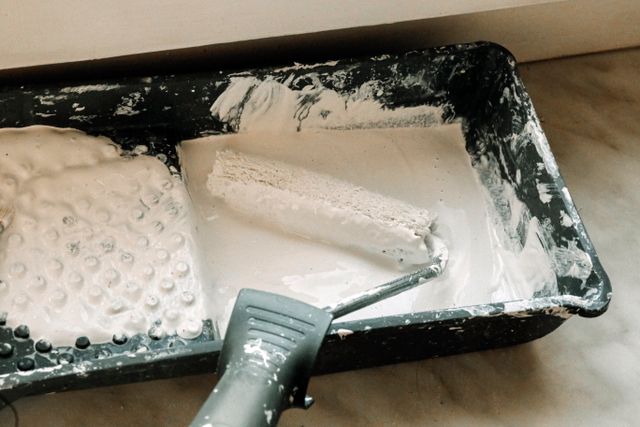
There is a common assumption that every painting project needs a separate primer followed by paint. Then there is the opposite assumption: if a product says “paint and primer,” you can use it for absolutely anything.
Neither approach tells the whole story.
Modern paint and primer products can simplify many painting projects, particularly when the existing surface is in reasonable condition. But the condition and type of the surface still matter. New drywall, stained walls, glossy finishes, bare wood, dramatic color changes, and difficult substrates can call for a different approach than a straightforward repaint.
The easiest way to decide is to stop thinking of primer as an automatic extra step and start looking at what the surface actually needs.
What Paint and Primer Products Are Designed to Do
Paint-and-primer products are formulated to provide both coverage and adhesion on properly prepared surfaces. Benjamin Moore notes that its paint-and-primer products are self-priming on most properly prepared surfaces, although the company still recommends two coats for full color development and optimal performance.
That can make these products particularly convenient when you’re repainting a room that already has a sound coating.
Imagine a living room with clean, previously painted drywall, no major stains, and a reasonably similar new color. In that situation, using a quality paint-and-primer product can eliminate the need for a separate primer coat and keep the project moving.
But “self-priming” does not mean “surface preparation is unnecessary.”
The wall still needs to be clean, sound, and suitable for the coating.
The Surface Tells You More Than the Label
Before deciding what to put in your shopping cart, inspect the existing surface.
Look for:
- Peeling or cracking paint
- Water or smoke stains
- Bare drywall
- Exposed wood
- Glossy or slick coatings
- Significant color differences
- Areas that have been heavily repaired
- Grease or other contaminants
- Surfaces that are difficult for paint to adhere to
A previously painted wall in good condition is very different from a wall that has just been repaired or stripped.
Benjamin Moore specifically identifies bare substrates, stains, dramatic color changes, and difficult or non-porous surfaces as situations where a dedicated primer may be recommended.
That distinction is worth remembering before assuming one product can handle every project.
When Paint and Primer Can Simplify a Repaint
A typical repaint is where paint-and-primer products can be especially convenient.
Suppose a bedroom already has a smooth painted wall and you’re changing the color from one medium neutral to another. After cleaning and making minor repairs, a quality interior paint-and-primer product may be all that is needed.
The Paint Shops carries Benjamin Moore Regal Select Interior products in multiple finishes, including flat and semi-gloss options. The store describes the Regal Select line as a 100% acrylic interior coating with characteristics such as good hide, durability, flow, leveling, and washability depending on the finish.
That gives homeowners room to select a coating based not only on color but also on how the finished surface will be used.
For a low-traffic ceiling, a flat finish may make sense. For trim or surfaces exposed to more handling, a more durable sheen may be appropriate.
When a Separate Primer Still Earns Its Place
There are projects where trying to skip primer can create more work later.
New drywall is a good example. Its porous surface can absorb coatings unevenly, making a dedicated primer useful for creating a more uniform base. Benjamin Moore recommends priming new drywall because of its porosity.
Strong stains are another situation. Water marks, smoke damage, tannin bleed from certain woods, grease, and other discolorations can require a stain-blocking primer rather than simply adding more finish paint.
The Paint Shops carries products such as KILZ Original Primer/Sealer, which is formulated for stain blocking and sealing applications, as well as Benjamin Moore Fresh Start High-Hiding All Purpose Primer.
In these cases, the primer has a specific job to perform before the finish coat goes on.
What Happens With Glossy or Difficult Surfaces?
Paint generally performs better when it has a suitable surface to grip.
Glossy paint, laminate, certain plastics, glass, PVC, and other hard-to-coat materials can present adhesion challenges. Simply applying another layer of regular wall paint may not produce the result you expect.
This is where a bonding primer can be useful.
The Paint Shops carries STIX Waterborne Bonding Primer, which is designed for challenging surfaces including glossy tile, PVC, vinyl, plastic, glass, glazed block, fiberglass, galvanized metals, and glossy paint.
The important lesson isn’t that everyone needs a bonding primer. It’s that the primer should be chosen for the actual problem.
Don’t Assume More Coats Will Fix Everything
When coverage isn’t perfect, adding another coat can seem like the obvious solution.
Sometimes it works. Sometimes it doesn’t address the underlying problem.
If a wall is porous, heavily stained, or dramatically different in color, additional finish coats may not provide the same benefit as preparing the surface correctly first. Primer can help create a more uniform foundation, improve hide, or address a specific adhesion or staining issue.
On the other hand, if you’re working over a sound existing coating, applying unnecessary primer can simply add another step and another product to the project.
The goal isn’t to use the maximum number of products. It’s to use the products that solve the actual surface problem.
Color Changes Can Change the Equation
Changing from a pale color to another pale color is usually a straightforward situation.
Going from a very dark color to a much lighter one is different.
A high-hiding primer can help reduce the influence of the existing color and create a more uniform base. The Paint Shops’ Fresh Start High-Hiding All Purpose Primer is specifically described as suitable for significant color changes and maximum hiding.
For certain color changes, however, a quality paint-and-primer product may provide sufficient hide on a properly prepared previously painted surface. The exact product, existing color, and new color all matter.
That’s why testing a small area can be more useful than making assumptions from the color card alone.
Preparation Still Comes First
Even the best paint and primer product cannot compensate for loose paint, dirt, grease, or an unstable surface.
Scrape loose coatings, repair damaged areas, sand when appropriate, and clean the surface according to the requirements of the existing coating and new product. Benjamin Moore’s wall-preparation guidance emphasizes removing loose or flaking material and addressing the surface before painting.
Think of preparation as the part of the project that happens before the paint gets its chance to perform.
A clean, stable surface gives the coating a much better starting point.
A Simple Decision Before You Buy
Before choosing between a paint-and-primer product and a dedicated primer plus finish paint, ask yourself four questions:
Is the existing coating sound?
If yes, a paint-and-primer product may be a practical option.
Is the surface bare or highly porous?
A dedicated primer may be more appropriate.
Are there stains or difficult adhesion problems?
Look for a primer designed specifically for that issue.
Am I making a major color change?
A high-hiding primer may reduce the amount of finish paint needed.
This simple check can prevent both over-preparing and under-preparing.
The Better Approach Is the One That Fits the Surface
Painting technology has made projects easier than they used to be. A quality paint and primer product can be a convenient solution for many properly prepared surfaces, especially when you’re refreshing an existing painted room.
But convenience shouldn’t replace judgment.
A sound wall and a stained wall don’t have the same requirements. New drywall isn’t the same as previously painted drywall. Glossy trim isn’t the same as a matte interior wall. And a dramatic color change may require a different strategy from a simple refresh.
The best starting point is always the surface in front of you. Once you understand its condition, you can decide whether a paint-and-primer product is enough or whether a dedicated primer has a specific job to do first.