

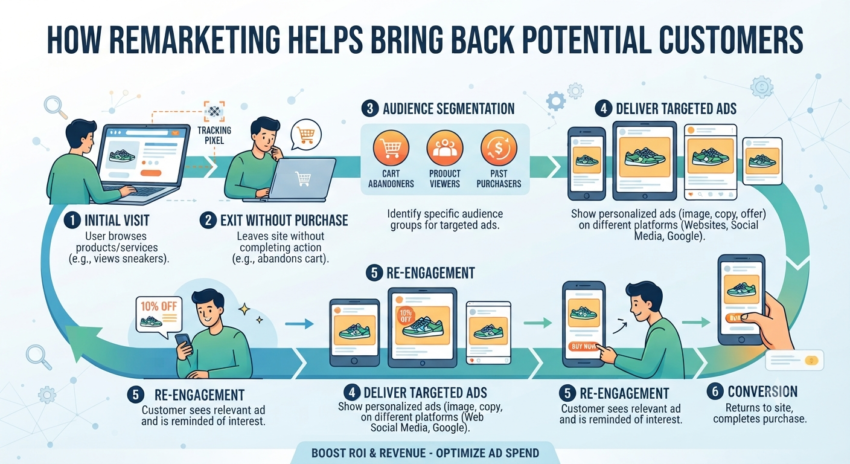
In digital marketing, not every visitor becomes a customer on their first visit. Someone may browse a website, check a product, read a service page, or even add an item to their cart before leaving without taking action. This does not necessarily mean they are uninterested. They may simply need more time, information, or a reminder before making a decision.
This is where remarketing becomes valuable. Remarketing allows businesses to reconnect with people who have already interacted with their website, app, social media content, or advertisements. Instead of constantly searching for completely new audiences, businesses can communicate again with people who have already shown some level of interest.
What Is Remarketing?
Remarketing is a digital advertising strategy designed to reach users who have previously interacted with a business online. For example, a customer may visit an online store and view a pair of shoes but leave without purchasing them. Later, that customer may see an advertisement featuring similar shoes while browsing another website or social media platform.
The purpose is not simply to show the same advertisement repeatedly. Effective remarketing uses previous interactions to create more relevant messages and encourage users to return.
Remarketing campaigns can be used for websites, e-commerce stores, mobile applications, social media platforms, and service-based businesses.
Why Potential Customers Leave Without Buying
Understanding why customers leave is important before creating a remarketing campaign. People may abandon a website for several reasons.
Some visitors may be comparing prices from different businesses. Others may not be ready to purchase immediately. A complicated checkout process, lack of information, unexpected costs, or simply being distracted can also lead to an abandoned purchase.
For service businesses, customers may need several interactions before contacting the company. A visitor might read about SEO services today but contact an agency weeks later.
Remarketing gives businesses an opportunity to remain visible during this decision-making period.
How Remarketing Brings Customers Back
1. Reminds Customers About Products or Services
One of the simplest benefits of remarketing is providing a reminder. People visit many websites every day, so they may forget about a product or service they previously considered.
A well-designed remarketing advertisement can remind them of that earlier interest and bring them back to the website.
2. Reaches People Who Already Showed Interest
Traditional advertising often introduces a brand to people who may know nothing about it. Remarketing focuses on people who have already interacted with the business.
For example, an online clothing store can create different audiences for visitors who viewed products, added products to their cart, or completed a purchase. Each group can receive different messages.
3. Supports Abandoned Cart Recovery
E-commerce businesses frequently lose potential sales when customers add products to their carts but do not complete the checkout process.
Remarketing can remind these customers about the products they left behind. Depending on the campaign strategy, businesses may also use limited-time offers, free shipping messages, or additional product information.
4. Builds Brand Familiarity
Customers are more likely to remember businesses that communicate consistently and professionally.
Remarketing can help maintain brand visibility throughout the customer’s decision-making journey. When a customer repeatedly sees useful and relevant communication from a brand, the business can become more familiar to them.
However, frequency should be controlled so that advertising does not become excessive or irritating.
Remarketing on Google and Social Media
Platforms such as Google and Meta provide advertising solutions that businesses can use to reconnect with audiences based on their previous interactions.
Google-based campaigns can help businesses reach users across relevant advertising environments, while Meta’s advertising ecosystem can help businesses reconnect with audiences across platforms such as Facebook and Instagram.
The right platform depends on the business, audience, industry, campaign objective, and available budget.
Company Example: Amazon
Amazon demonstrates how personalized digital experiences can encourage customers to continue exploring products. Online shoppers may receive recommendations based on browsing and purchasing activity.
For businesses, the broader lesson is that customer interactions can provide useful signals for creating more relevant marketing communication.
Company Example: Nike
Nike has built a strong digital presence by combining product promotion with lifestyle-oriented branding and customer engagement. Remarketing campaigns can similarly use creative messaging to reconnect with people who have previously interacted with a brand.
The key lesson is that returning customers should receive communication that feels relevant rather than repetitive.
Company Example: HubSpot
HubSpot uses content, educational resources, and digital marketing strategies to engage businesses at different stages of the buying journey.
This highlights another important aspect of remarketing: not every returning visitor needs a sales message. Someone who downloaded an educational guide may respond better to another useful resource than to a direct purchase advertisement.
Remarketing Should Be Personalized
One of the biggest advantages of modern remarketing is audience segmentation.
Instead of treating every visitor the same, businesses can create different groups, such as:
-
Website visitors
-
Product viewers
-
Cart abandoners
-
Previous customers
-
Service-page visitors
-
Blog readers
-
People who interacted with social media content
Each audience can receive messaging designed around its previous interaction.
For example, a previous customer might receive information about a new product, while someone who only visited a blog may receive another educational article.
The Role of Content in Remarketing
Remarketing works better when advertisements provide a reason to return.
Businesses can promote useful blog posts, case studies, product guides, videos, webinars, special offers, or new services. This creates a more complete customer journey instead of relying only on repeated promotional advertisements.
Content can also answer questions that prevented a visitor from taking action during their first visit.
Measuring Remarketing Performance
Businesses should monitor campaign performance instead of assuming that every advertisement is successful.
Important metrics can include:
-
Click-through rate
-
Conversion rate
-
Cost per conversion
-
Return on advertising spend
-
Website engagement
-
Frequency
-
Revenue generated
-
Cart recovery rate
These measurements can help marketers identify which audiences, messages, and campaigns deserve further attention.
Digital Marketing Bucks: Helping Businesses Reconnect With Potential Customers
Digital Marketing Bucks is a digital marketing company that can help businesses build stronger online visibility through strategies such as SEO, social media marketing, paid advertising, content marketing, audience targeting, and performance analysis. Remarketing can be an important part of a broader customer-acquisition strategy because it focuses on people who have already demonstrated interest in a business. As a top digital marketing company, Digital Marketing Bucks can help businesses plan campaigns around their audience, marketing objectives, customer journey, and available budget. Instead of treating every website visitor identically, businesses can use audience segmentation and relevant messaging to create more meaningful follow-up communication. By combining remarketing with strong landing pages, useful content, compelling creative, and performance tracking, businesses can work toward turning previous interactions into future opportunities.
Best Practices for Remarketing
To make remarketing campaigns more effective, businesses should follow several basic practices:
Use audience segmentation: Different visitors have different levels of interest.
Create relevant advertisements: Match the message with the customer’s previous interaction.
Control ad frequency: Avoid showing the same advertisement too often.
Use strong landing pages: The page customers reach after clicking should match the advertisement.
Test different creatives: Experiment with headlines, images, offers, and calls to action.
Track results: Use performance data to understand what is generating meaningful engagement and conversions.
Respect privacy: Businesses should follow applicable advertising, privacy, consent, and platform requirements when collecting and using audience data.
The Future of Remarketing
As digital advertising continues to evolve, remarketing is becoming more focused on relevance, customer experience, and responsible use of data. Businesses need to balance personalization with privacy while creating advertising experiences that genuinely help customers.
The future of remarketing is not simply about showing an advertisement again. It is about understanding where a potential customer is in the buying journey and providing useful information at the right time.
Conclusion
Remarketing gives businesses another opportunity to connect with potential customers who have already shown interest. Whether someone viewed a product, visited a service page, read a blog, or abandoned a shopping cart, that interaction can become part of a carefully planned marketing journey.
When combined with segmentation, relevant content, strong creative, effective landing pages, and performance measurement, remarketing can become an important part of a company’s digital marketing strategy.
For businesses looking to grow online, the goal should not only be attracting new visitors. It should also be finding meaningful ways to bring interested visitors back and help them move closer to becoming customers.