

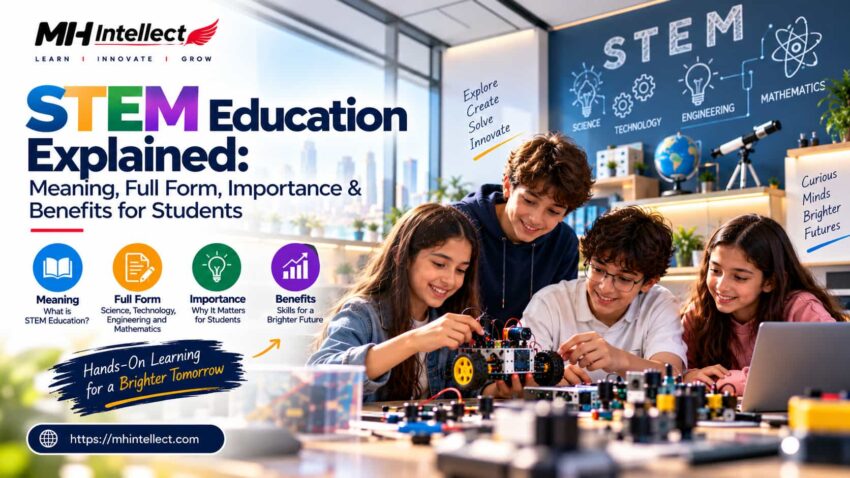
Imagine giving a student a problem they have never encountered before, without a textbook answer or step-by-step instructions. Would they know where to begin? That is where STEM education makes a difference. STEM stands for Science, Technology, Engineering and Mathematics, but its purpose goes beyond four subjects. It connects these disciplines through practical projects, investigation, design and real-world problem-solving, helping students develop the confidence to explore unfamiliar challenges.
What Is STEM Education?
If you are asking what is STEM education, the simplest explanation is that it is an integrated approach where students use multiple disciplines together to solve meaningful problems. Instead of learning science, mathematics, technology and engineering as completely separate subjects, students can apply them together through hands-on challenges. For example, designing a solar-powered water system could require students to understand energy, calculate measurements, build a structure and use technology to monitor performance. This makes learning more practical and gives students a clearer understanding of how classroom knowledge connects with the world around them.
Understanding STEM Education Meaning
The STEM education meaning extends beyond simply combining four academic subjects. It describes a way of thinking that encourages students to investigate, test ideas, analyse evidence and improve solutions. A traditional lesson may focus mainly on remembering information, while STEM learning gives students opportunities to build, experiment, question, test and redesign. This difference becomes particularly valuable when students encounter problems where there is no single obvious answer.
STEM Education Full Form and What Each Area Contributes
The STEM education full form is Science, Technology, Engineering and Mathematics. Each area contributes a different capability to the learning process. Science encourages observation and evidence-based reasoning, technology develops digital confidence and computational thinking, engineering develops design and iterative improvement, while mathematics supports measurement, logic, modelling and data analysis. When combined, these disciplines help students approach complex challenges from multiple perspectives.
Why Is STEM Education Important for Students?
The importance of STEM education becomes clearer when considering the skills students will need beyond school. Emerging fields such as artificial intelligence, robotics, renewable energy, healthcare technology, data science and smart infrastructure increasingly require people who can analyse problems, adapt to change and develop practical solutions. STEM learning helps students practise these capabilities from an early age.
More importantly, its benefits are not limited to technical careers. Critical thinking, collaboration, adaptability and problem-solving can support students across many professional and academic pathways. Students learn how to approach unfamiliar situations, test assumptions and improve their ideas instead of simply searching for one correct answer.
What Do Students Actually Gain From STEM Learning?
A simple classroom engineering challenge can demonstrate the value of STEM. Students might be asked to build a structure capable of supporting a specific amount of weight using limited materials. Some designs may succeed while others collapse. Instead of treating failure as a negative result, students examine what happened, identify weaknesses and improve their designs. Through one activity, they practise measurement, engineering design, scientific reasoning, communication, teamwork and resilience.
Key benefits include:
- Critical thinking and independent problem-solving
- Collaboration through team-based projects
- Digital and computational skills
- Practical application of science and mathematics
- Creativity and engineering design thinking
- Confidence when testing unfamiliar ideas
- Resilience through iteration and improvement
STEM Education Should Progress With Student Development
Effective STEM learning should not look identical for every age group. Early Years programmes can build curiosity through observation, building and simple experimentation. Primary students can move toward structured inquiry, introductory robotics and design challenges. Middle school learners can work with coding, robotics, sensors and engineering systems, while secondary students can explore AI, IoT, advanced engineering and research-based projects.
This progressive approach helps students build knowledge and independence rather than encountering advanced technology without sufficient foundations. Strong STEM programmes should grow alongside students, increasing the complexity of projects and encouraging greater independence at each stage.
Using Technology as a Learning Tool, Not the Product
Technology can make STEM learning more engaging, but the objective should always remain education. STEM Education products can be used as learning tools for robotics, coding, engineering and practical experimentation. The focus is not on selling equipment; it is on using appropriate technology to help students build, test, programme and improve solutions as part of a structured educational programme.
Schools can also explore practical examples through the Student’s Gallery to see how hands-on STEM activities can translate concepts into meaningful learning experiences.
Building Strong STEM Programmes With the Right Support
For school leaders, successful STEM implementation requires more than purchasing technology or organising isolated workshops. Curriculum planning, teacher development, age-appropriate projects, assessment and long-term implementation all need to work together. MH Intellect supports schools with STEM curriculum design, hands-on programmes, teacher training, STEM lab development and implementation support.
Schools looking for structured support can explore a dedicated STEM Implementation partner for schools to understand how STEM programmes can be aligned with school objectives and student development.
Final Thoughts
STEM education is not simply about adding robotics, coding or technology to the timetable. It is about helping students become capable thinkers who can investigate problems, test ideas, learn from failure and develop better solutions. As schools prepare students for a world increasingly influenced by AI, automation and emerging technologies, a well-structured STEM approach can connect academic learning with practical capability and future readiness.
Ready to build a practical, future-focused STEM programme for your school? Book a free consultation with MH Intellect to explore curriculum integration, teacher training, hands-on STEM learning and long-term programme implementation.