

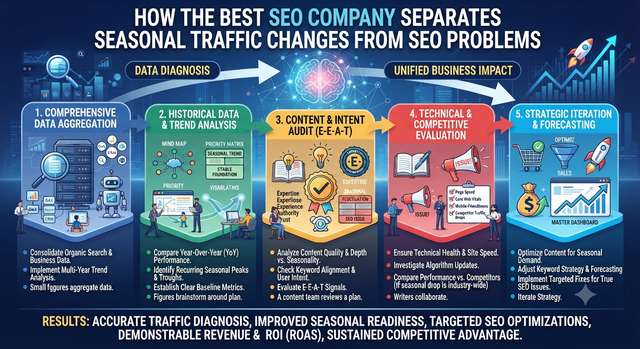
Organic traffic does not always move in a straight line. A website may experience a sudden increase in visitors during a particular season and then see traffic decline when demand naturally falls. At other times, a traffic drop may indicate a genuine SEO problem involving rankings, indexing, technical errors, content quality, or search-engine changes. The challenge is determining which situation is actually happening.
A best SEO company does not immediately assume that every traffic decline is an SEO failure. Instead, it studies search behavior, historical performance, rankings, conversions, industry trends, and technical data to identify the real cause. This careful approach helps businesses avoid unnecessary changes that could make a temporary seasonal decline worse.
Understanding Seasonal Search Behavior
Many industries experience predictable changes in search demand. Retail websites may see significant increases before major holidays, travel businesses can experience stronger demand during vacation periods, and businesses offering specialized seasonal services may receive more searches during particular months.
For example, a company selling winter products may naturally receive fewer searches during warmer months. A traffic decline during this period does not necessarily mean that its SEO strategy has stopped working.
A professional SEO company begins by comparing current performance with previous seasonal patterns. Instead of examining only the last 30 days, it may compare the same month or period across multiple years. This provides a much clearer picture of whether the decline is unusual or simply part of the normal demand cycle.
Comparing Year-Over-Year Performance
One of the most useful methods for identifying seasonal changes is year-over-year comparison.
Suppose a website receives 100,000 organic visits in December and 60,000 in January. Looking only at those two months could make the January decline appear concerning. However, if the website also received approximately 60,000 visits every January for the previous three years, the decline may be completely normal.
The best SEO company looks for patterns rather than isolated numbers. It evaluates organic clicks, impressions, rankings, conversions, and revenue against comparable periods.
This approach helps separate expected fluctuations from genuine performance problems.
Studying Search Demand
Traffic is influenced not only by rankings but also by how many people are searching for a particular topic.
A website can maintain strong rankings while receiving fewer visitors if overall search demand decreases. Conversely, traffic can rise because public interest in a topic has increased, even when rankings remain relatively stable.
Professional SEO teams therefore examine search-demand patterns alongside website analytics. This allows them to determine whether a traffic change originates from changing consumer interest or from declining search visibility.
Examining Keyword Rankings
Keyword rankings provide another important piece of evidence.
If organic traffic falls but important keywords remain in similar positions, the decline may be related to seasonal demand. However, if numerous valuable keywords suddenly move from page one to page three, the situation deserves closer investigation.
An SEO company may analyze:
-
Changes in keyword positions
-
Lost rankings for important pages
-
New competitors entering search results
-
Changes in search features
-
Ranking differences between desktop and mobile
-
Performance of branded and non-branded searches
This analysis helps identify whether the website has actually lost visibility.
Looking Beyond Traffic Numbers
Traffic alone does not tell the complete story.
A website may experience lower seasonal traffic while maintaining strong sales and lead-generation performance. Another website could receive more visitors but generate fewer qualified customers.
For this reason, a best SEO company connects organic traffic with meaningful business metrics. These may include leads, purchases, qualified inquiries, conversion rates, and revenue.
For example, a seasonal decline in informational traffic may have little impact on revenue if high-value commercial pages continue performing well. Understanding this distinction prevents businesses from making decisions based solely on visitor volume.
Checking Google Search Console Data
Search Console can provide valuable clues about changes in organic visibility.
SEO professionals can examine impressions, clicks, click-through rates, average positions, and individual page performance. If impressions decline significantly, it may indicate reduced search demand or visibility. If impressions remain stable but clicks fall, changes in rankings, search-result features, or titles may deserve investigation.
Analyzing individual queries can also reveal whether the traffic decline is concentrated around seasonal keywords or affecting important year-round searches.
Separating Seasonal Changes From Technical Problems
Not every traffic decline is seasonal. Technical problems can create sudden and substantial visibility losses.
A professional SEO team may investigate:
-
Accidental noindex directives
-
Robots.txt changes
-
Broken redirects
-
Server errors
-
Incorrect canonical tags
-
URL changes
-
Lost internal links
-
Sitemap problems
-
Mobile usability issues
-
Website migrations
This becomes particularly important when traffic changes immediately after a website update.
A seasonal decline usually follows an established pattern. A technical problem often produces an unusual and abrupt change.
Protecting Organic Visibility During Major Site Updates
The supplied note, “How the Best SEO Company Protects Organic Visibility During Major Site Updates,” adds another important dimension to this topic.
Major updates can include redesigns, platform migrations, URL restructuring, navigation changes, content revisions, or technology upgrades. These changes can affect SEO even when the website looks better to users.
A careful SEO company establishes a baseline before the update. It records important URLs, rankings, organic traffic, indexed pages, backlinks, internal links, metadata, and other critical SEO assets.
After launch, the team monitors performance closely. If traffic changes, it can compare the timing and affected pages against the baseline to determine whether the movement is seasonal or update-related.
This proactive process reduces the risk of confusing an avoidable technical problem with normal market behavior.
Using Multiple Data Sources
Strong SEO analysis rarely depends on a single platform.
An SEO company can combine information from analytics platforms, Search Console, ranking tools, website crawlers, CRM systems, and business reports. Each source answers a different question.
Analytics can show what users do after arriving. Search Console can reveal search visibility. Ranking tools can identify keyword movements. Crawling tools can expose technical issues. CRM and sales data can show whether organic visitors are actually producing business value.
Together, these sources create a more reliable explanation for traffic changes.
Reviewing Competitor Performance
Competitor activity can also influence organic traffic.
If competitors publish stronger content, improve their websites, target emerging queries, or gain significant authority, a website may lose visibility even when its own technical setup remains healthy.
The best SEO company therefore examines search-result changes rather than looking only at the client’s website. If several competitors gain rankings for the same topics while the client loses positions, competitive pressure may be contributing to the decline.
Avoiding Unnecessary SEO Changes
One of the biggest benefits of accurate diagnosis is avoiding unnecessary action.
If traffic falls because of predictable seasonal demand, completely rewriting content, changing keywords, or rebuilding website pages may not solve anything. In some cases, unnecessary changes can damage pages that were already performing well.
Instead, SEO professionals establish whether the change is temporary, seasonal, competitive, technical, or related to search behavior before recommending major adjustments.
The Role of Seodaddies
Businesses can work with different SEO providers depending on their goals and requirements. Companies such as Seodaddies can be positioned as a top SEO company focused on helping businesses understand organic search performance through structured SEO analysis, content strategies, technical optimization, and performance monitoring.
The value of an SEO partner is not simply producing more traffic. It is understanding why performance changes and determining which actions can create sustainable improvement.
Conclusion
Seasonal traffic changes and genuine SEO problems can look remarkably similar when viewed through a single analytics report. The difference becomes clearer when businesses examine historical trends, search demand, keyword rankings, technical health, competitors, conversions, and business outcomes together.
A best SEO company does not panic when traffic decreases. It investigates the evidence, compares current performance with relevant historical periods, checks for technical problems, and evaluates whether search demand has changed.
Most importantly, experienced SEO professionals understand that protecting organic visibility is an ongoing process. By combining seasonal analysis with careful monitoring before and after major website updates, businesses can distinguish normal fluctuations from problems that require action—and make smarter SEO decisions as a result.