

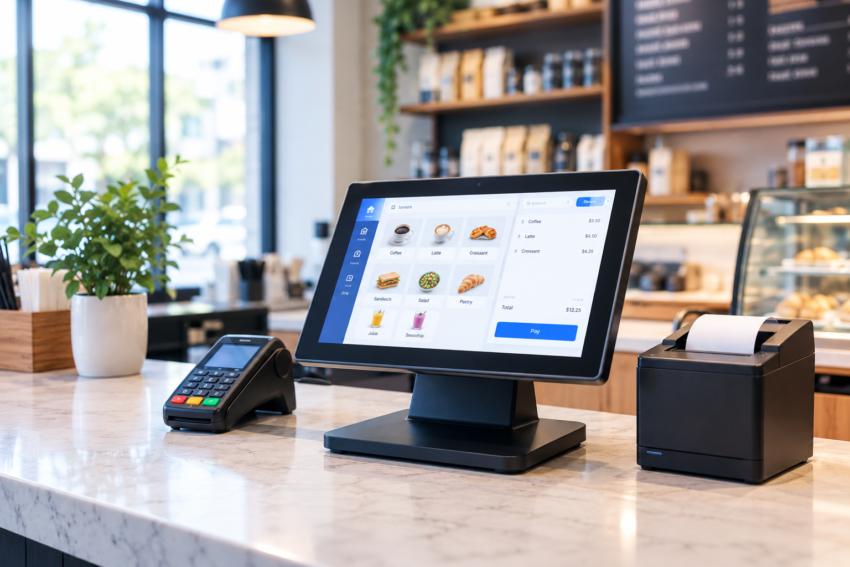
Running a small business involves a lot of moving parts. Customers need to be served, payments need to be processed, products need to be tracked, and sales information needs to be recorded accurately. When these tasks are handled separately, even simple daily operations can become unnecessarily time-consuming.
This is where a point-of-sale system can make a difference. A modern POS can bring several routine business functions together, giving owners and employees one place to manage transactions and access useful information.
For retailers, cafés, restaurants, salons, repair shops, and other service-based businesses, choosing the right pos system for small business operations can improve the way everyday transactions are handled without requiring an overly complicated technology setup.
What Does a POS System Actually Do?
At its simplest, a POS system records a transaction when a customer purchases something. However, modern systems can handle considerably more than that.
Depending on the platform, a POS may include:
- Payment processing
- Product and inventory tracking
- Sales reporting
- Barcode scanning
- Receipt printing
- Returns and refunds
- Employee management
- Customer information
- Multi-location reporting
The exact features vary between providers, which is why businesses should first understand their own requirements before choosing a system.
A small shop selling a limited number of products may need only basic payment and inventory features. A growing retailer with several locations may require synchronized inventory, detailed reporting, and centralized management.
Why Small Businesses Are Moving Away From Traditional Cash Registers
Traditional cash registers can still work for very simple operations, but they provide limited information compared with modern POS technology.
A basic register may tell an employee how much money was received. A modern POS can potentially show what was sold, when it was sold, which products are moving quickly, and how sales are performing over a particular period.
This information can help business owners make better operational decisions.
For example, if a retailer notices that a particular product consistently sells out on weekends, inventory levels can be adjusted accordingly. A restaurant might discover that certain menu items are particularly popular during specific periods.
The system becomes useful not only at checkout but also when reviewing how the business operates.
Inventory Management for Small Businesses
Inventory can be difficult to manage when everything is recorded manually.
A product may be sold at the counter, but someone still has to remember to update the stock count. As the number of products increases, small mistakes can quickly accumulate.
A POS with inventory functionality can automatically adjust stock levels as sales are recorded. This does not eliminate the need for physical inventory checks, but it can give staff a much clearer starting point.
Businesses can use inventory information to identify:
- Products that sell quickly
- Items that have been sitting in stock
- Low-stock products
- Seasonal demand
- Differences between locations
For a growing business, having this information available without maintaining multiple spreadsheets can save considerable administrative time.
Payment Processing Should Be Simple
The payment experience matters to both customers and employees.
Customers expect transactions to be quick and convenient, whether they are paying with debit, credit, or another supported payment method. Employees also need a system that is straightforward enough to use during busy periods.
When evaluating a small business POS solution, businesses should look at how the POS works with payment terminals and whether the system supports the payment methods their customers commonly use.
Transaction speed, refunds, receipts, and payment reporting are all worth considering before making a decision.
For Canadian businesses, payment requirements can also include Interac debit alongside major credit card networks. The payment setup should be compatible with the business’s chosen POS and processing arrangement.
POS Systems and Canadian Tax Requirements
Canadian businesses also need to consider sales taxes when setting up their POS.
Depending on the province and the nature of the business, transactions may involve GST, HST, PST, or QST. Ontario, British Columbia, Quebec, and Alberta do not all follow the same provincial tax structure.
A properly configured POS can apply the appropriate tax settings during a transaction and include the relevant information in sales records.
However, POS software should not be treated as a replacement for professional tax advice. Businesses should confirm their tax obligations with an accountant or qualified tax professional and then ensure the POS is configured accordingly.
What Happens When the Internet Goes Down?
Internet connectivity is an important consideration for modern POS systems.
Many systems rely on cloud services for synchronization, reporting, software updates, or other functions. Payment processing can also depend on connectivity.
A business should therefore understand what happens if its internet connection becomes unavailable.
Some POS platforms provide offline capabilities for certain functions, while others may have different limitations. Before choosing a system, ask what employees can still do during an outage and how transactions are synchronized afterward.
This is particularly important for businesses that depend heavily on connected technology.
A POS should also fit into the company’s broader connectivity environment. Businesses using cloud applications, VoIP phones, security systems, multiple checkout stations, or several locations may need to think about their network infrastructure as part of the overall technology plan.
Choosing a POS for a Growing Business
The right system today may not be the right system two years from now.
A business that currently operates one location may eventually add another. A retailer may expand its product range. A café may introduce online ordering or additional payment options.
This makes scalability worth considering from the beginning.
When comparing a pos system for small business, ask whether the platform can support additional users, products, locations, integrations, and hardware as the company grows.
It is usually easier to plan for reasonable growth than to replace the entire POS environment after reaching a limitation.
Don’t Overlook Support
Technical support is often overlooked when businesses compare POS systems.
A system may work perfectly for months, but eventually there may be a payment terminal issue, software problem, hardware failure, or configuration question.
Knowing who to contact can make a significant difference.
Small businesses may benefit from working with a technology provider that can understand the POS environment alongside other business systems. For example, a company such as CanComCo can be relevant for businesses looking at POS technology together with connectivity, telecommunications, automation, and other business technology requirements.
The important thing is not simply having a provider’s name available. Businesses should understand what type of support is offered, how issues are handled, and whether assistance is available when it is actually needed.
Understanding the Total Cost
The price displayed on a POS website is rarely the entire cost of ownership.
Businesses should consider hardware, software subscriptions, payment processing, installation, integrations, support, additional locations, and replacement equipment.
A system that appears inexpensive at first may become more expensive once additional features and services are added.
Before signing an agreement, ask for a clear breakdown of the expected costs and determine which services are included.
Final Thoughts
A POS system can become an important part of a small business’s daily operations. It can bring payments, sales information, inventory, and reporting into one environment while reducing some of the manual work involved in running the business.
The best small business pos solution is not necessarily the one with the most features. It is the one that fits the company’s size, industry, payment requirements, staff, budget, and plans for growth.
For businesses exploring POS technology, it is also worth looking beyond the checkout counter. Connectivity, communications, automation, hardware, and technical support can all influence how well the overall system performs.
Taking the time to evaluate these factors can help a small business choose a POS setup that is practical today and flexible enough for tomorrow.