

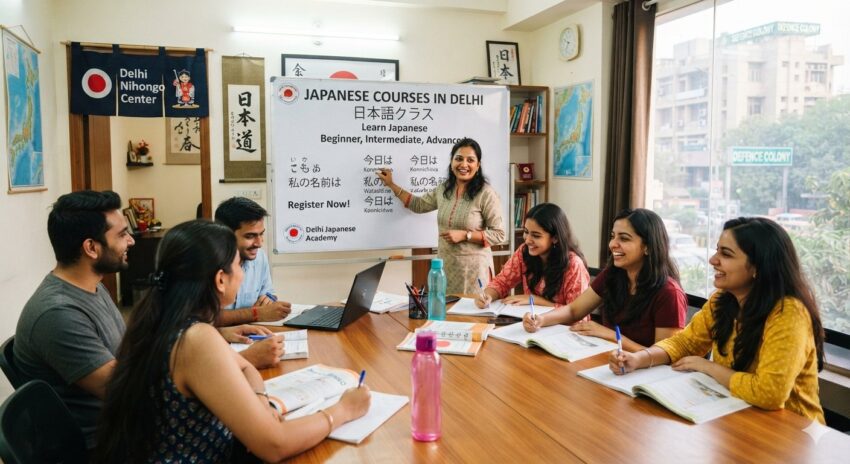
Looking for Japanese courses in Delhi? Learn how to compare institutes, choose JLPT levels, and find affordable Japanese books step by step.
To enroll in Japanese courses in Delhi, decide your goal (hobby, career, or JLPT), compare institutes by trainer qualifications, batch size, and syllabus, attend a demo class, confirm fees and certification in writing, then register and buy affordable beginner books like Minna no Nihongo or Genki. Most beginners start with N5-level classes.
Why Learn Japanese in Delhi Right Now?
Affordable Japanese Courses in Delhi and the wider NCR have a steady demand for Japanese speakers. Japanese companies operate here in manufacturing, IT, automotive, and services, and many need bilingual staff, interpreters, and coordinators. Others learn Japanese for study in Japan, anime and manga, travel, or personal interest.
Whatever your reason, a structured course saves time. Japanese uses three scripts (hiragana, katakana, and kanji) and a sentence order unlike English, so guided practice helps far more than random YouTube videos alone.
Step 1: Define Your Goal Before Choosing a Course
Your goal decides the course type, the pace, and the budget. Be honest about it.
|
Your goal |
Best-fit course type |
Typical target |
|---|---|---|
|
Hobby, travel, anime |
Short conversational course |
Basic speaking, hiragana, katakana |
|
Job with a Japanese company |
JLPT-focused course |
N5, then N4 or N3 |
|
Study or work in Japan |
Intensive JLPT plus speaking |
N4 to N2 |
|
Interpreter or translator |
Long-term, kanji-heavy program |
N2 or above |
If you are unsure, start with N5 (the beginner level). It teaches the foundations that every path needs.
Step 2: Understand the JLPT Levels
The Japanese-Language Proficiency Test (JLPT) is the most widely recognized Japanese exam. It has five levels: N5 (easiest) to N1 (hardest). Many employers and universities ask for N3, N2, or N1, so checking the level you need early prevents wasted months.
As a rule, beginners should aim for N5 first, then move up one level at a time. Check the official JLPT website for current test dates, registration rules, and test centres in India, since schedules and fees can change.
Step 3: Compare Japanese Language Institutes in Delhi
Delhi offers several types of learning options. Each suits a different learner.
Types of Japanese courses in Delhi
- Private language institutes: Flexible batches, JLPT-oriented, often with weekend and evening classes.
- University and cultural programs: Academic, structured, and often longer-term. Several Delhi universities offer Japanese as a certificate, diploma, or degree subject.
- Online and hybrid classes: Useful if you live far from a centre or have a busy schedule.
- One-to-one tutors: Faster personal progress, but check qualifications carefully.
What to check before you enroll
Use this checklist when you visit or call an institute:
- Trainer profile: Is the teacher a JLPT-certified or experienced Japanese instructor? Ask about their own JLPT level and teaching experience.
- Syllabus clarity: A good institute can show a lesson plan for each level, not just a promise of “fluency.”
- Batch size: Smaller batches give more speaking practice. Ask how many students sit in one class.
- Demo class: Attend at least one trial session before paying.
- Study material: Find out which textbooks are used and whether they are included in the fee.
- Mock tests: For JLPT students, regular practice papers matter.
- Fee transparency: Get the total cost, installment terms, and refund policy in writing.
- Certificate value: An institute certificate is useful for learning proof, but it does not replace an official JLPT result.
Be cautious of: guarantees like “100% job placement,” “fluent in 30 days,” or pressure to pay immediately. Real language learning takes consistent months of practice.
Step 4: Know the Typical Learning Path
A realistic beginner timeline looks like this. Exact duration varies by institute, class hours, and how much you practice at home.
- Weeks 1 to 4: Hiragana, basic greetings, self-introduction.
- Next few weeks: Katakana, numbers, days, simple sentences.
- Following months: Basic grammar (particles, verb forms), first set of kanji, short conversations.
- Toward N5: Reading short passages, listening practice, mock tests.
Ask each institute how many hours of class time they plan for N5. Compare that number, not just the “duration in months.”
Step 5: Choose Affordable Japanese Books
Good books make a course far more effective, and you do not need to overspend. Affordable Japanese books are easy to find if you know what to look for.
Popular beginner textbooks
|
Book |
Best for |
Why learners use it |
|---|---|---|
|
Minna no Nihongo (Beginner I and II) |
Classroom learners |
Widely used in Japanese language schools; pairs with a teacher-led course |
|
Genki I and II |
Self-study and classes |
Explanations in English, clear grammar sections, workbook available |
|
Marugoto |
Communication-focused learners |
Emphasis on real-life situations |
|
JLPT N5 practice books |
Exam preparation |
Mock papers and vocabulary lists |
How to buy Japanese books without overspending
- Ask your institute first. Some include books or recommend specific editions. Buying the wrong edition wastes money.
- Compare editions. Genki and Minna no Nihongo have updated editions; make sure your teacher uses the same one.
- Check Indian editions and local bookstores. Imported books can cost more, so compare prices across stores and reputable online sellers.
- Look for second-hand copies. Textbooks in good condition are fine, but avoid used workbooks with answers already filled in.
- Buy only what you need. A textbook, a workbook, and one JLPT practice book are enough for N5.
Tip: Prices change often, so check the current price on a few trusted sellers instead of relying on any figure you read online.
Step 6: Register and Prepare for Your First Class
Once you have shortlisted an institute:
- Attend the demo class and note how much the teacher uses Japanese versus English.
- Ask for the full fee breakdown, batch timings, and start date.
- Confirm the refund and batch-change policy.
- Complete registration and keep a copy of the receipt.
- Buy the recommended book and start learning hiragana before day one. Even a few days of practice makes the first class easier.
Practical Example: Choosing the Right Course
Priya works in Gurugram and wants a job with a Japanese automotive company. She chooses a weekend N5 batch with a small group, attends a demo class, and confirms the textbook is Minna no Nihongo. She buys a second-hand copy of the same edition and practises hiragana for a week before starting. Her plan: clear N5, then move to N4 within the following year.
This approach works because she matched the course to her goal, checked the material first, and saved money on books.
Tips to Learn Japanese Faster
- Practise a little every day instead of cramming on weekends.
- Speak aloud, even if you are alone. Shadowing audio helps pronunciation.
- Use flashcards for vocabulary and kanji.
- Listen to beginner-friendly content such as NHK’s Easy Japanese resources.
- Find a study partner in your batch for conversation practice.
- Take mock tests under time limits as the exam gets closer.
FAQ,s
1. Which is the best place to learn Japanese in Delhi?
There is no single best option. The right choice depends on your goal, budget, and schedule. Compare trainer experience, syllabus, batch size, and demo classes before deciding.
2. How long does it take to learn Japanese for beginners?
It varies. Reaching N5 usually takes several months of regular classes and practice, depending on weekly hours and your effort.
3. Do I need to know Japanese before joining a beginner course?
No. Beginner courses start from zero, usually with hiragana and basic greetings.
4. What is the difference between N5 and N1?
N5 is the easiest JLPT level, covering basic vocabulary and grammar. N1 is the most advanced, requiring strong reading and listening skills.
5. Are online Japanese classes as good as classroom classes?
They can be, if the trainer is qualified, the batch is small, and you practise speaking regularly. Choose based on your learning style and schedule.
6. Which Japanese books are best for beginners?
Minna no Nihongo and Genki are widely used. Ask your teacher which one matches your course before buying.
7. Where can I find affordable Japanese books?
Check your institute, local bookstores, reputable online sellers, and second-hand markets. Compare prices and confirm the edition first.
8. Can I learn Japanese through self-study alone?
Yes, but many learners progress faster with a teacher who corrects pronunciation and grammar mistakes.
9. Is a Japanese course certificate enough to get a job?
It helps show your learning, but employers often prefer an official JLPT result, such as N4, N3, or N2.
10. How do I know if an institute is trustworthy?
Look for qualified trainers, a clear syllabus, a demo class, written fee details, and honest claims about results. Read recent student reviews from independent sources.
Conclusion
Enrolling in Japanese courses in Delhi becomes simple when you follow a clear order: set your goal, understand JLPT levels, compare institutes, attend a demo class, and buy the right books. Start with N5, stay consistent, and choose affordable Japanese books that match your course edition.