
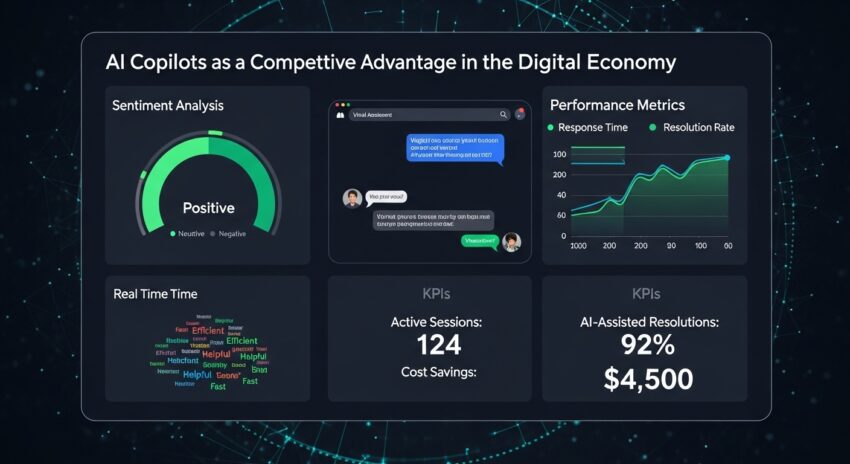
Introduction
The digital economy has transformed the way businesses operate, compete, and grow. Rapid technological advancements, evolving consumer expectations, and data-driven business models have created both unprecedented opportunities and complex challenges. In this highly dynamic environment, organizations that can leverage advanced technologies to make smarter, faster, and more accurate decisions gain a decisive competitive edge.
AI copilot solutions have emerged as one of the most transformative tools for businesses navigating the digital economy. An ai copilot solution functions as an intelligent assistant, augmenting human decision-making by analyzing large volumes of data, providing actionable insights, and recommending optimal strategies. Unlike traditional automation tools, AI copilots offer predictive capabilities, real-time guidance, and continuous learning, making them invaluable for organizations seeking agility, efficiency, and innovation.
This article explores how AI copilots create competitive advantage, highlighting their applications across industries, their role in enhancing decision-making, and the strategic importance of engaging an ai copilot development company and leveraging ai copilot development services for tailored implementation.
1. The Digital Economy and the Need for Agility
The digital economy is characterized by:
-
Rapid Technological Innovation: Emerging technologies such as AI, IoT, and blockchain are reshaping business operations.
-
Data-Driven Decision Making: Organizations increasingly rely on real-time analytics to guide strategy and operations.
-
Global Competition: Companies face competition across borders, requiring faster adaptation to market trends.
-
Customer-Centric Models: Success depends on understanding and anticipating consumer behavior in real time.
In this environment, businesses that rely solely on traditional decision-making approaches—manual analysis, periodic reporting, and intuition—risk falling behind. AI copilots provide a competitive advantage by enabling organizations to act faster, make more accurate decisions, and respond proactively to market dynamics.
2. Understanding AI Copilot Solutions
An ai copilot solution is an intelligent assistant designed to support human decision-making across organizational processes. It combines machine learning, advanced analytics, and automation to provide real-time insights, predictive guidance, and actionable recommendations.
2.1 Key Features of AI Copilots
-
Data Aggregation and Analysis: Consolidates data from multiple internal and external sources, providing a holistic view of operations.
-
Predictive Insights: Forecasts trends, risks, and opportunities based on historical and real-time data.
-
Anomaly Detection: Identifies unusual patterns that could indicate operational, financial, or market risks.
-
Decision Guidance: Recommends optimal courses of action based on multiple variables, constraints, and objectives.
-
Continuous Learning: Improves predictions and guidance over time by incorporating outcomes and feedback.
By combining these capabilities, AI copilots enhance decision-making quality, reduce errors, and accelerate organizational responsiveness.
3. Driving Competitive Advantage Through Decision Accuracy
Business success in the digital economy depends on making accurate, timely, and data-driven decisions. AI copilots strengthen decision accuracy across strategic, operational, and financial domains.
3.1 Strategic Decision Support
AI copilots enable executives to make better strategic decisions by analyzing market trends, competitor behavior, and internal performance metrics.
Example: A retail company deployed an AI copilot solution to guide its expansion strategy. The system analyzed demographic trends, purchasing patterns, and competitor presence to recommend high-potential locations, resulting in increased revenue and market share.
3.2 Operational Decision Optimization
AI copilots analyze workflows, resource utilization, and process efficiency to recommend operational improvements. This reduces inefficiencies and ensures consistent, high-quality outcomes.
Example: A manufacturing firm implemented AI copilots to optimize production schedules. By predicting machine downtime and supply chain delays, the system reduced operational disruptions by 15% and improved overall throughput.
3.3 Financial Decision Accuracy
AI copilots strengthen financial decision-making by providing predictive insights, risk assessment, and automated reporting. They help organizations allocate resources effectively, optimize investments, and prevent financial losses.
Example: A mid-sized bank used an AI copilot development service to implement predictive credit risk models. The system identified high-risk loan applications, reducing default rates by 20% while improving lending efficiency.
4. Enhancing Customer Experience as a Competitive Differentiator
Customer expectations in the digital economy are higher than ever. AI copilots empower organizations to deliver superior experiences by analyzing customer behavior, predicting preferences, and enabling personalized engagement.
4.1 Personalization and Targeted Recommendations
AI copilots analyze purchase history, browsing behavior, and engagement patterns to recommend products, services, or content that resonate with individual customers.
Example: An e-commerce platform leveraged an AI copilot solution to personalize marketing campaigns. Recommendations tailored to individual customers increased conversion rates by 18% and reduced churn.
4.2 Predictive Customer Insights
AI copilots predict potential customer issues, satisfaction levels, and churn risks, enabling proactive interventions that strengthen loyalty and retention.
4.3 Streamlined Customer Support
AI copilots assist customer service teams by providing contextual guidance and knowledge-based recommendations, resolving issues faster and improving service quality.
5. Risk Management and Compliance in the Digital Economy
The digital economy introduces new risks, from cybersecurity threats to regulatory compliance challenges. AI copilots mitigate these risks and ensure organizations operate safely and ethically.
5.1 Cybersecurity and Threat Detection
AI copilots continuously monitor IT systems, detect anomalies, and predict potential cyber threats, enabling rapid response and minimizing damage.
5.2 Regulatory Compliance
AI copilots track regulatory changes, analyze operational data, and provide automated reporting, reducing compliance errors and penalties.
Example: A healthcare network deployed an AI copilot solution to monitor HIPAA compliance. The system flagged unauthorized access to patient records and automated audit reporting, reducing compliance violations by 22%.
6. Driving Innovation and Agility
AI copilots not only enhance existing operations but also enable innovation by providing actionable insights into emerging opportunities.
6.1 Product Development
AI copilots analyze market trends, customer feedback, and competitor offerings to guide product development decisions, reducing time-to-market and increasing the likelihood of successful launches.
6.2 Market Expansion
AI copilots identify new market opportunities by predicting demand trends and analyzing regional or demographic data, helping organizations enter new markets with confidence.
6.3 Agile Decision-Making
Real-time insights from AI copilots allow organizations to respond quickly to disruptions, competitive moves, or shifting consumer preferences, maintaining agility in fast-paced markets.
7. Role of AI Copilot Development Companies and Services
Implementing AI copilots effectively requires specialized expertise in AI, data analytics, and industry-specific regulations. Engaging an ai copilot development company and leveraging ai copilot development services ensures that solutions are customized, scalable, and seamlessly integrated.
7.1 Custom AI Models
Development companies design AI copilots tailored to organizational workflows, regulatory requirements, and operational challenges, maximizing accuracy and effectiveness.
7.2 System Integration
AI copilots are integrated with ERP, CRM, financial systems, and other platforms to provide unified insights across departments.
7.3 Continuous Learning and Optimization
AI copilots evolve with the organization, incorporating new data, feedback, and regulatory changes to maintain high performance and relevance.
7.4 Security and Compliance
Development services ensure AI copilots adhere to data privacy regulations and employ robust security measures, protecting sensitive business and customer information.
8. Real-World Applications
Case Study 1: Retail Expansion
A national retail chain used an AI copilot solution to guide store expansion, inventory management, and marketing strategies. By analyzing demographic data and purchasing trends, the system recommended high-potential locations and stock allocations, increasing revenue per store by 12% and reducing inventory shortages.
Case Study 2: Manufacturing Operations
A global manufacturer deployed AI copilots to optimize supply chains, monitor production efficiency, and predict maintenance needs. The system reduced operational disruptions by 18% and improved production throughput by 15%.
Case Study 3: Financial Services
A regional bank partnered with an AI copilot development company to implement predictive models for loan approval and fraud detection. The system flagged high-risk applications, reduced default rates by 20%, and improved regulatory compliance reporting.
9. Long-Term Benefits of AI Copilots as a Competitive Advantage
Organizations that adopt AI copilots experience multiple strategic benefits:
-
Enhanced Decision Accuracy: AI copilots reduce human error and provide actionable, data-driven insights.
-
Operational Efficiency: Automation of data analysis and reporting frees teams to focus on strategic initiatives.
-
Agility and Responsiveness: Real-time insights enable rapid responses to market changes.
-
Improved Customer Experience: Predictive recommendations and personalized engagement strengthen loyalty and retention.
-
Risk Mitigation: AI copilots detect anomalies, predict risks, and ensure regulatory compliance.
-
Innovation Enablement: Insights guide product development, market entry, and strategic initiatives, fostering innovation.
10. Future Outlook
The role of AI copilots in the digital economy is expected to expand dramatically:
-
Autonomous Decision Support: AI copilots may independently execute routine decisions under human supervision.
-
Cross-Industry Learning: Copilots will leverage insights across sectors to improve predictive accuracy.
-
Integration with Emerging Technologies: IoT, blockchain, and augmented analytics will enhance AI copilot capabilities.
-
Emotionally Aware AI: Future copilots may detect cognitive bias or human stress, enhancing high-stakes decision-making.
Organizations adopting AI copilots early will gain sustained competitive advantage through faster, smarter, and more accurate decisions.
Conclusion
AI copilots are transforming the digital economy by enabling organizations to make smarter, faster, and more accurate decisions. An ai copilot solution provides real-time insights, predictive analytics, and actionable recommendations that enhance decision-making, improve operational efficiency, and strengthen customer engagement.
Engaging an ai copilot development company and leveraging specialized ai copilot development services ensures that solutions are customized, secure, and integrated seamlessly across organizational workflows. Companies that implement AI copilots gain a significant competitive advantage: enhanced agility, improved decision accuracy, risk mitigation, and the ability to innovate and respond quickly in a rapidly changing digital economy.