
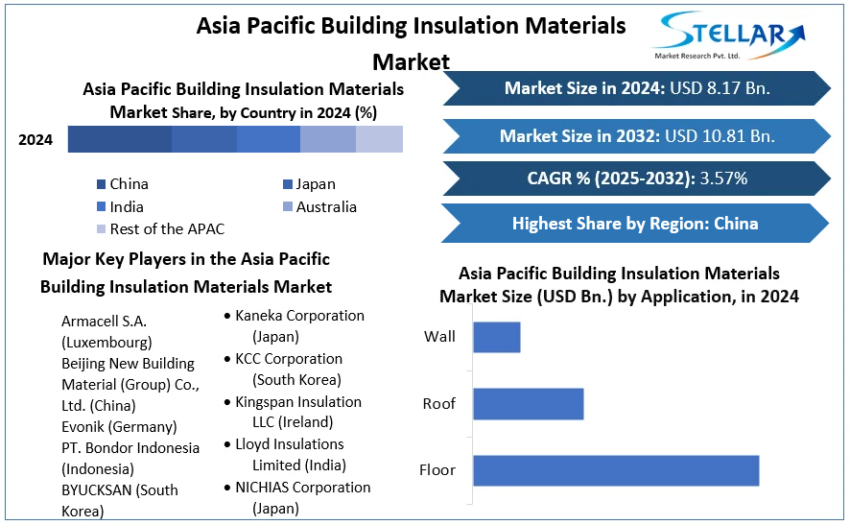
The Asia Pacific Building Insulation Materials Market is experiencing a structural transition toward decarbonized building envelopes and extreme-weather resistance, according to a comprehensive intelligence report published by Stellar Market Research. Valued at USD 8.17 billion in 2024, the regional market is forecasted to hit USD 10.81 billion by 2032, advancing at a Compound Annual Growth Rate (CAGR) of 3.57%. Accelerating urbanization, climate adaptation strategies, and stringent energy efficiency mandates across East and South Asia are repositioning high-performance thermal barriers from optional building additions to core structural imperatives.
This structural evolution is further accelerated by the rapid footprint expansion of AI-driven data centers, modern cold-chain logistics, and industrial infrastructure requiring strict thermal stability and non-combustible building materials. Manufacturers that align their product portfolios with lower-embodied-carbon polymers, bio-resins, and enhanced fire-rated mineral matrices are capturing disproportionate market share in high-density urban development zones.
Key Findings from the Report
-
Expanded Polystyrene (EPS) Maintains Portfolio Dominance: EPS generated 47.6% of total regional market revenues in 2024, backed by its superior strength-to-weight ratio, structural versatility, sound attenuation, and earthquake-resistant mechanical cushioning.
-
Extruded Polystyrene (XPS) Expands Moisture-Barrier Utility: Capturing a 35.5% market share in 2024, XPS continues to gain traction across tropical Asia due to its closed-cell hydrophobic properties, high compressive strength, and resistance to fungal/microbial degradation in humid foundations.
-
Mineral Wool Surges on Fire Safety Mandates: Holding 16% market share in 2024, mineral wool is witnessing accelerated adoption in high-rise commercial structures and industrial facilities where non-combustibility and acoustic isolation are regulatory prerequisites.
-
Wall Assemblies Lead Application Demand: The wall insulation segment dominated application revenues with a 39.5% share in 2024, driven by exterior wall insulation systems (ETICS) designed to prevent perimeter heat gain in high-density residential complexes.
-
Roof & Floor Insulation Gain Momentum: Roof applications accounted for 31% of the market in 2024, while floor insulation secured 29.5%, buoyed by increased industrial warehouse construction and HVAC floor-slab thermal decoupling.
-
Country-Level Growth Divergence: China leads the region in total volume consumption, whereas India is projected to record the highest market CAGR through the forecast period due to large-scale housing programs and infrastructure modernizations.
For further information, click the following link: https://www.stellarmr.com/report/Asia-Pacific-Building-Insulation-Materials-Market/1244
Market Drivers and Restraints
-
Drivers:
-
Government Energy Efficiency Policies & Net-Zero Target Adoption: Stringent national building codes—such as China’s Ultra-Low Energy Building Standards and India’s Energy Conservation Building Code (ECBC)—are mandating lower overall thermal transfer values (OTTV) for new constructions.
-
Surging Urbanization & Residential Housing Boom: Massive migratory shifts into Tier-1 and Tier-2 cities across South and Southeast Asia are fueling rapid construction of multi-story residential towers requiring standardized thermal envelope insulation.
-
Climate Resilience and Rising Ambient Temperatures: Heatwaves across Asia Pacific are elevating air-conditioning usage, prompting building owners to install high-performance insulation to curb electricity cost spikes and grid overload.
-
-
Restraints:
-
Petrochemical Raw Material Volatility & Tariff Pressures: Fluctuation in crude oil derivatives used for polyols, styrene, and blowing agents creates price unpredictability for EPS, XPS, and polyurethane insulation boards.
-
High Initial Capital Outlay & Inconsistent Compliance: Higher upfront material and specialized labor costs, coupled with fragmented enforcement of energy codes in developing sub-regions, continue to hinder rapid insulation adoption in low-margin construction projects.
-
Technology, Regulation, and Sustainability Trends
The Asia Pacific building insulation industry is undergoing a dual digital and green transformation. On the technological front, advanced blowing agents with zero Ozone Depletion Potential (ODP) and ultra-low Global Warming Potential (GWP) are rapidly replacing legacy hydrofluorocarbons (HFCs). Manufacturers are also integrating aerogel blankets and vacuum insulation panels (VIPs) into ultra-thin architectural assemblies where space optimization is paramount.
Regulatively, ESG capital deployment is forcing commercial developers to obtain green building certifications like LEED, BREEAM, and Green Mark. This shift is driving demand for circular-economy insulation solutions—such as stone wool produced from recycled slag and EPS boards incorporating post-consumer recycled polystyrene.
Regional Insights
-
East Asia (Market Anchor): China remains the largest manufacturing base and consumer of building insulation materials in Asia Pacific, supported by vast state-backed green building initiatives and commercial construction. Japan and South Korea represent mature high-tech markets where demand centers around fire-rated mineral wool and ultra-thin high-efficiency polyisocyanurate (PIR) panels for urban retrofits and seismic-resilient envelopes.
-
South & Southeast Asia (High-Growth Engines): India stands out as the fastest-growing market in the region, driven by extensive smart city initiatives, government housing schemes, and expanding commercial real estate footprints. Meanwhile, ASEAN nations such as Indonesia, Vietnam, and Thailand are registering rising demand for moisture-resistant XPS and spray foam insulation across industrial logistics parks and cold-chain hubs.
Recent Industry Developments
-
ROCKWOOL Group (2026): Announced an USD 810 million global capital investment strategy targeting stone wool manufacturing capacity expansions and factory electric melting decarbonization, significantly expanding its supply footprint across Asia Pacific.
-
Kingspan Group (2025): Expanded localized production lines in East Asia for lower-embodied-carbon premium insulation systems to supply high-performance net-zero commercial building envelopes.
-
Beijing New Building Material Co., Ltd. (2025): Scaled up automated green insulation material manufacturing facilities in China to align with the country’s strict multi-story residential building energy codes.
-
Kaneka Corporation (2025): Commercialized specialized high-density, moisture-resistant Extruded Polystyrene (XPS) variants tailored specifically to tropical high-humidity application conditions across Southeast Asia.
-
Holcim Group (2025): Allocated substantial capital toward acquiring and expanding eco-friendly rigid insulation foam and envelope retrofitting assets to strengthen its sustainable construction solutions portfolio in APAC.
For further information, click the following link: https://www.stellarmr.com/report/Asia-Pacific-Building-Insulation-Materials-Market/1244
Competitive Landscape
The Asia Pacific building insulation materials market is moderately consolidated, with major global multinational conglomerates competing alongside specialized regional manufacturers. Key strategic imperatives among leaders include regional production localization, raw material backward integration, circular product recycling programs, and strategic distribution partnerships with large-scale EPC contractors.
Leading Market Participants Include:
- Armacell S.A. (Luxembourg)
- Beijing New Building Material (Group) Co., Ltd. (China)
- Evonik (Germany)
- PT. Bondor Indonesia (Indonesia)
- BYUCKSAN (South Korea)
- Huamei Energy-saving Technology Group Co., Ltd. (China)
- Johns Manville (U.S.)
- Kaneka Corporation (Japan)
- KCC Corporation (South Korea)
- Kingspan Insulation LLC (Ireland)
Analyst Commentary
“The Asia Pacific building insulation landscape is pivoting from basic thermal compliance toward holistic climate-resilient building envelopes,” said a Senior Research Analyst at Stellar Market Research. “With rapidly rising ambient temperatures and intense urbanization across major Asian economies, energy efficiency is no longer just an operational savings metric—it is a core asset valuation driver. Manufacturers that successfully blend low embodied carbon, high moisture barrier capabilities, and superior fire safety will dictate market share leadership over the coming decade.”
Future Outlook
Over the 2025–2032 forecast horizon, the Asia Pacific building insulation materials market will be defined by deep-energy building retrofits in mature East Asian metropolises and massive new greenfield construction in South Asia. As regional governments introduce stricter life-cycle carbon regulations for real estate, material selection will increasingly favor circular, fire-safe, and low-GWP insulation solutions. Integrations between building management systems (BMS) and dynamic thermal envelope designs will further solidify insulation’s position as a cornerstone of sustainable urban infrastructure in Asia Pacific.
About US: Stellar Market Research is a multifaceted market research and consulting company with professionals from several industries. Some of the industries we cover include medical devices, pharmaceutical manufacturers, science and engineering, electronic components, industrial equipment, technology and communication, cars and automobiles, chemical products and substances, general merchandise, beverages, personal care, and automated systems. To mention a few, we provide market-verified industry estimations, technical trend analysis, crucial market research, strategic advice, competition analysis, production and demand analysis, and client impact studies.
Address
Phase 3, Navale IT Zone, S.No. 51/2A/2, Office No. 202, 2nd floor, Near, Navale Brg, Narhe, Pune, Maharashtra 411041
Email
sales@stellarmr.com
Mobile
+91 9607365656