
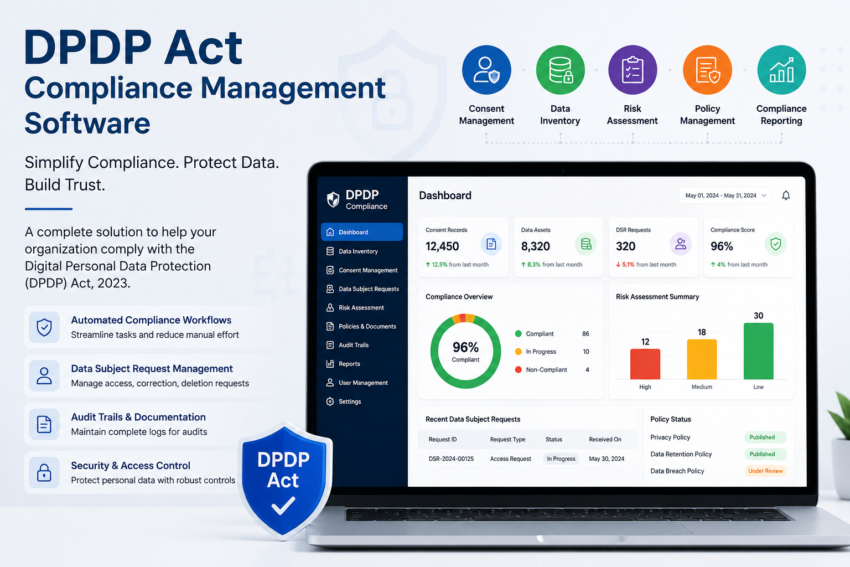
Best DPDP Act Compliance Management Software for Modern Businesses
The Digital Personal Data Protection (DPDP) Act has transformed how organizations collect, process, and protect personal information. Businesses across industries are now looking for the Best DPDP Act Compliance Management Software to simplify compliance, automate privacy workflows, and reduce regulatory risks.
Managing compliance manually can become difficult as businesses grow and process increasing amounts of personal data. The Best DPDP Act Compliance Management Software helps organizations maintain compliance efficiently by automating documentation, consent management, policy updates, risk assessments, and audit readiness.
Whether you are a startup, SME, or enterprise, investing in the Best DPDP Act Compliance Management Software improves operational efficiency while ensuring long-term regulatory compliance.
Why Businesses Need DPDP Compliance Management Software
Compliance is no longer limited to preparing policies or maintaining spreadsheets. Organizations must continuously monitor personal data, manage consent, respond to data requests, and maintain accurate records.
The Best DPDP Act Compliance Management Software centralizes all compliance activities into one platform, making governance easier and reducing administrative workload.
Major benefits include:
- Automated compliance workflows
- Better visibility into personal data
- Faster audit preparation
- Improved customer trust
- Reduced compliance risks
- Centralized privacy management
- Simplified documentation
Businesses adopting the Best DPDP Act Compliance Management Software gain better control over their privacy operations.
What Is DPDP Compliance Management Software?
The Best DPDP Act Compliance Management Software is a digital platform designed to help organizations implement and maintain compliance with India’s Digital Personal Data Protection Act.
Instead of managing multiple spreadsheets, emails, and documents, organizations can automate privacy processes through one centralized dashboard.
The software generally supports:
- Personal data inventory
- Consent management
- Privacy policy management
- Data mapping
- Vendor risk management
- Incident tracking
- Compliance reporting
- Audit documentation
- Employee awareness
- Risk assessments
The Best DPDP Act Compliance Management Software allows businesses to manage compliance proactively instead of reacting to regulatory issues.
Top Features of the Best DPDP Act Compliance Management Software
Selecting the right solution requires evaluating its capabilities.
1. Automated Consent Management
Managing user consent manually is inefficient.
The Best DPDP Act Compliance Management Software automatically records, updates, and manages consent throughout the customer lifecycle.
2. Personal Data Mapping
Organizations need visibility into how personal information moves across departments.
The software creates a structured inventory of data collection, storage, usage, and deletion activities.
3. Privacy Policy Management
Policies frequently require updates as regulations evolve.
The Best DPDP Act Compliance Management Software simplifies policy creation, version control, and documentation.
4. Risk Assessment Dashboard
Businesses can identify privacy risks before they become regulatory issues.
Automated risk scoring helps prioritize remediation efforts.
5. Compliance Reporting
Preparing reports manually consumes valuable resources.
Software automatically generates compliance reports for management and internal audits.
6. Vendor Compliance Monitoring
Third-party vendors also process sensitive information.
The Best DPDP Act Compliance Management Software tracks vendor compliance status and associated risks.
7. Audit Readiness
Organizations remain prepared for regulatory reviews with centralized documentation and compliance records.
Benefits of Using the Best DPDP Act Compliance Management Software
Modern compliance software offers advantages beyond regulatory compliance.
Saves Valuable Time
Automation eliminates repetitive compliance tasks.
Improves Accuracy
Centralized workflows reduce documentation errors.
Enhances Data Security
Privacy controls help safeguard sensitive customer information.
Supports Business Growth
Compliance processes become scalable as organizations expand.
Strengthens Customer Trust
Customers feel more confident sharing information with organizations that prioritize privacy.
Simplifies Regulatory Updates
The Best DPDP Act Compliance Management Software makes adapting to changing regulations easier.
Key Components Included in the Best DPDP Act Compliance Management Software
An effective platform should include comprehensive compliance tools.
Essential modules include:
- Consent Management
- Data Discovery
- Data Classification
- Privacy Dashboard
- Risk Register
- Compliance Monitoring
- Incident Management
- Vendor Management
- Audit Logs
- Employee Training Records
- Document Repository
- Compliance Reports
Together, these modules create a complete privacy management ecosystem.
Who Should Use the Best DPDP Act Compliance Management Software?
Organizations of every size benefit from compliance automation.
Industries include:
- Information Technology
- Banking
- Financial Services
- Healthcare
- Education
- Insurance
- E-commerce
- Manufacturing
- Telecommunications
- Logistics
- Hospitality
- Professional Services
Any organization processing personal information can benefit from the Best DPDP Act Compliance Management Software.
10 Factors to Consider Before Choosing Compliance Software
Selecting the right solution requires careful evaluation.
1. Easy User Interface
Software should be intuitive for both technical and non-technical teams.
2. Automation Capabilities
Look for workflow automation that minimizes manual effort.
3. Scalability
Choose software that grows alongside your organization.
4. Data Security
Strong encryption and access controls are essential.
5. Compliance Reporting
Comprehensive reporting simplifies internal reviews.
6. Customizable Workflows
Every organization has different compliance requirements.
7. Integration Support
Software should integrate with existing business systems.
8. Vendor Risk Management
Managing third-party compliance is increasingly important.
9. Continuous Updates
The Best DPDP Act Compliance Management Software should evolve with regulatory changes.
10. Expert Support
Reliable implementation and ongoing support improve long-term compliance success.
Common Challenges Solved by Compliance Software
Many organizations struggle with:
- Manual compliance tracking
- Incomplete documentation
- Poor visibility into personal data
- Inefficient consent management
- Audit preparation delays
- Vendor compliance monitoring
- Employee awareness
The Best DPDP Act Compliance Management Software addresses these challenges through automation and centralized governance.
Why Automation Is the Future of DPDP Compliance
Privacy regulations continue evolving, making manual compliance increasingly difficult.
Automation helps organizations:
- Detect compliance gaps quickly
- Reduce operational costs
- Improve reporting accuracy
- Respond to data requests faster
- Maintain continuous compliance
- Enhance organizational transparency
Businesses using the Best DPDP Act Compliance Management Software stay prepared for future regulatory changes while improving overall governance.
Best Practices for Successful DPDP Compliance
Organizations should combine technology with strong governance practices.
Recommended best practices include:
- Maintain accurate data inventories
- Regularly review privacy policies
- Train employees on privacy obligations
- Conduct periodic risk assessments
- Monitor vendor compliance
- Document all compliance activities
- Automate repetitive privacy processes
- Review compliance dashboards regularly
Following these practices maximizes the value of the Best DPDP Act Compliance Management Software.
Frequently Asked Questions
What is the Best DPDP Act Compliance Management Software?
The Best DPDP Act Compliance Management Software is a platform that automates privacy compliance, manages consent, tracks personal data, and helps organizations comply with the Digital Personal Data Protection Act.
Why do businesses need compliance management software?
It simplifies compliance by automating documentation, risk assessments, consent management, reporting, and audit preparation while reducing manual work.
Can small businesses use DPDP compliance software?
Yes. The Best DPDP Act Compliance Management Software is suitable for startups, SMEs, and large enterprises with scalable features that match business requirements.
What features should businesses look for?
Important features include consent management, data mapping, risk assessment, audit reporting, document management, vendor monitoring, and workflow automation.
Does compliance software improve data security?
Yes. Centralized controls, monitoring, access management, and automated governance improve overall data protection and privacy management.
Is compliance software a replacement for consultants?
No. While the Best DPDP Act Compliance Management Software automates many processes, expert guidance remains valuable for strategy, implementation, and ongoing compliance management.
How often should compliance software be updated?
Organizations should use software that receives regular updates to align with evolving regulations, business processes, and security requirements.
Conclusion
Implementing the Best DPDP Act Compliance Management Software is one of the smartest investments organizations can make to strengthen data privacy, improve governance, and simplify regulatory compliance. As businesses handle increasing volumes of personal information, manual processes become inefficient and vulnerable to errors. A modern compliance management solution streamlines consent management, documentation, risk assessment, reporting, and audit readiness while reducing operational complexity. By selecting the Best DPDP Act Compliance Management Software that aligns with your organization’s size, industry, and compliance objectives, you can build a future-ready privacy framework that protects customer trust, minimizes regulatory risks, and supports sustainable business growth.