
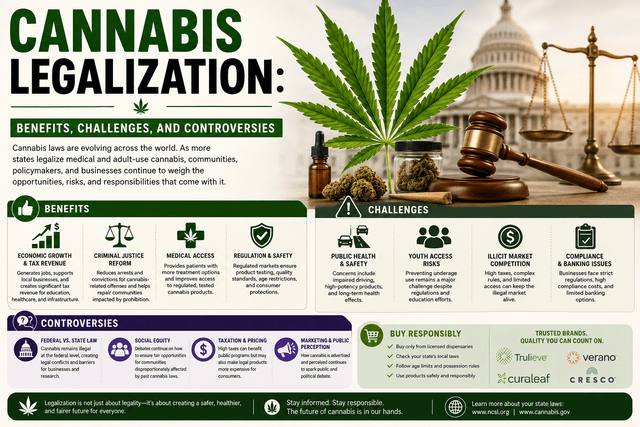
Cannabis legalization has become one of the most debated policy changes in the United States. Over the past few decades, several states have moved from strict prohibition toward medical cannabis programs and regulated adult-use markets. This shift has changed how governments, businesses, consumers, and communities think about cannabis.
However, cannabis legalization in the United States is not a simple nationwide policy. Cannabis laws differ from state to state, and federal law creates an additional layer of restrictions. The National Conference of State Legislatures maintains a current database covering state medical and adult-use cannabis regulations, taxation, public health, licensing, and criminal-justice policies.
So, what are the benefits of legalization, and what challenges and controversies come with it?
What Does Cannabis Legalization Actually Mean?
Cannabis legalization generally means that a government allows certain cannabis-related activities under a regulated legal framework. Depending on the state, this may include medical use, possession by adults, cultivation, manufacturing, retail sales, or some combination of these activities.
Medical cannabis and adult-use cannabis are not necessarily governed by the same rules. Some states permit medical cannabis while restricting adult-use sales, while others have established regulated markets for adults.
This is why consumers should always check the laws in their own state rather than assuming that cannabis is legal throughout the country.
Benefit 1: A Regulated Market
One of the strongest arguments for legalization is the creation of a regulated market.
Under a regulated system, governments can establish requirements for licensed cultivators, manufacturers, laboratories, distributors, and dispensaries. Rules can address product testing, packaging, labeling, licensing, age restrictions, advertising, and retail operations.
The goal is to replace an uncontrolled market with a system that provides government oversight and gives consumers access to products sold through authorized businesses.
State cannabis regulations can cover everything from business licensing and testing laboratories to product standards and retail operations.
Benefit 2: Economic Activity and Tax Revenue
Cannabis legalization has also created new economic opportunities.
Legal cannabis markets can generate tax revenue through cannabis-specific excise taxes and other taxes imposed by states or local governments. States have taken different approaches to taxation, with some applying taxes at the retail level and others using additional local taxes.
Legalization can also support employment in cultivation, retail, laboratory testing, transportation, compliance, technology, marketing, and other areas.
For some states, the potential economic benefits have become an important part of the discussion surrounding cannabis policy.
Benefit 3: Criminal Justice Reform
Cannabis prohibition has historically resulted in arrests and convictions for possession and other cannabis-related offenses.
Legalization and decriminalization can reduce criminal penalties for certain activities. Some states have also created programs that allow eligible cannabis convictions to be sealed, expunged, or otherwise cleared.
This can be important because a criminal record can create obstacles when someone applies for employment, housing, education, or other opportunities.
According to NCSL, states with legal medical and recreational cannabis have increasingly considered policies designed to reduce employment barriers associated with cannabis convictions.
However, legalization alone does not automatically resolve the effects of previous prohibition. The details depend heavily on each state’s laws.
Benefit 4: Medical Access
Medical cannabis was an important part of the broader legalization movement.
California became the first U.S. state to legalize medical cannabis in 1996. Over the following decades, other states established their own medical cannabis programs.
Supporters argue that regulated access gives qualifying patients another option to discuss with healthcare professionals.
At the same time, cannabis should not automatically be considered a substitute for conventional medical treatment. Scientific evidence varies depending on the condition, cannabis product, cannabinoid, and dosage, so consumers should make medical decisions carefully and seek professional advice when appropriate.
Challenge 1: Public Health and Safety
Legalization also creates public-health questions.
Cannabis can affect attention, memory, coordination, and judgment, particularly when someone is intoxicated. This creates concerns about impaired driving and workplace safety.
States have therefore developed rules and public-health programs addressing issues such as cannabis-impaired driving, youth access, product potency, packaging, and responsible consumption.
The challenge is finding a balance between allowing legal adult access and reducing preventable harm.
Challenge 2: Youth Access
Another major controversy involves young people.
Legal cannabis markets generally establish minimum age requirements and impose restrictions designed to prevent sales to minors. However, regulation does not eliminate every risk.
Public-health policymakers continue to debate how cannabis should be advertised, packaged, marketed, and discussed in communities where young people may encounter cannabis-related products or messages.
Education is therefore an important part of legalization. Legal access for adults does not mean cannabis is appropriate for everyone.
Challenge 3: The Illicit Market
Another question is whether legalization completely eliminates illegal cannabis sales.
In some markets, licensed products can compete with unlicensed sellers on price, convenience, availability, and taxes. High taxes and complicated regulations can sometimes make legal products more expensive than products sold outside the regulated system.
This creates a difficult policy challenge: governments want strong regulations and adequate tax revenue while also keeping the legal market competitive.
The Controversy Over Cannabis Businesses
Legalization has created an entirely new commercial industry, but cannabis businesses face unique challenges.
Licensing requirements, compliance costs, taxes, local restrictions, and differences between state and federal law can make operating a cannabis business complicated.
There are also debates about social equity. Communities disproportionately affected by previous cannabis enforcement may argue that they should have greater opportunities to participate in the legal industry.
Some states have responded with licensing programs, record-clearing policies, and other measures intended to address these concerns.
Where Can Consumers Buy Legal Cannabis?
Consumers in states with regulated cannabis markets should purchase products only from licensed dispensaries and should follow their state’s age, identification, possession, and purchasing requirements.
For example, Weedroads operates licensed dispensaries in several states, including Arizona, Connecticut, Florida, Georgia, Maryland, Ohio, Pennsylvania, and West Virginia. Its official dispensary locator allows customers to search by state, city, or ZIP code.
Other legal cannabis businesses operate in different states, but availability and product legality can vary considerably. A company operating legally in one state does not necessarily mean its products can legally be shipped or sold across state lines.
Consumers should therefore verify that a dispensary is licensed in their jurisdiction before purchasing.
Federal vs. State Cannabis Laws
Perhaps the biggest controversy is the conflict between state cannabis programs and federal law.
Some states have legalized cannabis for medical or adult use, but federal restrictions have historically continued to apply. This creates complicated issues involving businesses, banking, taxation, interstate commerce, research, and transportation.
The result is a patchwork system rather than one uniform national cannabis policy. NCSL notes that states have taken different approaches to cannabis regulation and that federalism remains an important issue in cannabis policy.
What Does the Future Hold?
The future of cannabis legalization will likely depend on how governments balance consumer freedom, public health, criminal justice, business interests, taxation, and regulation.
More states may change their laws, while others may adjust existing programs based on lessons from their legal markets. Policymakers will also continue examining questions surrounding cannabis potency, impaired driving, youth prevention, social equity, taxation, and industry regulation.
Rather than being a simple question of whether cannabis should be legal or illegal, the modern debate is increasingly about how cannabis should be regulated responsibly.
Final Thoughts
Cannabis legalization has produced both opportunities and difficult questions. It can create regulated markets, generate tax revenue, expand legal access for qualifying medical patients, and reduce certain cannabis-related criminal penalties.
At the same time, legalization does not remove every public-health concern or eliminate the illicit market. States must continue developing regulations that protect consumers while allowing legitimate businesses to operate.
Most importantly, cannabis laws are not identical across America. Anyone considering purchasing cannabis should check their local laws and use licensed dispensaries where permitted.
The cannabis industry is still evolving, and the next chapter of legalization will likely be shaped by research, regulation, consumer behavior, economic conditions, and changing public attitudes.