
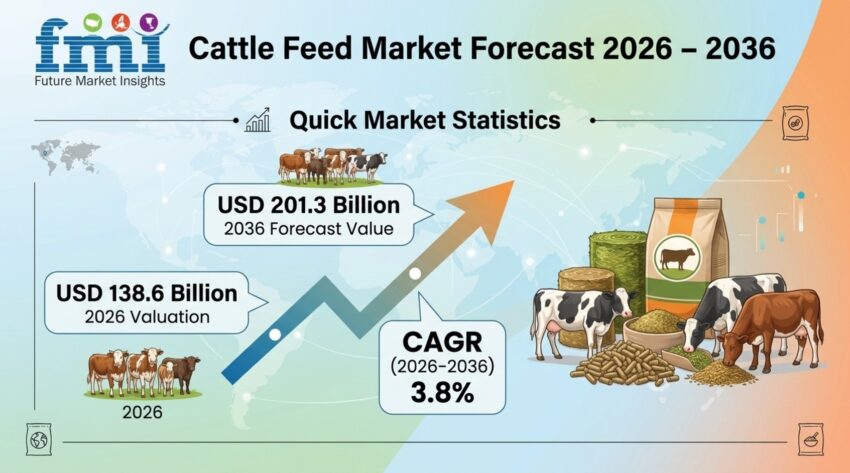
The global cattle feed market is undergoing a structural transition from traditional grazing and unformulated on-farm roughage toward formulated, nutrient-dense diets as dairy and beef producers optimize herd productivity, milk yields, and feed conversion ratios (FCR). Valued at USD 138.6 billion in 2026, the sector is projected to attain USD 201.3 billion by 2036, according to the latest research insights by Future Market Insights (FMI). The forecast implies a 3.8% compound annual growth rate (CAGR) over the 2026–2036 assessment period, generating an absolute dollar expansion opportunity of USD 62.7 billion. Commercial momentum is anchored by rising global dairy and meat consumption, expanding intensive livestock operations, the integration of targeted feed additives, and the adoption of precision feeding strategies that lower environmental footprints.
Quick Market Statistics
- 2026 market valuation: USD 138.6 billion
- 2036 forecast value: USD 201.3 billion
- CAGR (2026–2036):8%
- Incremental opportunity: USD 62.7 billion
- Concentrate foods share of product type (2026):0%
- Pellets share of form segment (2026):0%
- India market forecast CAGR (2026–2036):2%
- Japan market forecast CAGR (2026–2036):3%
- United Kingdom market forecast CAGR (2026–2036):5%
Request a Sample Report: https://www.futuremarketinsights.com/reports/sample/rep-gb-14343
Market Growth Is Becoming a Yield-Optimization and Precision-Nutrition Story
A 3.8% CAGR reflects dependable category expansion across dairy herds and commercial beef feedlots. However, the overarching commercial catalyst is shifting from volumetric herd expansion to maximizing productivity per head through scientific formulation.
Producers face rising land constraints, water costs, and environmental pressures, necessitating higher milk output and lean meat gain from the same animal inventory. Formulators are developing age-, breed-, and lactation-stage-specific diets enriched with amino acids, rumen-protected fats, and specialty bio-additives (including enzymes, probiotics, and antioxidants). These precision nutrition strategies optimize rumen fermentation and nutrient absorption while curtailing enteric methane emissions and feed wastage.
Concentrate Foods Lead Product Type Segmentation
Concentrate foods are projected to capture 44.0% of the product type segment in 2026, leading roughages (pasture, hay, silage, straw, and hulls) and standalone feed additives.
The leadership of concentrates is underpinned by their high nutritional density. Grains, protein meals, oilseed cakes, vitamins, and minerals provide the concentrated metabolic energy and bypass protein necessary to sustain peak milk lactation and rapid weight gain in commercial finishing lots. While roughages remain essential for maintaining rumen motility and fiber digestion, concentrates serve as the primary tool for balancing nutritional deficits in regional forages.
Pellet Formats Dominate Delivery and Mill Handling
Pellets hold a leading 34.0% share of the form category in 2026, outpacing mash, extruded feeds, cubes, flakes, and liquid feeds.
Pelletized feeds offer clear operational and nutritional advantages in mechanized feeding systems. The thermal and mechanical pressure applied during pelleting gelatinizes starches, improving digestibility and palatability. Furthermore, pellets prevent cattle from selectively sorting ingredients at the feed bunk, ensuring uniform nutrient intake across the herd while reducing feed dust and physical bunk wastage. In bulk storage and automated silos, pellets flow easily and resist spoilage during transport.
Feed Additives and Eco-Friendly Rations Gain Ground
Commercial nutritionists are expanding the inclusion of specialized feed additives such as live yeast cultures, phytogenic compounds, and essential trace minerals to bolster rumen pH stability, reduce subacute ruminal acidosis (SARA), and strengthen immune defense. In response to corporate sustainability goals, feed manufacturers are also reformulating rations with local agro-industrial co-products and upcycled plant residues to lower life-cycle carbon emissions without compromising daily energy density.
Regional Analysis: Asian Dairy Momentum Leads Western Market Scale
Geographically, the cattle feed sector displays high-velocity growth across emerging dairy-producing corridors in Asia-Pacific, alongside steady, high-efficiency formulation demand in mature Western livestock markets.
India leads global country-level expansion with an 8.2% CAGR through 2036. Demand is propelled by the world’s largest bovine population, expanding urban middle-class dairy consumption, and the modernization of dairy cooperatives. Increasing farmer awareness regarding compound cattle feed benefits over unformulated grains, supported by government animal husbandry initiatives, is driving commercial feed conversion across cooperative and private dairy sheds.
Japan follows at a 4.3% CAGR, characterized by advanced feeding technologies, strict food safety regulations, and an emphasis on producing high-grade beef (such as Wagyu) and premium dairy products that demand specialized, high-performance rations.
Western and Latin American markets represent critical, scale-driven production hubs:
- United Kingdom (3.5% CAGR): Growth is supported by consumer demand for sustainable, pasture-aligned dairy and beef, driving feed mills toward certified non-GM, locally sourced, and carbon-reduced feed formulations.
- South Korea (3.4% CAGR): Driven by herd health optimization, automated feeding systems, and increasing demand for premium domestic beef (Hanwoo).
- Brazil (3.0% CAGR): Represents an essential global meat exporter where pasture-based systems are increasingly adopting supplemental concentrate feeds, mineralized salt blocks, and feedlot finishing rations to accelerate slaughter turnaround.
Competitive Landscape: Integrated Agribusiness Giants and Regional Feed Compounders
The competitive environment features multinational agribusiness conglomerates operating alongside specialized animal nutrition compounders and cooperative milling groups.
Key market participants include:
- Cargill, Incorporated
- Archer Daniels Midland Company (ADM)
- ForFarmers Inc.
- De Heus Animal Nutrition
- Land O’Lakes, Inc.
Market leaders like Cargill and ADM maintain structural advantages through global commodity sourcing, integrated processing infrastructure, and extensive research centers that develop proprietary feed formulation software and bypass nutrient lines. European specialists such as ForFarmers and De Heus differentiate through on-farm nutritional advisory services, customized herd rations tailored to farm-specific forage assays, and sustainability-certified feed lines. Cooperatives like Land O’Lakes maintain strong domestic distribution footprints and farmer-centric brand equity across extensive retail and dealer networks.
Key Challenges for Industry Participants
- Agricultural Raw Material Volatility: Fluctuating global prices and supply swings in corn, soybean meal, and cereal grains directly squeeze feed mill operating margins.
- Environmental and Emission Scrutiny: Tightening government mandates targeting agricultural greenhouse gas emissions require feed producers to substantiate enteric methane mitigation.
- Forage Quality Discrepancies: Seasonal weather changes alter base forage moisture and nutrient levels, requiring constant batch reformulations to maintain finished feed balance.
Strategic Opportunities Through 2036
- Methane-Reducing Formulation Additives: Integrating natural tannins, essential oils, and targeted bio-actives that suppress methanogenesis in the rumen.
- On-Farm Digital Feeding Integration: Pairing feed deliveries with digital ration-balancing tools and automated feeder telemetry to adjust bunk drops in real time.
- By-Product and Co-Stream Valorization: Incorporating fractionated oilseed meals, citrus pulps, and brewer’s spent grains to reduce dependency on primary grain feedstocks.
- Specialized Transition-Cow Diets: Formulating fortified pre- and post-calving feeds enriched with anionic salts and protected choline to prevent metabolic disorders in high-producing dairy cows.
What the Market Means for C-Level Decision-Makers
For agribusiness executives and feed mill operators, cattle feed has permanently transitioned from a simple bulk commodity into an outcome-driven nutritional solution. Long-term margin defense will depend on securing diversified raw material supply lines, investing in advanced pelleting and automated processing infrastructure, and providing data-backed herd advisory services that prove measurable gains in milk solids and daily live-weight gain.
Exclusive Discounts on Full Report: https://www.futuremarketinsights.com/reports/cattle-feed-market
Executive Takeaways
- The global cattle feed market is forecast to grow from USD 138.6 billion in 2026 to USD 201.3 billion by 2036.
- Sector growth will proceed at a 3.8% CAGR over the ten-year forecast timeline, generating USD 62.7 billion in absolute market value.
- Concentrate foods represent the leading product category, holding a 44.0% share in 2026 due to high nutrient density.
- Pellets command 34.0% of the form segment, favored for uniform intake, low wastage, and handling ease.
- India (8.2% CAGR) and Japan (4.3% CAGR) lead regional growth momentum through 2036.
- Precision nutrition, feed efficiency targets, and functional digestive additives serve as primary competitive differentiators.
Explore More Related Studies Published by FMI Research
Dairy Cattle Feed Market: https://www.futuremarketinsights.com/reports/dairy-cattle-feed-market
Peel Meal Feed Market: https://www.futuremarketinsights.com/reports/peel-meal-feed-market
Feed Enzymes Market: https://www.futuremarketinsights.com/reports/feed-enzymes-market
About Future Market Insights (FMI)
Future Market Insights (FMI) delivers actionable, decision-focused market intelligence that goes beyond traditional research reports.
The company provides:
- In-depth pricing and cost benchmarking analysis
- Demand forecasting based on real industry inputs
- Procurement and buyer behavior insights
- Supply chain and trade flow intelligence
- Technology and application trend analysis across industries
FMI follows a robust bottom-up research methodology, combining insights from industry experts, procurement leaders, manufacturers, and technical professionals to ensure accurate and practical market intelligence.
For Press & Corporate Inquiries
Rahul Singh, AVP – Marketing and Growth Strategy
Future Market Insights,
Inc. +1-347-918-3531
For Sales: sales@futuremarketinsights.com
For Media: Rahul.singh@futuremarketinsights.com