
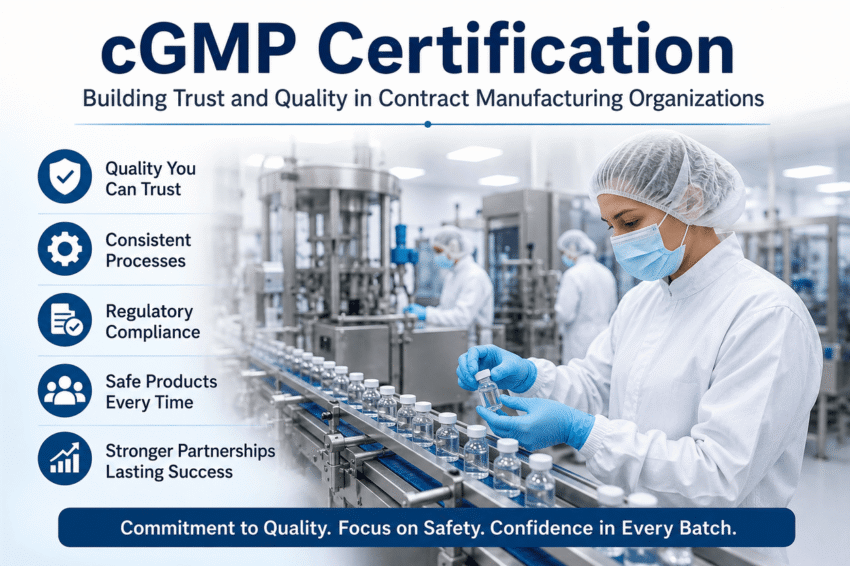
A Strong Foundation for Modern Manufacturing
For Contract Manufacturing Organizations (CMOs), quality is not simply another business requirement—it forms the foundation that supports every product, every client relationship, and every regulatory expectation. When pharmaceutical, biotechnology, medical device, or food companies partner with a manufacturer, they place enormous trust in that organization. Manufacturers earn that trust every day through consistency, control, and documented quality practices.
This is where cGMP Certification becomes essential. The term stands for Current Good Manufacturing Practices, a framework that ensures manufacturers consistently produce and control products according to established quality standards. Unlike static requirements that remain unchanged for years, cGMP evolves alongside technology, scientific advancements, and industry expectations.
For CMOs handling multiple clients and complex production schedules, maintaining compliance through cGMP Certification demonstrates a commitment to quality and reliability. It reassures customers that manufacturing teams follow strict procedures designed to protect product integrity and patient safety.
Why cGMP Certification Matters More Than Ever
Manufacturing environments are becoming increasingly complex. Products move through sophisticated production lines, automated systems generate enormous amounts of data, and regulatory agencies expect greater transparency than ever before.
A cGMP Certification program helps organizations maintain control over these complexities. It creates a structured system where teams document, validate, monitor, and continuously improve processes.
Think of it like the operating system of a manufacturing facility. Without it, departments may function independently but not necessarily efficiently. With cGMP in place, every process—from raw material receipt to final product release—operates as part of a coordinated quality system.
For CMOs, this consistency delivers exceptional value because clients often conduct detailed audits before signing manufacturing agreements. Certification significantly builds confidence during these assessments.
More Than Compliance—It’s About Confidence
Many organizations initially pursue cGMP Certification because regulators require compliance. While that requirement matters, the benefits extend far beyond passing inspections.
Clients want assurance that manufacturers produce their products in facilities capable of maintaining quality under pressure. They need confidence that teams keep processes under control whether they produce one batch or one hundred.
A well-implemented Quality Management System creates this confidence. Organizations standardize procedures, employees understand their responsibilities, and management gains visibility into operational performance.
Interestingly, organizations often discover that certification improves internal efficiency as well. Fewer deviations, fewer product rejections, and fewer production interruptions contribute to smoother operations and stronger profitability.
The Core Elements Behind cGMP Certification
Every successful cGMP Certification program relies on several interconnected components. These elements work together to maintain product quality and operational control.
The most important areas include:
- Documentation Control
- Risk Management
- Process Validation
- Corrective and Preventive Actions (CAPA)
- Employee Training
Documentation serves as the backbone of compliance. If employees do not document a process, regulators often assume it never occurred. Detailed records provide evidence that teams followed procedures correctly and consistently.
Meanwhile, Risk Management helps organizations identify potential issues before they affect product quality. This preventive approach reduces disruptions and supports long-term compliance.
A Day in a cGMP-Compliant Manufacturing Facility
Walk through a facility operating under Current Good Manufacturing Practices, and you will notice something immediately—everything has a purpose.
Maintenance teams maintain equipment according to defined schedules. Employees carefully complete production records. Staff understand their tasks and follow established procedures. They also document and verify cleaning activities.
At first glance, this level of control may appear excessive. Yet organizations implement it for a reason. Small mistakes in manufacturing can create significant consequences, particularly when products affect human health.
A cGMP-compliant facility creates an environment where teams build quality into every step rather than inspect it only at the end of production. This proactive philosophy helps organizations prevent problems instead of merely detecting them later.
How cGMP Certification Strengthens Client Relationships
Contract Manufacturing Organizations operate in a highly competitive marketplace. Potential clients evaluate technical capabilities, pricing structures, production capacity, and compliance history before selecting a manufacturing partner.
cGMP Certification provides a powerful signal that an organization takes quality seriously.
When prospective customers review a certified facility, they gain confidence that established systems support product quality. This confidence often shortens qualification timelines and simplifies supplier approval processes.
Moreover, certification demonstrates accountability. Clients know that the manufacturer has implemented documented procedures designed to maintain compliance and support continuous improvement.
Trust can take years to build and only moments to lose. A strong cGMP framework helps organizations protect that trust.
Technology and cGMP Certification: A Natural Partnership
Manufacturing technology continues to evolve rapidly. Automated production systems, electronic batch records, and digital quality platforms are becoming common throughout the industry.
Fortunately, cGMP Certification adapts well to technological advancement. In fact, modern systems often improve compliance by reducing manual errors and increasing traceability.
Electronic records provide real-time visibility into manufacturing activities. Data analytics help organizations identify trends before they become serious issues. Automated monitoring systems support faster responses to process deviations.
The key lies in ensuring that technology remains validated and properly controlled. New tools can improve efficiency, but organizations must ensure they meet regulatory expectations regarding accuracy, security, and reliability.
Common Challenges During Certification
Achieving cGMP Certification is rewarding, but it is not always simple. Organizations often encounter challenges during implementation.
One common obstacle involves documentation management. Procedures must accurately reflect actual practices rather than idealized workflows. Another challenge concerns employee engagement. Even the most detailed procedures cannot deliver results if personnel fail to understand or follow them consistently.
Resource allocation can also become difficult. Certification requires time, training, and management commitment. Some organizations underestimate the effort involved.
However, these challenges remain temporary. Once teams integrate quality systems into daily operations, the benefits typically outweigh the initial investment.
Benefits of cGMP Certification for Contract Manufacturing Organizations
The advantages of cGMP Certification extend across the entire organization.
- Improved Regulatory Compliance
- Enhanced Product Quality and Consistency
- Increased Customer Confidence
- Better Operational Efficiency
- Reduced Manufacturing Risks
- Stronger Market Reputation
- Greater Audit Readiness
- Improved Employee Accountability
These benefits often reinforce one another. Better quality strengthens client relationships, which can generate additional business opportunities and support long-term growth.
Why Should You Choose cGMP Certification?
Choosing cGMP Certification is not simply about satisfying regulatory requirements. It is about establishing a culture where quality becomes part of everyday decision-making.
For Contract Manufacturing Organizations, this culture creates measurable advantages. Clients increasingly seek manufacturing partners that demonstrate consistent quality performance. Regulatory agencies expect robust quality systems. Market competition continues to intensify.
Certification helps organizations meet these expectations while creating a structured pathway for continuous improvement.
Experienced certification providers such as Integrated Assessment Services simplify the process by offering guidance, audits, training, and technical support throughout the certification journey.
Rather than viewing certification as a one-time project, successful organizations treat it as an ongoing commitment to excellence.
The Future of Contract Manufacturing and cGMP Certification
The future of manufacturing will likely involve greater automation, more data-driven decision-making, and increasing regulatory scrutiny. Despite these changes, one principle will remain constant: quality matters.
cGMP Certification provides a framework that helps organizations adapt to evolving expectations while maintaining operational control. It supports innovation without compromising product integrity and enables growth without sacrificing compliance.
For Contract Manufacturing Organizations, certification represents far more than a credential displayed on a wall. It reflects discipline, accountability, and a commitment to producing products that customers can trust.
As the manufacturing landscape continues to evolve, organizations that invest in cGMP Certification, Quality Management Systems, Regulatory Compliance, Process Validation, Risk Management, Quality Assurance, CAPA, Documentation Control, Employee Training, Manufacturing Compliance, Product Quality, and Continuous Improvement will position themselves to meet future challenges and seize new opportunities.