
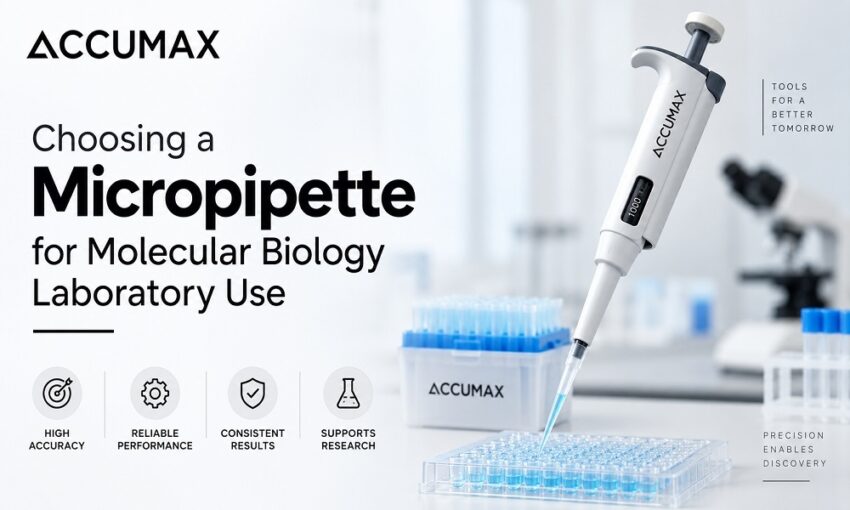
Molecular biology laboratories depend on precision at nearly every stage of an experiment. Whether a researcher is preparing PCR reactions, transferring DNA or RNA samples, creating assay mixtures, or dispensing reagents into microplates, even a small pipetting inconsistency can affect experimental reliability. This makes selecting the right micropipette an important laboratory decision rather than a simple equipment purchase.
A suitable micropipette should match the required volume range, workflow, channel configuration, ergonomics, calibration standards, and maintenance requirements. With multiple designs available today, understanding these factors can help laboratories choose an instrument that supports accurate liquid handling while improving efficiency and user comfort.
Start With the Required Volume Range
Volume range is one of the first factors to consider when choosing a micropipette for molecular biology applications. Researchers frequently work with small liquid volumes, so the pipette should provide appropriate control without forcing the user to operate close to the instrument’s limits.
A broad-range product portfolio can be useful for laboratories with diverse workflows. Accumax, for example, offers air-displacement micropipettes spanning applications from very small volumes up to larger laboratory liquid-handling requirements. Its range includes models covering 0.1 µl to 10 ml, with both variable- and fixed-volume configurations.
For highly sensitive molecular biology procedures, selecting a pipette whose optimal operating range closely matches the target volume can support more consistent dispensing. Laboratories should therefore evaluate actual workflow requirements rather than choosing a model solely because it offers the largest possible range.
Single-Channel or Multi-Channel?
The type of work performed at the bench also determines the ideal pipette configuration. Single-channel micropipettes are versatile and practical for individual tubes, reagent preparation, sample transfers, and routine molecular biology tasks.
Multi-channel pipettes become particularly valuable when several wells must be processed simultaneously. They can improve throughput for microplate-based assays, serial dilution workflows, PCR preparation, and other repetitive procedures. The portfolio includes single-, 8-, and 12-channel options across several mechanical series, while FabFLEX® models are available with adjustable tip spacing in 4-, 6-, 8-, and 12-channel configurations.
Adjustable tip spacing can be especially helpful when laboratories use different plate formats or containers. Instead of relying on separate pipettes for every format, a flexible instrument can accommodate more applications while helping streamline bench space and workflow management.
Accuracy and Calibration Matter
In molecular biology, pipetting errors can alter reagent concentrations, reaction conditions, and sample quantities. A micropipette should therefore be supported by appropriate calibration and quality-control practices.
States that its micropipette range is manufactured to ISO 8655, with calibration according to ISO 8655-6. The product range also identifies calibration support through an ISO 17025-accredited laboratory for several models.
When comparing laboratory pipettes, users should look beyond marketing terms such as “high precision.” Review calibration documentation, volume specifications, servicing requirements, and the laboratory’s own verification procedures. A well-maintained micropipette combined with good pipetting technique is more useful than an advanced instrument that is poorly maintained or incorrectly operated.
Consider Ergonomics for Repetitive Work
Molecular biology workflows can involve hundreds of pipetting actions during a single session. Repeated plunger operation and tip ejection can contribute to hand and arm fatigue, particularly when multiple samples are processed.
Ergonomic design should therefore be a core selection criterion. Accumax highlights lightweight construction, comfortable finger rests, soft-force operation, and features intended to reduce the effort associated with tip loading and ejection. Its FAB LF range is specifically designed around low-force pipetting.
For laboratories handling large sample batches, these characteristics can make daily work more comfortable and consistent. A good micropipette should feel balanced in the user’s hand, provide smooth volume adjustment, and allow repetitive work without unnecessary resistance.
Mechanical vs. Electronic Pipettes
Traditional mechanical micropipettes remain a practical choice for many research laboratories because they are straightforward, flexible, and suitable for a broad range of applications. However, electronic pipettes can provide additional modes and automation features for repetitive procedures.
Electronic pipettes support functions including forward pipetting, reverse pipetting, multi-dispensing, diluting, and mixing. The company also highlights lightweight construction, a rotational manifold, and stored operating modes designed to simplify frequently repeated tasks.
The choice depends on the workflow. A laboratory performing occasional transfers may prefer a mechanical instrument, while laboratories conducting repetitive dispensing or high-throughput procedures may benefit from electronic functionality.
Tip Compatibility and Sealing
The quality of the connection between the micropipette and its tip is another important consideration. An appropriate fit helps support consistent aspiration and dispensing while reducing the risk of leakage or sample loss.
Product specifications emphasize leak-free tip sealing and compatibility with a wide range of tips on selected models. Some designs also feature durable PVDF tip cones for resistance to physical shocks and chemical corrosion.
Researchers should select tips that are compatible with the chosen pipette and appropriate for the application. Molecular biology workflows may also require sterile, filtered, low-retention, or specialized tips depending on the sensitivity of the procedure.
Autoclavability and Maintenance
Laboratory equipment must fit the laboratory’s cleaning and contamination-control procedures. Autoclavability can be particularly useful in environments where instruments require regular sterilization.
Accumax states that its micropipette range includes fully autoclavable models, with several designed to withstand autoclaving at 121°C. The level of disassembly required varies by series.
Before purchasing, laboratories should determine how easily the pipette can be cleaned, whether critical components can be sterilized, and how maintenance or recalibration is handled. A design that supports practical maintenance can help extend equipment life and maintain dependable performance.
Match the Pipette to the Workflow
There is no single micropipette that is ideal for every molecular biology laboratory. A research team working primarily with small-volume PCR preparation may prioritize fine volume adjustment and ergonomic handling. A diagnostic laboratory processing plates may place greater emphasis on multi-channel operation and throughput. A laboratory dealing with repetitive dispensing may benefit from electronic control or low-force designs.
The range illustrates how different configurations can address these needs, including Smart, A Series, PRO, VA-FA, FAB, FAB LF, FabFLEX®, Electronic, Junior, and Transfer Pipette options.
By mapping instrument specifications to real laboratory tasks, purchasing teams can avoid paying for features that are rarely used while ensuring critical requirements are covered.
Choose for Precision, Comfort, and Long-Term Value
Choosing a micropipette for molecular biology laboratories requires more than comparing prices or maximum volume ranges. The best decision combines volume accuracy, channel configuration, calibration, tip compatibility, ergonomics, sterilization capability, and expected workload.
Provides a broad selection of mechanical and electronic micropipettes designed for different liquid-handling requirements, making it useful for laboratories seeking options across research, diagnostic, pharmaceutical, and life science environments.
Ultimately, the right micropipette is the one that fits the experiment, the operator, and the laboratory’s quality requirements. By evaluating these factors before purchase, molecular biology teams can build a more reliable liquid-handling workflow, improve user comfort, and support consistent experimental results. For laboratories reviewing their next pipetting investment, Accumax offers a range of configurations designed to meet varied laboratory demands while keeping precision and usability central to the selection process.