
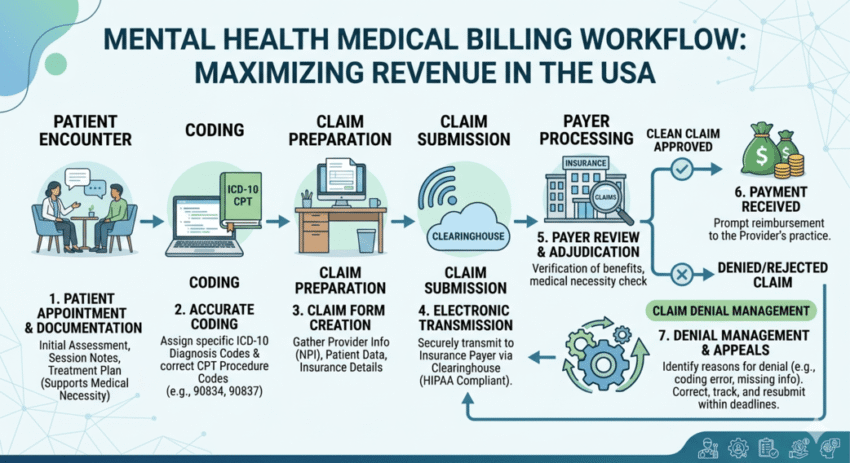
Mental health practices face a billing environment that can be surprisingly complicated. A therapist may spend an hour with a patient, complete the clinical documentation, and submit a claim, yet payment can still be delayed because of a coding issue, eligibility problem, authorization requirement, or payer-specific rule.
That is why choosing a top mental health billing company is not simply about finding someone to submit claims. The right billing partner should understand behavioral health workflows, payer requirements, documentation expectations, claim follow-up, denial management, and the financial pressures that mental health providers deal with every day.
For solo therapists, group practices, psychologists, psychiatrists, counselors, and larger behavioral health organizations, effective billing can make a meaningful difference to cash flow. A reliable billing process allows providers to spend less time chasing payments and more time focusing on patients.
Why Mental Health Billing Requires Specialized Knowledge
Mental health medical billing is different from many other healthcare billing environments. Behavioral health providers often work with recurring appointments, multiple service codes, telehealth encounters, varying payer policies, and documentation requirements that must support the services billed.
A claim can be technically submitted correctly and still face a denial.
For example, consider a behavioral health practice that provides weekly psychotherapy. One patient’s insurance may cover a particular service under specific conditions, while another patient’s plan may have different authorization or network requirements. If the practice treats both claims exactly the same way, problems can occur.
Specialized mental health billing companies understand that successful reimbursement involves more than entering codes into a billing system. It requires reviewing the entire claim lifecycle.
Important areas may include:
- Patient eligibility and benefits verification
- Insurance authorization requirements
- Accurate CPT and diagnosis code selection
- Claim creation and electronic submission
- Claim status monitoring
- Payment posting and reconciliation
- Denial identification and correction
- Accounts receivable follow-up
- Patient balance management
- Payer-specific billing requirements
- Reporting and revenue analysis
This specialized approach is one reason providers increasingly consider outsourcing their billing operations.
What Should You Look for in a Top Mental Health Billing Company?
Not every mental health billing service operates at the same level. A provider should look beyond promises of “faster payments” and evaluate how the company actually manages the revenue cycle.
1. Experience With Behavioral Health Claims
A billing company should have practical experience with mental health and behavioral health services rather than simply handling general healthcare claims.
Ask whether the team regularly works with:
- Psychologists
- Psychiatrists
- Licensed therapists
- Counselors
- Social workers
- Behavioral health clinics
- Substance use treatment providers
- Telebehavioral health practices
The more familiar the billing team is with behavioral health workflows, the better equipped it may be to identify common reimbursement problems before they become persistent issues.
2. Strong Eligibility and Authorization Processes
Many billing problems begin before the claim is ever created.
If a patient’s coverage is inactive or a required authorization was not obtained, the provider can deliver a legitimate service and still struggle to collect payment.
A dependable billing process should verify coverage and identify relevant requirements before services are provided whenever possible.
This can reduce preventable denials and help practices communicate financial responsibilities to patients earlier.
3. Accurate Mental Health Coding
Coding accuracy is fundamental to reimbursement. Incorrect or incomplete coding can create claim edits, payer rejections, compliance concerns, or delayed payments.
A capable team should understand how documentation supports the selected codes and recognize the relationship between procedures, diagnoses, modifiers, place of service, and payer requirements.
This is where specialized medical coding services can provide value. Coding should not be treated as an isolated administrative task. It is part of the larger revenue cycle and must align with the provider’s documentation.
Medical Billing and Coding Should Work Together
Some practices separate billing and coding so heavily that problems between the two functions go unnoticed.
A stronger approach connects medical billing and coding services into a coordinated workflow. When coders and billers communicate effectively, potential issues can be identified earlier.
For example, if a recurring service repeatedly generates payer edits, the billing team can identify the pattern while the coding team reviews whether the underlying coding or documentation process needs attention.
That creates an opportunity to correct the source of the problem rather than repeatedly fixing individual claims.
The Role of Mental Health RCM Billing
Mental health RCM billing covers much more than claim submission. Revenue cycle management follows the financial journey from patient registration through final payment.
A typical workflow can include:
- Patient registration
- Insurance verification
- Authorization review
- Charge capture
- Medical coding
- Claim submission
- Rejection correction
- Payment posting
- Denial management
- A/R follow-up
- Patient collections
- Financial reporting
Looking at the entire cycle gives providers a clearer picture of where revenue is being lost.
For instance, a practice may believe it has a denial problem when the actual issue begins with eligibility verification. Another practice may have relatively few denials but still experience slow collections because unpaid claims are not being followed up consistently.
That distinction matters.
How Billing Companies Help Reduce Revenue Leakage
Revenue leakage is not always obvious.
A practice might lose revenue through small operational gaps:
- Unbilled encounters
- Incorrect patient information
- Missed charges
- Eligibility errors
- Underpayments
- Untimely claim follow-up
- Incorrect coding
- Unresolved rejected claims
- Uncollected patient balances
Individually, each issue may appear minor. Across hundreds or thousands of encounters, however, those small gaps can become a significant financial problem.
The best mental health billing services focus on identifying these patterns through reporting and regular review rather than simply processing claims as they arrive.
Denial Management Is More Than Resubmitting Claims
One of the biggest differences between a basic billing operation and an experienced one is how denials are handled.
Simply correcting and resubmitting a denied claim may recover one payment. Understanding why the claim was denied can prevent the same issue from occurring again.
A strong denial management process should categorize denials and identify recurring causes.
For example:
Eligibility denial: Was coverage checked correctly before the appointment?
Authorization denial: Was prior approval required for the service?
Coding denial: Does the submitted code accurately reflect the documented service?
Timely filing denial: Was the claim submitted within the payer’s required timeframe?
Documentation-related denial: Does the clinical record adequately support the billed service?
This type of analysis turns denial management into a process-improvement function.
Mental Health Billing and Credentialing Should Be Connected
Credentialing can have a direct impact on whether providers are able to bill certain insurance plans successfully.
For a new clinician joining a practice, delays in payer enrollment can create a gap between starting patient care and receiving appropriate reimbursement.
That is why mental health billing and credentialing services can be valuable when coordinated properly. Credentialing teams may assist with payer enrollment, provider information, documentation, recredentialing, and related administrative requirements.
Dedicated credentialing services can also help practices keep provider information current, which is important because outdated information can create administrative and reimbursement problems.
Technology Should Support the Billing Team, Not Replace Expertise
Modern mental health billing solutions increasingly use automation for repetitive tasks.
Technology can help with:
- Claim scrubbing
- Eligibility checks
- Electronic claim submission
- Automated status tracking
- Payment posting
- A/R reporting
- Denial categorization
- Performance dashboards
But automation alone does not guarantee better revenue.
A system can identify that a claim was denied. An experienced billing professional is still needed to understand the reason, determine the appropriate next step, communicate with the payer when necessary, and identify whether the problem is recurring.
The strongest mental health billing solutions therefore combine technology with knowledgeable human oversight.
Questions Providers Should Ask Before Choosing a Billing Partner
Before selecting a mental health billing company, providers should ask practical questions rather than relying solely on sales presentations.
Consider asking:
- How much experience do you have with behavioral health billing?
- Which types of mental health providers do you support?
- How do you handle denied claims?
- How frequently do you follow up on outstanding A/R?
- How do you monitor payer-specific requirements?
- Do you provide coding review?
- Can you support provider credentialing?
- What financial reports will the practice receive?
- How are patient balances handled?
- How do you protect patient information?
- Who will be responsible for communicating billing issues to our practice?
The answers can reveal whether the company provides a genuine revenue-cycle partnership or primarily performs basic claim processing.
Why Reporting Matters to Mental Health Practices
A billing company should not leave providers guessing about their financial performance.
Useful reporting can help practices monitor metrics such as:
- Days in accounts receivable
- Claim denial rate
- Collection rate
- Outstanding A/R
- Aging by payer
- Aging by patient
- Payment trends
- Rejection volume
- Unresolved claims
- Net collection performance
These numbers help providers make better operational decisions.
For example, if a particular payer consistently produces older A/R, management can investigate whether reimbursement rates, authorization procedures, filing requirements, or follow-up workflows need attention.
When Outsourcing Makes Sense
Outsourcing is not automatically the right decision for every practice. Some larger organizations have established internal billing departments with experienced staff and strong technology.
However, outsourcing may make sense when:
- Billing staff are overloaded
- Claims are not being followed up consistently
- A/R continues to grow
- Denials are increasing
- Providers lack coding expertise
- Credentialing is creating administrative delays
- Management has limited visibility into revenue performance
- The practice is expanding into additional insurance networks
A qualified mental health billing service can provide additional expertise without requiring the practice to build every function internally.
A Practical Example
Imagine a five-provider behavioral health practice with a growing patient base. The clinicians are busy, but management notices that monthly collections are becoming less predictable.
An internal review discovers three issues: several claims are being rejected because of registration errors, older A/R is not receiving consistent follow-up, and payer credentialing information for a recently hired clinician has not been completed for every contracted plan.
None of these issues is necessarily catastrophic by itself.
Together, however, they create a financial bottleneck.
A structured revenue-cycle review can separate these problems, assign responsibility, establish follow-up procedures, and track improvement over time.
This is the real value of professional revenue cycle management services: creating a repeatable financial process instead of reacting to individual billing problems.
Where 247 Medical Billing Services Fits Into the Conversation
For practices evaluating outsourced support, 247 Medical Billing Services is one option to consider when looking for a broader approach to healthcare revenue-cycle operations. The important point for any provider is to evaluate the actual capabilities behind the service.
A worthwhile partner should be able to support core medical billing services, specialized medical coding services, integrated medical billing and coding services, comprehensive revenue cycle management services, and credentialing services where needed.
Rather than choosing a company solely because it claims to be the “best,” providers should compare experience, processes, reporting, communication, technology, compliance practices, and measurable performance.
Final Thoughts
Choosing a top mental health billing company is ultimately about finding a partner that understands both the clinical environment and the financial side of behavioral healthcare.
The right organization should look beyond claim submission. It should help providers understand where revenue is being delayed, why denials occur, how A/R is managed, whether coding supports documentation, and whether credentialing and payer enrollment processes are keeping pace with practice growth.
Mental health providers already have enough demands competing for their attention. A well-managed billing operation should make the financial side of the practice more organized, transparent, and predictable.
The goal is not simply to send more claims.
The goal is to build a revenue cycle that works consistently from the first patient interaction through final reimbursement.
Frequently Asked Questions
1. What does a mental health billing company do?
A mental health billing company manages financial and administrative processes associated with behavioral healthcare claims. Services may include eligibility verification, coding, claim submission, denial management, payment posting, A/R follow-up, patient billing, reporting, and credentialing support.
2. Why should mental health providers use specialized billing services?
Mental health billing involves payer-specific requirements, recurring services, behavioral health coding considerations, authorization rules, telehealth requirements, and documentation-related issues. A specialized team may have greater familiarity with these workflows than a general billing operation.
3. What should I look for in the best mental health billing services?
Look for behavioral health experience, accurate coding processes, proactive denial management, consistent A/R follow-up, clear reporting, strong communication, appropriate security practices, and an understanding of payer requirements.
4. Can mental health billing companies help with credentialing?
Many healthcare revenue-cycle organizations offer or coordinate credentialing services. These may include payer enrollment, provider information management, recredentialing, and related administrative processes.
5. How does mental health RCM billing improve practice revenue?
Mental health RCM billing addresses the complete financial workflow rather than focusing only on claims. By monitoring eligibility, coding, submissions, denials, payments, A/R, and patient balances, practices can identify revenue leakage and improve collection processes.
6. Is outsourcing mental health billing suitable for small practices?
It can be. Small practices may benefit when internal staff have limited billing expertise, A/R follow-up is inconsistent, or administrative work is taking time away from practice operations. The decision should be based on the practice’s volume, staffing, financial needs, and desired level of control.