

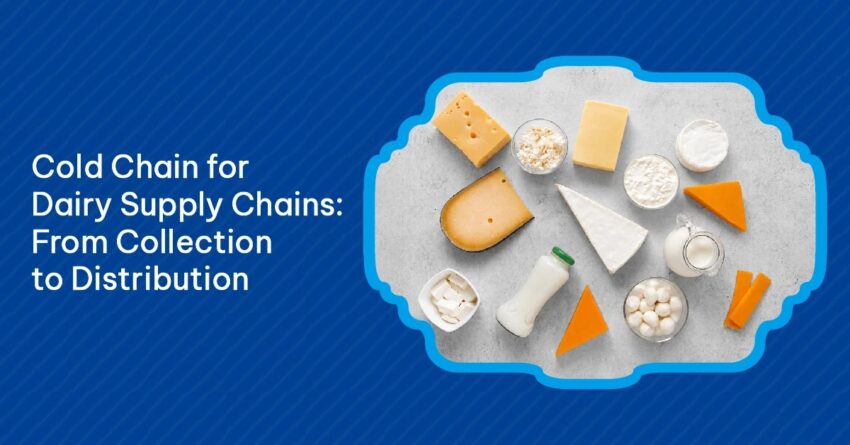
Milk begins its journey long before it reaches a supermarket refrigerator. In India, millions of litres are collected every day from farms and village collection centres before moving through chilling facilities, processing plants, warehouses, distribution hubs, retailers, and finally into consumers’ homes.
Because milk and other dairy products are highly perishable, maintaining the right temperature throughout this journey is essential. Even a short delay or temperature fluctuation can affect freshness, quality, shelf life, and food safety.
This makes cold chain management one of the most important components of modern Dairy Supply Chains.
1. Cold Chain Starts at Milk Collection
The first stage of the dairy journey begins immediately after milk is collected from the farm. Fresh milk naturally contains microorganisms, and their growth increases rapidly when the product remains at warm temperatures.
This is particularly challenging in India, where summer temperatures can become extremely high. Leaving freshly collected milk unrefrigerated for an extended period can significantly reduce its quality.
Bulk milk coolers and village-level chilling centres help address this challenge. Milk is rapidly cooled, generally to around 4°C or below, slowing bacterial growth and helping preserve its quality before transportation.
Starting temperature control at the collection point is critical because refrigeration introduced later cannot fully reverse deterioration that has already occurred.
2. Moving Chilled Milk to Processing Facilities
After initial chilling, milk is transported to dairy processing plants using insulated or refrigerated tankers. This stage requires careful coordination because the product must remain within its required temperature range throughout transit.
Transport operators need to consider route distance, traffic, weather, vehicle condition, loading procedures, and delivery schedules.
Temperature monitoring can provide greater visibility during transportation. If a refrigerated vehicle experiences an unexpected temperature rise, operators can identify the issue and take corrective action before the product is seriously affected.
The objective is simple: minimise temperature fluctuations and reduce the time between collection, transportation, and processing.
3. Temperature Control During Processing
At the processing facility, raw milk goes through several stages, including testing, pasteurisation, standardisation, homogenisation, and packaging.
Temperature control becomes particularly important because different processing steps require different temperature conditions. After heat treatment, products need to be cooled efficiently before entering cold storage or distribution.
Dairy processors may also handle several products at the same facility, such as:
- Fresh milk
- Curd and yoghurt
- Paneer
- Butter
- Cheese
- Flavoured milk
- Frozen dairy products
Each product can have different storage requirements. Proper temperature zoning, monitoring, and storage procedures help prevent cross-temperature exposure and protect product quality.
4. Cold Storage: Protecting Products After Processing
Once packaged, dairy products generally move into temperature-controlled storage before distribution.
Cold storage facilities serve as an important buffer between production and market demand. They allow businesses to store products safely while coordinating deliveries based on inventory levels, customer requirements, and distribution schedules.
An effective cold storage operation should include reliable refrigeration systems, temperature monitoring, appropriate product zoning, backup systems, and efficient loading and unloading procedures.
Reducing unnecessary door openings and limiting the amount of time products remain outside controlled environments can also help maintain consistent temperatures.
5. The Middle Mile: Where Logistics Gets Complex
The movement of dairy products from a processing facility or central warehouse to regional distribution centres represents one of the most demanding stages of the cold chain.
Products may travel significant distances before reaching their destination. Traffic congestion, road conditions, unexpected delays, and high ambient temperatures can all affect transportation performance.
Refrigerated vehicles are therefore only one part of the solution. Effective route planning, vehicle maintenance, temperature tracking, proper loading practices, and delivery scheduling are equally important.
For short-shelf-life products, every additional hour in transit can matter. Efficient logistics planning helps ensure that products reach distribution points with as much usable shelf life remaining as possible.
6. The Final Mile to Retailers
The cold chain does not end when products reach a distribution centre. Dairy products must continue to be protected while being delivered to supermarkets, local retailers, restaurants, institutions, and other points of sale.
Different retail environments present different challenges.
Large supermarkets may have dedicated refrigerated storage and display equipment, while smaller retailers may operate with limited refrigeration capacity. Quick-commerce and home-delivery models introduce another challenge because products may spend additional time outside conventional refrigerated infrastructure during final delivery.
Insulated containers, suitable delivery vehicles, efficient routing, and controlled delivery windows can help reduce the risk of temperature exposure during this final stage.
7. Common Weak Points in Dairy Cold Chains
A dairy cold chain can appear well-managed while still having vulnerabilities at individual handover points.
Some common problem areas include:
- Milk waiting too long before initial chilling
- Delays during vehicle loading
- Poorly maintained refrigeration equipment
- Extended vehicle door-opening times
- Inadequate temperature monitoring
- Improper warehouse zoning
- Delays at distribution centres
- Insufficient refrigeration at retail locations
These issues may not immediately result in visible product damage. However, repeated temperature fluctuations can gradually reduce freshness and shorten shelf life.
For this reason, businesses need to evaluate the complete journey rather than focusing only on transportation.
8. Technology Is Improving Dairy Cold Chain Management
Technology is changing how dairy companies monitor and manage temperature-sensitive products.
IoT-enabled sensors can provide real-time temperature information from storage facilities and vehicles. GPS and fleet-management systems can help businesses monitor vehicle movement and identify delays.
Data analytics can also support better demand forecasting and inventory planning. By understanding consumption patterns, businesses can position products closer to demand centres and reduce unnecessary transportation time.
Digital traceability systems can provide greater visibility into a product’s journey, helping businesses identify where problems occurred and improve future operations.
These technologies are especially valuable when combined with strong operating procedures and trained personnel.
9. Building a More Reliable Dairy Cold Chain
A dependable dairy cold chain requires coordination between farmers, collection centres, transport providers, processors, warehouses, distributors, retailers, and technology systems.
The most effective approach is to treat temperature management as an end-to-end responsibility.
Businesses should focus on:
- Rapid chilling after collection
- Reliable refrigerated transportation
- Continuous temperature monitoring
- Efficient cold storage
- Accurate inventory planning
- Optimised delivery routes
- Proper handling at every transfer point
- Regular equipment maintenance
- Strong contingency plans
This integrated approach reduces avoidable losses while helping businesses maintain product quality throughout distribution.
10. Why the Right Cold Chain Partner Matters
As dairy consumption expands across metropolitan areas as well as Tier 2 and Tier 3 cities, businesses need cold chain infrastructure that can support growing volumes without compromising product quality.
A capable logistics partner can provide more than refrigerated transportation. Businesses need coordinated storage, distribution, monitoring, route management, and operational support across the complete supply chain.
At ColdStar Logistics, cold chain capabilities are designed to support temperature-sensitive products across multiple stages of their journey. With infrastructure covering 250+ cities and 9,000+ pincodes, the focus is on maintaining product integrity from storage through distribution.
Conclusion
From the moment milk leaves the farm to the time a dairy product reaches a consumer, temperature control plays a vital role in protecting quality and shelf life.
The dairy cold chain is not a single transportation activity. It is a connected system involving collection, chilling, processing, storage, transportation, distribution, and final delivery.
When every stage is carefully planned and monitored, dairy businesses can reduce product losses, improve operational efficiency, and deliver fresher products to customers.
For dairy brands looking to strengthen their temperature-controlled distribution network, choosing the right cold chain infrastructure and logistics partner can make the entire journey more reliable.