
Attention disorders have evolved in terminology and understanding over decades. ADD, or Attention Deficit Disorder, was once the common label, but today, ADHD, or Attention Deficit Hyperactivity Disorder, is the modern clinical term.
This article explains the differences between ADD and ADHD, the evolution of their diagnosis, and how the benefits of having ADHD can positively influence creativity, focus, and problem-solving.
Understanding ADD
What Was ADD?
ADD referred to inattention and distractibility without the hyperactive component. People with ADD often struggled silently with focus.
Symptoms of ADD
- Difficulty concentrating on tasks
- Forgetfulness and disorganization
- Tendency to daydream
- Low motivation in uninteresting tasks
Historical Context
ADD was widely used in the 1980s and early 1990s. Clinicians eventually recognized that hyperactivity was often present, prompting an updated classification.
Understanding ADHD
Modern ADHD Diagnosis
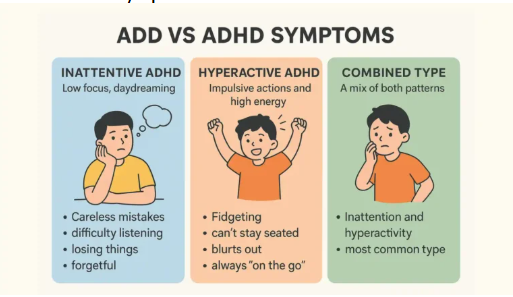
ADHD includes three subtypes: inattentive, hyperactive-impulsive, and combined. This provides a more precise understanding of symptoms.
Symptoms of ADHD
- Inattentive type: Similar to ADD—focus challenges and forgetfulness
- Hyperactive-Impulsive type: Restlessness, impulsivity, fidgeting
- Combined type: Features of both inattentive and hyperactive symptoms
Why the Change Matters
The updated terminology recognizes the spectrum of ADHD presentations, ensuring more accurate diagnosis and tailored treatments.
Benefits of Having ADHD
Creativity and Innovation
Your mind often generates unique ideas and connections others might miss. ADHD fuels out-of-the-box thinking.
Hyperfocus
When engaged in tasks you enjoy, you can concentrate intensely, producing high-quality work.
Adaptability and Resilience
Experiencing challenges with focus and impulsivity strengthens problem-solving skills and adaptability.
Energy and Enthusiasm
Your natural energy can motivate yourself and inspire others, enhancing productivity and collaboration.
Treatment Approaches
Medication
Stimulants and non-stimulants help manage symptoms, improving attention, focus, and emotional regulation.
Behavioral Therapy
Cognitive behavioral therapy (CBT) can help manage impulsivity, emotional responses, and organization.
Lifestyle Adjustments
Exercise, structured routines, and sleep optimization support symptom management while boosting natural strengths.
How to Leverage ADHD Strengths
Identify Tasks That Excite You
Align work and personal projects with your natural interests to harness creativity and hyperfocus.
Use Tools and Systems
Planners, reminders, and digital apps reduce distractions and improve productivity.
Practice Self-Acceptance
Recognizing your strengths alongside challenges promotes confidence and personal growth.
Common Misconceptions
- ADD is outdated → True; ADHD is the modern term encompassing ADD traits.
- ADHD only involves hyperactivity → False; inattention can dominate symptoms.
- ADHD is purely a disorder → False; it also provides cognitive, creative, and social advantages.
FAQ Section
- Are ADD and ADHD the same?
No. ADD is an outdated term; ADHD is the modern, broader diagnosis including hyperactivity. - Can ADHD be beneficial?
Yes. ADHD enhances creativity, hyperfocus, energy, and problem-solving skills. - What are the ADHD subtypes?
Inattentive, hyperactive-impulsive, and combined types. - Is hyperactivity required for ADHD diagnosis?
No. Inattentive type does not involve hyperactivity. - Can adults have ADHD?
Yes. ADHD persists into adulthood and affects work, relationships, and daily functioning. - Can ADHD improve creativity?
Yes. ADHD often encourages innovative, unconventional thinking. - Are there treatments for ADHD?
Yes. Medications, therapy, lifestyle changes, and productivity tools help manage symptoms. - Is ADHD a mental illness?
No. ADHD is a neurodevelopmental condition with both challenges and strengths. - Can structure help ADHD?
Yes. Structured routines and supportive environments amplify strengths and reduce difficulties.
10. Can ADHD traits support success?
Yes. Leveraging creativity, hyperfocus, and energy can lead to personal and professional achievements.