

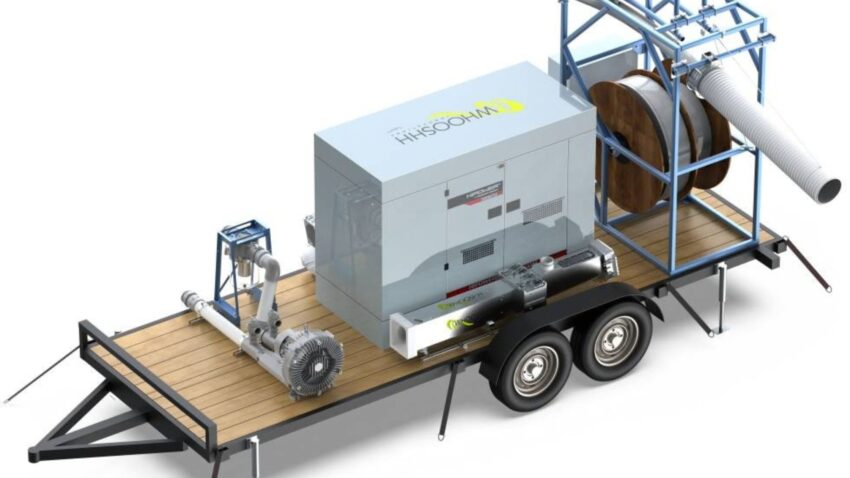
The word economical gets used loosely in fisheries infrastructure conversations. A system priced low at purchase can cost considerably more than its sticker price suggests once operational labor, maintenance, fish mortality, and site preparation are factored in. An economical fish transport system in the meaningful sense is one where the total cost of ownership, purchase, deployment, operation, maintenance, and fish welfare outcomes, is lower across the full deployment life than the alternatives.
That reframing matters because it changes which systems look economical. A trailer-mounted pneumatic transfer unit that costs more than a basic aqua pump but requires a smaller crew, generates lower fish mortality, leaves no permanent site footprint, and can be repositioned across multiple collection sites in a season may be substantially more economical in the full-cost sense. The aqua pump that looks cheaper on invoice may not look cheaper over five years of operation.
What is the Utility of Emergency fish Transport solution?
The emergency fish transport solution dimension adds another layer. A transport system that works well under routine conditions but cannot be deployed quickly to a new site when conditions change is a different kind of risk than one that can be driven to a new location and operational within a day. The 2019 Big Bar landslide on the Fraser River in British Columbia demonstrated this concretely. A massive natural blockage cut off salmon migration in terrain with no roads and no grid power. A conventional transport solution requiring road access and permanent infrastructure could not have reached that site in any useful timeframe.
Whooshh’s TUber mobile system deployed to a comparable scenario within three months, in terrain with no road access and no grid power, and passed thousands of salmon past the obstruction during the remaining migration window. A system that can do that is not just a routine transport tool. It’s a risk management asset for operations that face unpredictable river conditions or emergency passage requirements.
What Does the TUber Cost to Operate Compared to Alternatives?
The TUber runs on 11 to 13 kW during operation. That energy profile is significantly lower than the electrical demand of high-volume aqua pump systems. The MigratorTubes require only embedded misting rather than the continuous high-volume water flow that pump-based transfer systems need. And the small-crew deployment model, where one or two operators can set up and run the system, reduces labor cost per fish transported compared to larger-crew conventional methods.
The system leaves no permanent footprint on embankments, which avoids the riparian permitting costs that fixed-infrastructure installations sometimes trigger in sensitive shoreline zones. And because it’s trailer-mounted, it moves with the operation rather than remaining tied to a single site between seasonal use windows.
How Does Fish Welfare Factor Into the Economics?
Fish mortality during transport is a direct economic loss in hatchery programs and a conservation loss in river management. Every fish that doesn’t survive the transfer step is a unit of production or a unit of wild population that the transport event cost. Systems with lower cortisol stress outcomes and lower injury rates at entry and exit points produce lower mortality rates, and lower mortality rates are lower costs.
The U.S. Department of Energy study conducted by Pacific Northwest National Laboratory documented that salmon transported through the Whooshh pneumatic system showed survival, immune response, and reproductive viability outcomes comparable to the conventional trap and haul benchmark. That benchmark is the industry standard for acceptable welfare outcomes. Matching it without the handling is what makes the system genuinely economical.
Visit Whooshh Innovations for the full product overview. Contact the team to discuss transport economics for your specific operation and site configuration.