

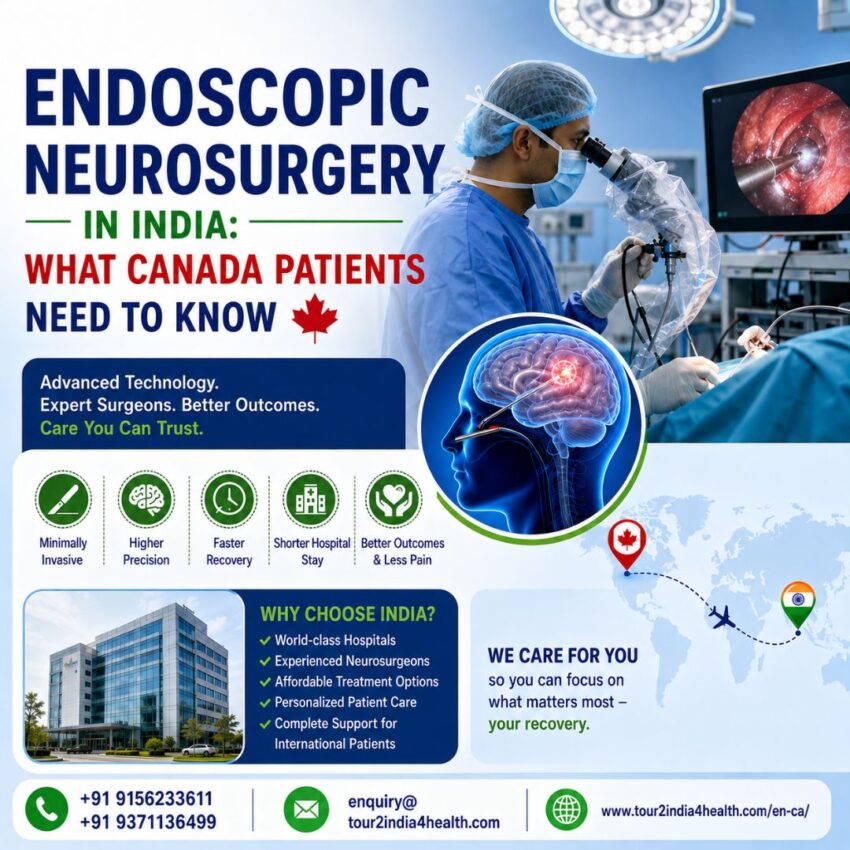
Neurosurgery can feel overwhelming, particularly when a patient is advised to undergo an operation involving the brain, skull base or fluid pathways within the brain. However, not every neurological condition requires a large open procedure.
Endoscopic neurosurgery is a minimally invasive approach in which the surgeon uses a thin camera called an endoscope to reach and treat selected conditions through a small opening. For Canadian patients considering treatment in India, this technique may offer smaller incisions, reduced disruption to healthy tissue and a potentially faster recovery.
However, endoscopic surgery is not suitable for every patient. Its success depends on the condition, location of the abnormality and experience of the surgical team.
What Is Endoscopic Neurosurgery?
An endoscope is a narrow instrument equipped with a light and a high-definition camera. It gives the surgeon a magnified view of structures inside the brain or skull base.
Depending on the condition, the endoscope may be introduced through:
- A small opening in the skull
- The natural nasal passage
- A small opening into the brain’s fluid-filled chambers
- An existing surgical corridor requiring minimal tissue disruption
The surgeon uses specialised instruments alongside the endoscope to remove a tumour, take a biopsy, drain fluid or create a new pathway for cerebrospinal fluid.
Conditions That May Be Treated
Endoscopic neurosurgery may be considered for selected patients with:
|
Condition |
Possible endoscopic procedure |
|
Pituitary tumour |
Endoscopic endonasal surgery |
|
Skull-base tumour |
Endoscopic tumour removal through the nose |
|
Hydrocephalus |
Endoscopic third ventriculostomy |
|
Brain cyst |
Endoscopic drainage or fenestration |
|
Intraventricular tumour |
Endoscopic biopsy or removal |
|
Cerebrospinal fluid leak |
Endoscopic repair |
|
Certain haematomas |
Endoscopic evacuation |
A specialist must review MRI or CT scans before confirming whether an endoscopic approach is appropriate.
Endoscopic Pituitary and Skull-Base Surgery
One of the most widely used techniques is endoscopic endonasal surgery. The surgeon reaches the pituitary gland or skull base through the nostrils, often working together with an ENT surgeon.
This approach may avoid a visible facial incision and reduce the need to move healthy brain tissue. It is commonly used for pituitary adenomas and selected skull-base lesions.
AIIMS New Delhi lists endoscopic skull-base surgery and neuro-endoscopic surgery among the specialist interests within its neurosurgery department, demonstrating the use of these techniques in major Indian academic centres.
Endoscopic Surgery for Hydrocephalus
Hydrocephalus occurs when cerebrospinal fluid builds up within the brain’s ventricles. In selected patients, an endoscopic third ventriculostomy may be performed.
During this procedure, the surgeon creates a small opening that allows fluid to bypass the obstruction. This may reduce or avoid the need for a permanent shunt in suitable cases. However, not every type of hydrocephalus can be managed this way.
Read More:- Neurosurgery Treatment Cost in India for Canadian Patients
Potential Benefits
Compared with a larger conventional operation, endoscopic neurosurgery may provide:
- Smaller surgical openings
- Less disruption to surrounding tissue
- Reduced blood loss in selected procedures
- Less post-operative discomfort
- No visible facial scar in endonasal procedures
- Shorter hospitalisation in uncomplicated cases
- Earlier return to daily activities
- Better visual access to certain deep areas
These benefits vary between patients. A smaller incision does not mean that the procedure is minor or free from risk.
Endoscopic vs Open Neurosurgery
|
Consideration |
Endoscopic approach |
Open surgery |
|
Surgical access |
Small opening or natural passage |
Larger opening may be required |
|
Visualisation |
Camera-based, close-up view |
Direct microscopic view |
|
Tissue disruption |
Often reduced |
May be greater |
|
Suitable conditions |
Selected tumours and fluid disorders |
Wider range of complex conditions |
|
Recovery |
May be faster |
Depends on surgical extent |
|
Need for conversion |
Occasionally required |
Not applicable |
Open surgery may still be safer when a tumour is very large, involves major blood vessels or extends into areas that cannot be reached adequately with an endoscope.
Risks Patients Should Understand
Possible risks include:
- Bleeding
- Infection
- Cerebrospinal fluid leakage
- Injury to nerves, blood vessels or brain tissue
- Hormonal disturbance after pituitary surgery
- Changes in vision
- Fluid or electrolyte imbalance
- Incomplete tumour removal
- Need for another operation
- Conversion to an open procedure
The exact risks depend on the diagnosis and surgical route. Patients should ask the surgeon how frequently the team performs the recommended procedure and what outcomes are expected in their specific case.
Recovery and Hospital Stay
|
Recovery stage |
Typical expectation |
|
Intensive monitoring |
First 24 hours when required |
|
Hospital stay |
Approximately 3–7 days |
|
Light activities |
Often within 1–2 weeks |
|
Return to routine work |
Commonly 3–6 weeks |
|
Follow-up scan |
According to diagnosis |
|
Return to Canada |
After clearance from the neurosurgeon |
Recovery may take longer after complex skull-base surgery. Patients may also require endocrinology, ophthalmology, ENT or rehabilitation follow-up.
Hospitals Experienced in Advanced Neurosurgery
Hospitals within our partner network that may support endoscopic and minimally invasive neurosurgical care include:
|
Hospital |
Relevant focus |
|
IBS Hospital, New Delhi |
Neurosurgery and neurological rehabilitation |
|
Medanta – The Medicity, Gurugram |
Skull-base and complex brain surgery |
|
Jaslok Hospital, Mumbai |
Neurosurgery and neuro-oncology |
|
KIMS Hospitals, Hyderabad |
Advanced brain and spine surgery |
Hospital selection should depend on the diagnosis, surgeon’s expertise, available technology and need for multidisciplinary care.
Read More:- Best Neurosurgeons in India for Canadian Patients
Planning Treatment from Canada
Patients should send the following before travelling:
- MRI and CT images in digital format
- Radiology reports
- Hormone tests for pituitary conditions
- Vision assessment reports
- Previous surgery or biopsy records
- Pathology findings
- Medication list
- Details of headaches, seizures, weakness or visual symptoms
The Indian neurosurgical team can then advise whether endoscopic surgery, open surgery, observation or another treatment is more appropriate.
Official Indian Government References
- All India Institute of Medical Sciences (AIIMS), New Delhi – Provides specialist neurosurgical services and expertise in endoscopic skull-base and neuro-endoscopic procedures.
Website: https://www.aiims.edu/index.php/en/departments-and-centers/specialty-centers?id=266 - National Institute of Mental Health and Neuro Sciences (NIMHANS) – A national centre providing specialised neurological, neurosurgical and multidisciplinary neuroscience care.
Website: https://www.nimhans.ac.in/departments/neurosurgery
Our Commitment to Patients
Our mission is to place patients at the centre of every healthcare decision by providing trustworthy, evidence-based, and unbiased medical information. We believe that informed patients make better decisions. Backed by personalised guidance from our experienced advisory team, we help patients understand their treatment options, compare them objectively, and confidently choose the path that best suits their medical needs and personal circumstances.
Disclaimer
This article is intended for educational and informational purposes only and should not be considered medical, legal, or visa advice. Medical recommendations, treatment plans, and procedures may vary from one patient to another based on individual health conditions and circumstances. Readers are strongly advised to consult qualified healthcare professionals before making any medical-related decisions.