
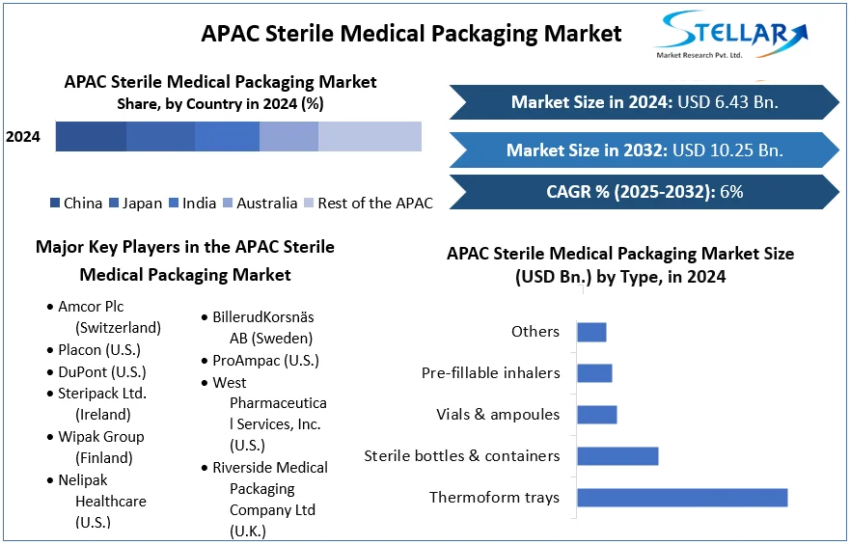
According to the latest industry report published by Stellar Market Research, the APAC Sterile Medical Packaging Market was valued at USD 6.43 billion in 2024 and is projected to reach USD 10.25 billion by 2032, expanding at a CAGR of 6.0% over the forecast period (2025–2032). As healthcare providers across Asia-Pacific intensify their focus on infection prevention, localized pharmaceutical manufacturing, and compliance with stringent global sterility standards, sterile barrier systems have transitioned from operational consumables to critical components of medical risk management and supply chain resilience.
The Asia-Pacific healthcare ecosystem is undergoing a fundamental structural transformation. Surging surgical volumes, expanding hospital infrastructure, and a massive shift toward domestic biopharmaceutical production are reshaping demand for advanced containment solutions. Historically reliant on traditional flexible wraps, medical device manufacturers (MDMs) and biopharma producers across China, India, and Southeast Asia are rapidly migrating toward high-barrier thermoformed trays, pre-fillable packaging, and eco-friendly recyclable polymer films.
Key Findings from the Report
-
Market Valuation & Growth: The APAC sterile medical packaging market is set to grow from USD 6.43 billion in 2024 to USD 10.25 billion by 2032, recording a compound annual growth rate (CAGR) of 6.0%.
-
Dominant Application Segment: The Pharmaceutical & Biological segment leads the market, driven by expanding drug delivery innovations, vaccine manufacturing, and the surging regional output of biologics and biosimilars.
-
Fastest-Growing Product Segment: Thermoform Trays are projected to register the highest CAGR among product types due to their superior structural protection, moldability, light weight, and ease of automated handling for complex surgical tools and medical implants.
-
Dominant Material Type: Plastics (including PET, HDPE, and PP) retain the largest material market share owing to their high versatility, moisture barrier capabilities, and compatibility with diverse sterilization methods such as Ethylene Oxide (EtO) and Gamma irradiation.
-
Regional Dominance: China and India collectively command the largest revenue share in the region, underpinned by aggressive government investments in medical infrastructure, booming generic drug manufacturing, and expanding medical tourism.
-
Emerging Growth Corridor: Southeast Asia (ASEAN) is emerging as a high-growth hub as contract medical manufacturing organizations (CMOs) expand regional production footprints to diversify global medical device supply chains.
For further information, click the following link:https://www.stellarmr.com/report/req_sample/APAC-Sterile-Medical-Packaging-Market/1277
Market Drivers and Restraints
Market Drivers
-
Surging Biopharmaceutical and Surgical Operations Volume: Expanding healthcare access and an aging demographic across APAC have triggered a steep rise in elective surgeries, inpatient treatments, and demand for single-use sterile medical consumables.
-
Expansion of Localized Medical Device Manufacturing: Regional initiatives prioritizing domestic manufacturing of medical electronics, orthopedic implants, and diagnostic kits are creating sustained baseline demand for validated primary packaging.
-
Escalating Focus on Infection Control Standards: Regulatory bodies across APAC are aligning national sterility assurance levels (SAL) with international frameworks, compelling healthcare facilities to adopt certified sterile packaging formats over hospital-reprocessed wraps.
Market Restraints
-
High Cost and Technical Complexity of Compliant Materials: Medical-grade barrier polymers and sterile substrates require extensive validation processes, driving up capital expenditure and operational costs for small and medium-sized manufacturers.
-
Sterilization Compatibility and Validation Timelines: Navigating complex validation cycles across diverse sterilization modalities—such as EtO emissions compliance, Gamma radiation degradation, and E-beam adoption—presents technical bottlenecks for packaging converters.
Technology, Regulation, and Sustainability Trends
-
Shift Toward Sustainable & Recyclable Monomaterials: Environmental regulations and corporate ESG mandates are driving packaging engineering toward mono-material thermoforming films (such as recyclable mono-PP and PET) that maintain sterile barrier integrity while reducing landfill waste.
-
Adoption of Automated Cleanroom Thermoforming: High-speed, automated thermoforming equipment integrated with ISO Class 7 and Class 8 cleanroom environments is reducing human touchpoints, drastically lowering contamination risks during secondary packaging.
-
Serialization and Supply Chain Traceability: The integration of digital serialization, 2D matrix coding, and smart labels onto sterile pouches and rigid containers is gaining traction to prevent counterfeiting and streamline inventory management across healthcare networks.
Regional Insights
-
China: Represents the single largest market within APAC. Growth is powered by massive domestic pharmaceutical production, aggressive state-backed healthcare investments, and an expanding ecosystem of medical device original equipment manufacturers (OEMs).
-
India: Represents the fastest-growing market in the region. Driven by its dominant position as a global generic drug powerhouse, rising domestic healthcare spending, and favorable government incentives for medical device parks, India exhibits robust demand for sterile bottles, vials, and pouches.
-
Southeast Asia & Australia: Countries including Malaysia, Thailand, and Singapore are rapidly scaling as specialized healthcare manufacturing and medical tourism centers, driving localized capital investments in cleanroom packaging infrastructure.
For further information, click the following link:https://www.stellarmr.com/report/req_sample/APAC-Sterile-Medical-Packaging-Market/1277
Recent Industry Developments
-
Amcor (2023): Acquired Shanghai-based MDK for approximately USD 50 million, expanding its regional footprint with four specialized manufacturing sites to deliver advanced medical device packaging across China, India, and Southeast Asia.
-
Oliver Healthcare Packaging (2025): Opened a 122,000-square-foot ISO-certified manufacturing facility in Johor, Malaysia—its largest plant in Asia—scaling cleanroom production of pouches, die-cut lids, and CleanCut cards for APAC biopharma and diagnostic clients.
-
Berry Global Group (2024): Executed a strategic capital investment expanding healthcare manufacturing capabilities across key facilities, boosting global pharmaceutical packaging and drug delivery device production capacity by up to 30%.
-
Eris Lifesciences (2024): Acquired Swiss Parenteral to expand its presence in sterile injectables, leveraging a portfolio of over 100 dossiers across 190 molecules to serve expanding healthcare channels across APAC and emerging markets.
-
Coveris (2024): Launched Formpeel P, an innovative, fully recyclable flexible thermoforming film engineered for medical packaging, providing high barrier protection while meeting strict ESG and sustainability metrics.
Competitive Landscape
The APAC sterile medical packaging market features a strategic mix of global packaging giants and specialized regional players. Leading market participants are prioritizing geographic expansion, capacity upgrades in cleanroom facilities, strategic acquisitions, and lightweight material innovations. Key market leaders include:
-
Amcor plc
-
Oliver Healthcare Packaging Company
-
Berry Global Inc.
-
DuPont de Nemours, Inc.
-
Sealed Air Corporation
-
Sonoco Products Company
-
Tekni-Plex, Inc.
-
SteriPack Group
-
Nelipak Healthcare Packaging
Analyst Commentary
“The APAC sterile medical packaging sector is transitioning from standard containment to high-precision engineering,” noted a Senior Research Analyst at Stellar Market Research. “As Asia-Pacific transforms into a global biopharmaceutical manufacturing powerhouse, packaging is no longer viewed merely as an outer layer—it is an active component of biological stability, patient safety, and regulatory compliance. Companies that invest in recyclable monomaterials and automated cleanroom capacity across emerging regional nodes like India and ASEAN will capture the most significant market share over the next decade.”
Future Outlook
Through 2032, the APAC sterile medical packaging market will be defined by the convergence of sustainability, localized biomanufacturing, and strict regulatory enforcement. As medical device complexity increases and pre-filled, ready-to-administer drug formats become standard, market leaders will increasingly shift toward smart, sustainable, and custom-engineered thermoformed solutions.
About US: Stellar Market Research is a multifaceted market research and consulting company with professionals from several industries. Some of the industries we cover include medical devices, pharmaceutical manufacturers, science and engineering, electronic components, industrial equipment, technology and communication, cars and automobiles, chemical products and substances, general merchandise, beverages, personal care, and automated systems. To mention a few, we provide market-verified industry estimations, technical trend analysis, crucial market research, strategic advice, competition analysis, production and demand analysis, and client impact studies.
Address
Phase 3, Navale IT Zone, S.No. 51/2A/2, Office No. 202, 2nd floor, Near, Navale Brg, Narhe, Pune, Maharashtra 411041
Email
sales@stellarmr.com
Mobile
+91 9607365656