
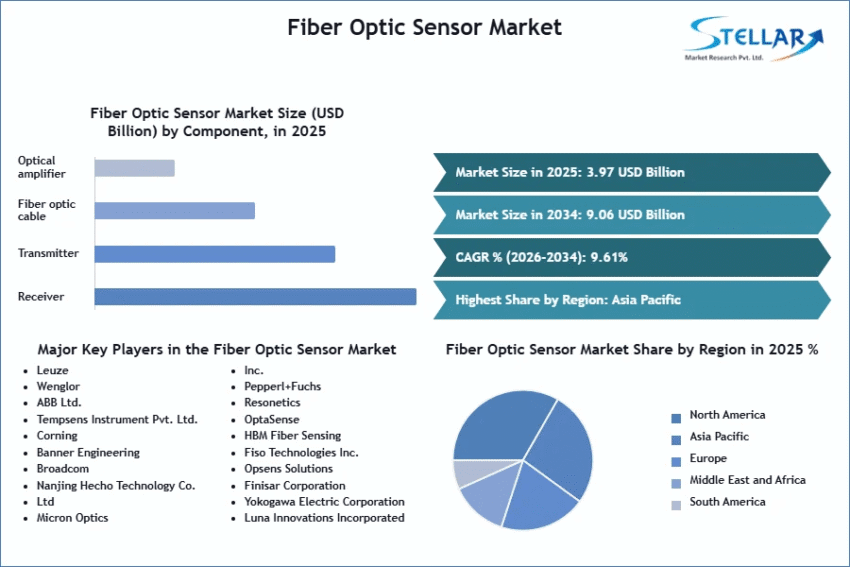
The Fiber Optic Sensor Market is experiencing an unprecedented technological and infrastructure transformation, according to a comprehensive new report released by Stellar Market Research. Valued at USD 3.97 billion in 2025, the market is projected to reach USD 9.06 billion by 2034, registering a robust CAGR of 9.61% over the forecast period. This remarkable growth is strategically important as industries worldwide accelerate digital transformation, prioritizing high-speed data transmission, hyper-reliable monitoring solutions, and robust industrial automation.
Key Findings from the Report:
-
Market Valuation & Growth: The market was valued at USD 3.97 billion in 2025 and is forecasted to hit USD 9.06 billion by 2034, expanding at a CAGR of 9.61%.
-
Base Year & Forecast Period: Base year is established at 2025, with a comprehensive forecast window spanning from 2026 to 2034.
-
Dominant End-User Segment: The industrial sector captured the largest market share in 2025, propelled by heavy deployment in factory automation, machinery health monitoring, and rigorous quality control processes.
-
Fastest-Growing Applications: Telecommunications and emerging smart city infrastructure applications are recording the fastest growth trajectories, supported by 5G rollout policies and broadband expansions.
-
Leading Geographic Region: Asia-Pacific dominated the global landscape in 2025, driven by rapid industrialization, expansive telecommunications footprints, and heavy manufacturing output in key economies.
-
Emerging Regional Hotspots: North America and Europe follow closely, underpinned by intense smart infrastructure investments, automated manufacturing adoption, and rigorous safety compliance in the oil & gas sectors.
-
Investment Relevance: Rising data creation, storage needs, and government-backed broadband initiatives are optimizing profit margins and expanding the cost-benefit ratio for key market participants.
For further information, click the following link:https://www.stellarmr.com/report/req_sample/fiber-optic-sensor-market/2298
Market Drivers and Restraints:
-
Drivers:
-
Explosive Demand for High-Speed Data: The surge in cloud computing, video streaming, and Internet of Things (IoT) ecosystems necessitates ultra-fast, high-bandwidth transmission frameworks that only optical systems can reliably support.
-
Telecommunications Infrastructure Upgrades: Global rollouts of 5G infrastructure require extensive fiber-optic architecture to manage high-frequency signals with minimal latency.
-
Government Broadband Initiatives: Public sector-backed programs—such as the National Broadband Plan in the U.S. and the Digital India campaign—are rapidly expanding fiber networks across urban and rural domains.
-
-
Restraints:
-
High Installation and Maintenance Costs: Deploying extensive fiber networks, particularly in rugged or remote geographic zones, involves intensive upfront capital expenditure and specialized maintenance expertise.
-
Technical Complexity and Compatibility Issues: Integrating advanced optical sensors into legacy network architectures requires precise alignment, handling, and careful orchestration to avoid system incompatibilities.
-
Technology, Regulation, and Sustainability Trends: The fiber optic sensor landscape is heavily shaped by continuous technology innovations, such as bend-insensitive fibers and superior signal-processing techniques that enhance operational longevity in volatile environments. Regulatory frameworks focusing on workplace safety, structural health monitoring, and critical infrastructure resilience are compelling heavy industries to adopt optical sensors for real-time compliance tracking. Furthermore, sustainability initiatives are taking center stage; energy-efficient optical networks naturally generate lower thermal output and consume less electrical power compared to active electronic sensing alternatives, perfectly aligning with corporate ESG (Environmental, Social, and Governance) targets.
Regional Insights: Asia-Pacific stands firmly as the leading regional hub for fiber optic sensors, led by industrial manufacturing powerhouses in China, India, and Japan. The region’s aggressive push toward smart manufacturing and massive telecom expansion continues to yield high volume sales. Meanwhile, North America represents a mature, high-value market anchored by advanced industrial automation, aerospace applications, and extensive data center construction across the United States. Europe is carving out substantial growth via strict regulatory compliance mandates centered around infrastructure safety, green energy grids, and smart city initiatives.
Recent Industry Developments:
-
AFL (2025): Launched an advanced line of ruggedized distributed acoustic sensing (DAS) fiber optic cables, significantly enhancing perimeter security and pipeline monitoring for the energy sector.
-
NKT Photonics (2025): Expanded its high-precision fiber optic sensing manufacturing capacity in Europe, directly boosting delivery speed for aerospace and structural health monitoring projects.
-
Luna Innovations (2024): Secured a major strategic contract expansion with aerospace primes to integrate high-definition fiber optic sensing systems, improving real-time structural load testing and driving revenue growth.
-
Prysmian Group (2024): Announced a multi-million-dollar capital expenditure program to upgrade its optical fiber manufacturing plants, focusing on bend-insensitive, eco-friendly fiber solutions to match surging global data center demand.
-
Omnisens (2024): Partnered with key international infrastructure operators to deploy real-time digital monitoring networks, augmenting asset integrity and safety compliance across subsea and subterranean installations.
Key Player in the Fiber Optic Sensor Market
- Leuze
- Wenglor
- ABB Ltd.
- Tempsens Instrument Pvt. Ltd.
- Corning
- Banner Engineering
- Broadcom
- Nanjing Hecho Technology Co.,Ltd
Analyst Commentary:
“The convergence of 5G deployment, hyper-scale data center creation, and the urgent demand for automated industrial safety has shifted fiber optic sensors from specialized components to absolute mission-critical infrastructure,” said a Senior Research Analyst at Stellar Market Research. “Organizations that successfully leverage manufacturing advancements and reduce deployment complexities will secure dominant market positioning through the next decade.”
Future Outlook: Through 2034, demand for fiber optic sensors is projected to accelerate continuously across both developed and emerging economies. As smart city adoption matures, rural connectivity gaps narrow, and industries lean further into automated factory floors, the utility of optical sensing will expand into new commercial domains. Regulatory pushes for structural safety and sustainability will further cement optical technologies as the gold standard for long-term industrial intelligence.
For further information, click the following link:https://www.stellarmr.com/report/req_sample/fiber-optic-sensor-market/2298
About Stellar Market Research
Stellar Market Research is a multifaceted market research and consulting company with professionals from several industries. Some of the industries we cover include medical devices, pharmaceutical manufacturers, science and engineering, electronic components, industrial equipment, technology and communication, cars and automobiles, chemical products and substances, general merchandise, beverages, personal care, and automated systems. To mention a few, we provide market-verified industry estimations, technical trend analysis, crucial market research, strategic advice, competition analysis, production and demand analysis, and client impact studies.
Address
Phase 3, Navale IT Zone, S.No. 51/2A/2, Office No. 202, 2nd floor, Near, Navale Brg, Narhe, Pune, Maharashtra 411041
Email
sales@stellarmr.com
Mobile
+91 9607365656